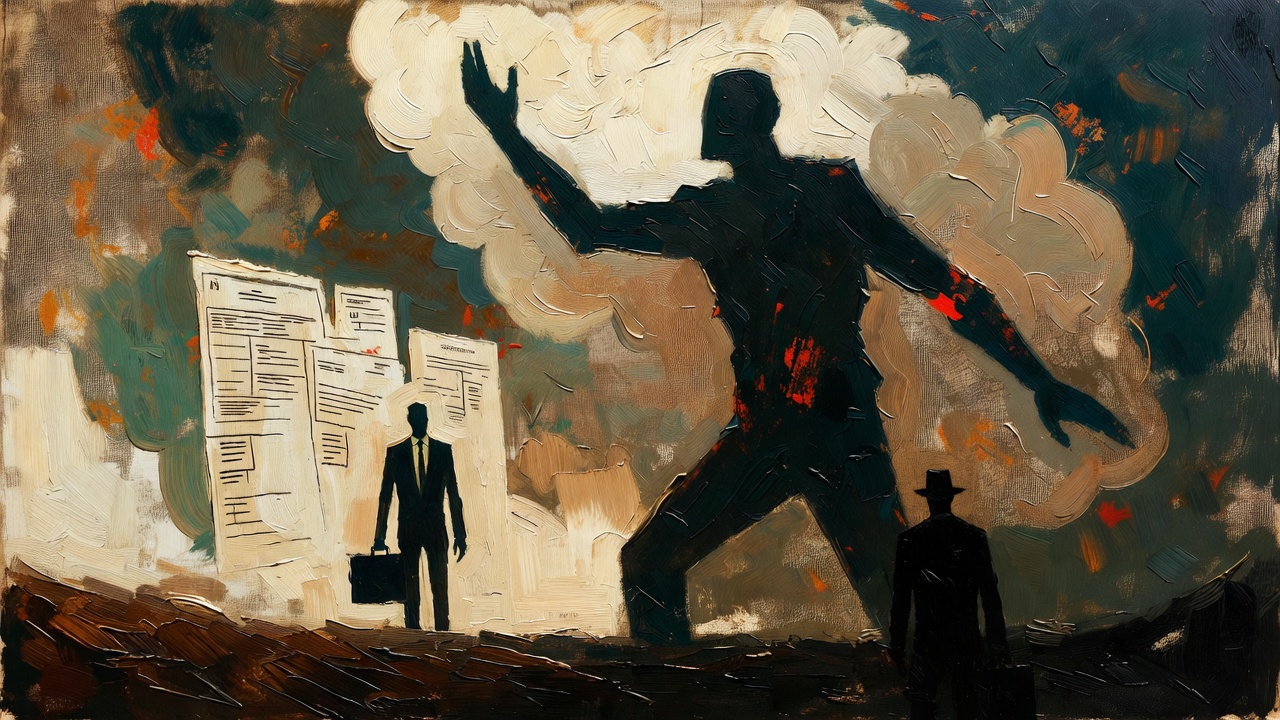
War by Other Means
Clausewitz wrote that war is the continuation of politics by other means. A tax dispute before a court is the continuation of an audit by other means. The terrain changes, the rules change, the dynamics change—but the conflict remains the same: the state wants money it considers its own; you want to keep it.
The difference is that in court, for the first time, you are playing on a field that does not belong exclusively to the opponent.
The Fog of War
Clausewitz: “War is the realm of uncertainty; three-fourths of the factors on which action in war is based are wrapped in a fog.”
A tax dispute is not mathematics. It is interpretation. And interpretation means uncertainty—for both sides.
Tax authorities operate in the conviction that they are right. That conviction is sometimes justified, sometimes not. But it is real, and it shapes the way they conduct the case. They see facts through the prism of their thesis. They overlook what doesn’t fit. They amplify what confirms it.
Your task is not to convince them they are wrong—because in proceedings before the authority, that rarely succeeds. Your task is to build material that will convince a court.
A court sees the matter differently. It has no thesis to defend. It has a question to answer: was the authority’s decision correct? This is a fundamental shift in perspective—and your greatest opportunity.
The Center of Gravity
Clausewitz: “One must reduce the whole war to a single center of gravity—to a single blow on which everything depends.”
Every tax case has dozens of threads. Authorities write justifications running to scores of pages, cite hundreds of provisions, quote interpretations and rulings. It can be overwhelming.
But in every case there is a center of gravity—one issue on which the outcome depends. It might be the legal classification of a transaction. It might be the assessment of evidence. It might be the interpretation of a specific provision. Find that point and concentrate your forces on it.
Diffusing your argumentation is a mistake made by inexperienced representatives. They write complaints running to fifty pages, raise twenty objections, bury the court in material. The effect is the opposite of what they intend: the court cannot tell what is truly important and what is filler.
A good complaint has three, perhaps four key arguments. The rest is noise.
Defense and Attack
Clausewitz: “Defense is the stronger form of waging war; attack is the more effective.”
In a tax dispute before a court, you are formally on defense. It is the authority that issued the decision; you are challenging it. But defense does not mean passivity.
The most effective strategy combines defense with counterattack. It is not enough to show that the authority was wrong. You must show why it was wrong—what methodological errors it committed, what evidence it overlooked, what logic it stretched. You must shift the burden of justification to the other side.
An authority that must explain its mistakes loses the initiative. The court begins to view the case through the prism of your objections, not through the prism of the decision’s rationale.
This is the moment when defense becomes attack.
Friction
Clausewitz: “Everything in war is very simple, but the simplest thing is difficult. These difficulties accumulate and produce a friction which no one can imagine who has not seen war.”
The theory of a tax dispute is simple: you are right, you prove it, you win. The practice is different.
There are deadlines that must be met—and missing them closes the path to court. There are formal requirements whose nonfulfillment ends the case before it begins. There are judges who have their habits, their predispositions, their ways of reading cases. There are hearings that do not go as you planned.
This is friction—the sum of small obstacles that are individually insignificant but together can halt even the strongest case.
An experienced representative knows friction. Knows where it appears and how to minimize it. Knows that cases are won not only by arguments but by discipline, punctuality, formal precision. Knows that a brilliant strategy without solid execution is worthless.
Escalation and Exhaustion
Clausewitz: “War by its nature tends toward the extreme.”
Tax disputes have a tendency to escalate. The authority issues a decision; you appeal. The second-instance authority upholds the decision; you go to court. The court of first instance dismisses your complaint; you file a cassation appeal. The Supreme Administrative Court overturns the judgment; the case returns for reconsideration.
Years pass. Costs mount. Nerves fray.
Clausewitz wrote of absolute war as a logical extreme that real wars never fully reach. A tax dispute has a similar dynamic: theoretically one can fight to the end; practically, one must be able to judge when the fight makes sense and when it is better to seek resolution.
This is not capitulation. It is rationality. Sometimes a settlement is victory. Sometimes withdrawing from one position allows you to defend another. Sometimes the best strategy is one that ends the war before it consumes more than it is worth.
Will
Clausewitz: “The physical forces are the sword; will is the hand that wields it.”
At the end of every tax dispute is a person. An entrepreneur who lives for years in uncertainty. Who receives court correspondence and feels a tightening in the stomach. Who wakes at night thinking about what happens if they lose.
The tax authorities know this. They count on you eventually giving up. On exhaustion defeating conviction. On your signing an amended return just to have peace.
Will is a resource that depletes. That is why you need someone to replenish it—someone who assumes the weight of conducting the dispute, who explains the procedures, who tells you where you stand. Who allows you to run your business while they wage the war.
What We Do
We represent entrepreneurs before regional administrative courts and the Supreme Administrative Court. We write complaints that strike the center of gravity of a case. We appear at hearings. We conduct cases from start to finish—or take them over midstream, when previous strategy has failed.
We do not promise victory—no one honest can promise that. We promise that your case will be conducted with a full understanding of what a tax dispute is: not merely a legal procedure, but a conflict that has its strategy, its tactics, and its psychology.
Because in this war, the winner is not the one who is right. The winner is the one who can prove it.