
ZND Token – Fresh Air in a Can
On a Polish cryptocurrency exchange, a collapsed token, and the ancient art of selling nothing for the price of something.
In May of 1961, an Italian artist named Piero Manzoni sealed ninety tin cans with his own excrement and priced them, gram for gram, at the going rate of gold. He was thirty years old. He had the labels printed in four languages. On each can he wrote “Produced by Piero Manzoni,” numbered it, and signed it, and then he shipped the edition out to collectors and galleries in the way one might ship preserves. Forty-six years later, on May 23, 2007, one of the cans from the edition was sold at Sotheby’s in Milan for a hundred and twenty-four thousand euros. Sixteen months after that, another can brought ninety-seven thousand two hundred and fifty pounds at a separate sale. Enrico Baj, Manzoni’s contemporary, once called the project “an act of defiant mockery of the art world, artists, and art criticism.” It was, and the joke has kept paying.
A few years before the cans, in 1959 and 1960, Manzoni had made forty-five objects he titled Corpo d’aria — “body of air.” Each was a wooden box, the size of a large book, containing a deflated balloon, a folding metal tripod, a brass mouthpiece, and a card of authenticity. The price was thirty thousand Italian lire. If the collector wanted Manzoni himself to inflate the balloon with his own breath — to fill it, that is, with the artist’s actual expelled air — there was a surcharge of two hundred lire per liter. Several collectors paid. The century of modern art taught buyers that the object in the transaction need not correspond to the value assigned to it. That the signature was the product. That the gesture was the product. That air, properly documented, could be more valuable than the wood it was stored in.
It took the financial markets about sixty years to arrive at the same insight.
* * *
A cryptocurrency token is a line of code. The standard, called ERC-20, was published openly on the Ethereum network and is compact enough to fit on a single laptop screen. The heart of the code that creates a token like ZND — the one issued in the summer of 2024 by an Estonian company called BB Trade Estonia OÜ, which operates the Polish cryptocurrency exchange zondacrypto — looks roughly like this:
contract ZND is ERC20 {
constructor() ERC20(“Zonda Token”, “ZND”) {
_mint(msg.sender, 700_000_000 * 10**18);
}
}
There are two lines of meaningful content. The first names the token. The second, the one that begins with _mint, performs the act of creation: it generates seven hundred million units and places them in the account of whoever executed the contract. The network fees run to a few dozen dollars. The transaction takes under a minute. There is no printing press, no guarantor, no notary, no depository. There is a text file, a compiler, and a wallet. Everything else — the white paper, the “tokenomics,” the road map, the tiered sale rounds, the vesting schedule, the staking program, the “cashback,” the “loyalty tiers” — is narrative applied to an operation that is, at its technical core, trivial. The ratio is the essential fact. In the pump-and-dump economy of crypto, the buyer has been persuaded that he is acquiring something rare, complicated, and expensive to produce. What he is acquiring is a row in a public database that the issuer generated with a click.
The difference between Manzoni and the ERC-20 issuers is that Manzoni was laughing. His collectors knew what they were buying, and knew that knowing what they were buying was part of what they were buying. The buyers of ZND are in the opposite position. They purchased the signature on the click, convinced that they were purchasing the foundation of a new economy.
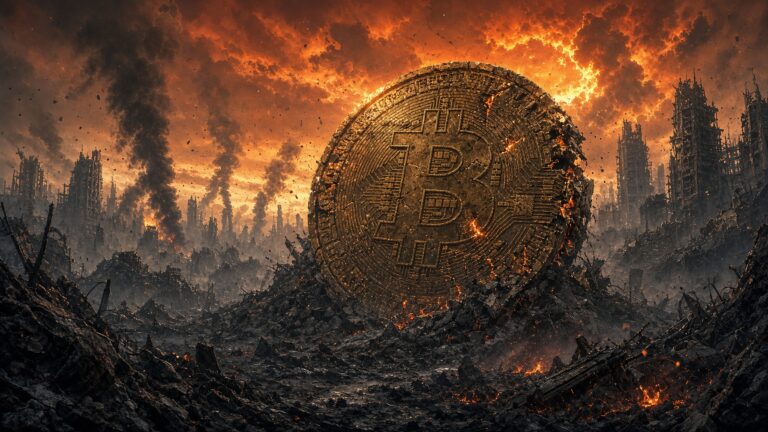
At its peak, a single ZND token traded at about eighty cents. In mid-April of 2026, as this is being written, it trades at approximately two-tenths of a cent. The drop exceeds ninety-nine and three-quarters per cent. A Polish investor who put the equivalent of twenty-five thousand dollars into ZND at the top of the market now holds, in nominal terms, something worth roughly sixty. This is not an anomaly. It is the mechanism functioning exactly as designed — which is to say, functioning well from every perspective except that of the person who bought in.
* * *
To understand what ZND actually was, it is useful to stop treating it as a technology project and start treating it as a corporate-finance operation. Issuing a token, for an ailing cryptocurrency exchange, is not really an act of engineering. It is what, in conventional banking, would be called bridge financing in conditions of impaired credit.
An ordinary bank that is running out of cash has recourse to the usual sources: the central bank, a private investor, another bank on the interbank market. Each of these creditors will conduct due diligence. Each will demand accounts, access to the books, collateral, guarantees. Each will ask uncomfortable questions about the gap between what the bank owes its customers and what it actually holds in reserves. Each will impose covenants. A cryptocurrency exchange has an alternative its banking counterpart does not. It can print its own financial instrument, describe it in a white paper as an integral element of its “ecosystem,” and sell that instrument to its own customers. The customers do not demand to see the books. They expect the price to go up, because the promotional material said that the price would go up.
From the issuer’s perspective, this kind of financing is without precedent in its attractiveness. The token carries no obligation of capital return. It bears no interest. It dilutes no equity. It imposes no covenants. It is unaccompanied by any due diligence. It never matures; the issuer decides when, how much, and to whom to unlock. In the dry language of banking law, it is — approximately — a perpetual subordinated loan without recourse, except that the party providing the loan does not know that he has made one.
Now consider what the financial statements of BB Trade Estonia OÜ look like, as filed by the company itself with the Estonian Commercial Register. The analyses of the 2023 filing that have circulated among counsel in this matter — and the underlying filing is public — suggest liabilities to customers on the order of seven hundred and twenty-two million euros against available cash of around nine and seven-tenths million. The ratio, in other words, is approximately seventy to one. The gap, again, is not a figure from a critical article. It is a figure from a document the company itself submitted to the Estonian government.
In this context, the emission of ZND in the summer of 2024 — eighteen months after the gap was already visible in the filings — stops looking like the construction of an “ecosystem” and starts looking like what, from a balance-sheet perspective, it actually was: an injection of liquidity from customers, for customers, in exchange for an instrument with no external market, no revenue, and no rights attached to it. In hospital terms, it was the first of several saline drips. The second was a related token issued in August of 2024, in partnership with the Polish Olympic Committee, called TMPL — about which more in a moment. The third is scheduled to arrive, on the accounts of a significant number of Polish Olympic medalists, within days.
* * *
The white paper of ZND, dated June 27, 2024, is a revealing document in the way that criminal confessions are sometimes revealing: not because it hides anything, but because it doesn’t. It is a disciplined filing that complies, at least in structure, with the disclosure requirements of the European Union’s Markets in Crypto-Assets regulation, known as MiCA. It is also, if one reads it with attention to the tables rather than to the adjectives, an instruction manual for how the losses were engineered.
Consider the allocation. Seven hundred million tokens in total supply. Of these, only a hundred and eighty-nine million — about twenty-seven per cent — were offered for public and private sale. The remaining five hundred and eleven million, which is to say seventy-three per cent of everything that would exist, were retained in pools under the issuer’s control. There was a Treasury pool (twenty-nine per cent), Ecosystem Incentives (fifteen per cent), a Team allocation (eight), Partners (eight), Liquidity (eight), and Marketing (five). The white paper presents these pools as ordinary features of tokenomics, which in a certain sense they are. What the tokenomics does not emphasize is the cumulative effect of the vesting schedules. A buyer in the Seed round was subject to an eight-month cliff followed by a twelve-month linear vesting — meaning his tokens would be distributed to him, in monthly increments, over the roughly twenty months after the Token Generation Event. The Team was subject to a twelve-month cliff and a thirty-six-month vesting. The Treasury pool was subject to a twenty-four-month cliff and a sixty-month vesting. On paper, the team and the issuer were locked in longer. In practice, the issuer was selling out of a single pocket of enormous size while the buyers were selling — if they could coördinate at all, which they could not — out of thousands of small ones.
The white paper also specifies, on page twenty-one, what would happen to the money the issuer received in exchange for the tokens. Forty-three per cent of it would be used to provide “liquidity” on the exchanges where the token traded — meaning that the issuer would feed roughly half of what the public paid for the token back into the order book, on both sides, to support the price. The same document, on page thirty-three, acknowledges a “substantial conflict of interests”: the software operating the ZND platform is provided by a company called ZND.CO OÜ, fifty per cent indirectly owned by the issuer, with the other fifty per cent owned by a firm called ICEO, which was, by the white paper’s own admission, “responsible for the technical, economic, and legal design of the ZND token.” The token was designed by one company, issued by a second that half-owns the first, and sold to the public over a platform controlled by the same two entities in combination. A further note on page eleven discloses that the sole shareholder of the Swiss holding company at the top of the corporate structure, DIVISIO HOLDING AG, is a gentleman named Przemysław Kral, who is also the chief executive of zondacrypto.
This is not, in any ordinary sense, a concealed fraud. The structure is on the page. The page is in English. The page is public. What the exchange relied on, correctly, is that the people buying the token would not read the page.
* * *
The mechanics of how a pump resolves into a dump have, by now, a substantial academic literature. Neil Gandal, J. T. Hamrick, Tyler Moore, Marie Vasek, and their coauthors, in a 2018 working paper published by the Becker Friedman Institute at the University of Chicago, catalogued three thousand seven hundred and sixty-seven pump signals on Telegram and a further thousand and fifty-one on Discord over a six-month period. For tokens outside the top five hundred by market capitalization — the thinly traded ones, where a small amount of coördinated buying moves the price a great deal — the median price rise during a pump was twenty-three per cent on Telegram and nineteen per cent on Discord. A year later, Jiahua Xu and Benjamin Livshits, presenting at the USENIX Security Symposium, documented four hundred and twelve pump-and-dump events across multiple Telegram channels and multiple exchanges, and showed that the full cycle — spike, dump, collapse below the opening price — can close inside twenty minutes.
The most relevant finding for purposes of what is happening in Warsaw this month is from Josh Clough and Matthew Edwards, working at the University of Bristol, who in 2023 presented a study of seven hundred and sixty-five pumped tokens at the APWG eCrime Symposium. They found that the average price of a pumped token fell by approximately thirty per cent relative to the broader market within one year of the pump, and that the decline already exceeded twenty-five per cent by ninety days. Their paper, in other words, suggests that pump-and-dumps are not merely zero-sum transfers from the late buyer to the early seller. They destroy the pumped asset. ZND is in the distribution Clough and Edwards describe. It is in the far tail.
* * *
In Polish Telegram and Discord channels during the run-up to the TGE, the supportive posts arrived in steady diurnal cycles. They used a narrow vocabulary — “the project has potential”; “it’s only getting started”; “long-term vision” — and reacted with hostility to any critical question. Whether these were bots or employees of a marketing subcontractor pretending to be enthusiastic private investors is, at this remove, impossible to determine without access to the servers. From a legal perspective, it doesn’t matter. Both cases are what Article 91 of MiCA defines as market manipulation. The pattern is also not specifically Polish. FINRA, the American brokerage self-regulator, issued an alert describing “a significant spike in investor complaints” about exactly this kind of scheme, prevalent since the autumn of 2023. The F.B.I., in a July, 2025, advisory, reported a three-hundred-per-cent year-over-year increase in complaints referencing “ramp-and-dump” fraud. In December of 2025, the S.E.C. charged three crypto platforms and four “investment clubs” — with names like Morocoin Tech Corp. and Zenith Asset Tech Foundation — whose victims lost a combined fourteen million dollars, all recruited through WhatsApp. In the first half of the same year, Meta removed more than six million eight hundred thousand WhatsApp accounts tied to “pig butchering” fraud networks, operating primarily out of scam compounds in Cambodia, Myanmar, and Thailand. The vocabulary of those Telegram posts, in other words, is global. The Polish is the local translation.
* * *
The second act of the zondacrypto story is the element that distinguishes it from an ordinary financial collapse. In August of 2024, during the Paris Olympics, the exchange entered into a partnership with the Polish Olympic Committee and issued a second token, the Olympic Token, ticker TMPL. The premises were white-and-red, the symbolism was the five rings, and the narrative was an appeal to national feeling: “support Polish sport, hold TMPL.” The bonuses for Polish medalists — the financial awards athletes receive from their national committee for standing on an Olympic podium — were denominated in TMPL. Fans, too, were encouraged to buy the token, in amounts corresponding to whatever they could spare, as a gesture of support for the country’s athletes.
This is the scheme American securities lawyers call affinity fraud — the practice of exploiting loyalty to a shared group or value in order to lower the target’s skepticism. The S.E.C. has maintained a dedicated category of enforcement actions under that name for decades. The principle underneath the typology is that there are two ways to lower an investor’s guard. You can lie to him, or you can arrange things so that he stops asking questions on his own. Olympic rings and a national flag are, statistically speaking, more effective than a lie. A prospective buyer of TMPL is not evaluating the fundamentals of the asset. He is buying because he wants to support Polish athletes. A refusal to buy presents itself — for the brief moment before reflection arrives — as something like a small personal failure of patriotism. This is the moment that gets monetized.
The history of the scheme is rich and grim. Consider a few examples.
In the early twenty-tens, a man named Ephren Taylor II — a self-styled “social capitalist” who called himself “the youngest Black CEO of a public company” — conducted what he called a Building Wealth Tour through African-American evangelical churches, including Atlanta’s New Birth Missionary Baptist Church, where the pastor introduced him from the pulpit. Taylor pitched promissory notes promising twelve to twenty per cent returns on “socially conscious” investments — laundromats, juice bars — and “sweepstakes machines” promising up to three hundred per cent in the first year. The money went to Taylor’s personal expenses, including the financing of his wife’s singing career. More than four hundred investors lost a combined fifteen and a half million dollars. In 2019, he was sentenced to nineteen years and seven months in federal prison.
In 2024, the S.E.C. charged Cynthia and Eddy Petion, the husband-and-wife operators of a firm called NovaTech Ltd., with running an affinity-fraud Ponzi scheme targeted at Haitian-American communities. Cynthia Petion’s promise to recruits, quoted verbatim in the S.E.C. complaint, was: “In this program, you are in profit from day one.” The scheme raised, according to Reuters, more than six hundred and fifty million dollars from over two hundred thousand investors worldwide — one of the largest documented affinity-fraud actions by dollar amount ever filed.
In March of the same year, the S.E.C. charged seventeen individuals associated with a Houston-based firm called CryptoFX LLC. The founder, Mauricio Chavez, had been conducting what he called educational seminars for the Latino community — teaching wealth-building through cryptocurrency trading, despite, in the S.E.C.’s sober phrasing, “no background, education, or training in investments or crypto assets.” The scheme raised three hundred million dollars from more than forty thousand investors, largely in cash. Real trading generated approximately two million six hundred thousand dollars in profit — less than one per cent of what was raised.
In 2018, a Utah real-estate operator named Rick Koerber, through his firms Founders Capital and Franklin Squires Investments, was convicted on fifteen counts of wire fraud and related charges. The assistant United States Attorney prosecuting the case described the operation as “a massive, calculated Ponzi scheme targeting his fellow members of The Church of Jesus Christ of Latter-day Saints.” Koerber’s scheme had raised a hundred million dollars from Mormon-community investors, at a net loss to them of forty-five million. In October of 2019, he was sentenced to a hundred and seventy months in federal prison.
And in September of 2023, the S.E.C. charged Tilila Walker Sumchai, a Californian woman operating an entity she called Tongi Tupe, with defrauding more than a thousand members of the Tongan-American community of approximately eleven million eight hundred thousand dollars. Her pitch was a “secret algorithm” that promised to turn a three-thousand-dollar investment into a hundred and forty-six thousand dollars in sixteen weeks. Her recruitment technique is the one that matters here, because it is the purest form of the pattern: she first paid out fabricated returns to respected leaders of the Tongan-American community, who — believing the payments represented genuine profits — then recommended the program to their families and neighbors. The leaders were not conspirators. They were believers. They had been paid exactly enough to convert them into unpaid sales agents.
The common structural element across these cases is the one that matters for the Polish Olympic medalists. The fraudster does not, in almost any case, sell directly to the victims. He sells to the community’s trusted figures — pastors in Atlanta, leaders in Haitian-American churches, elders in Tongan-American congregations — who, having been paid enough to believe the scheme is real, carry the pitch into their own networks without compensation. The Olympic medalists of Poland now occupy, in a Polish-language variation on this scheme, the role of those community figures. The difference is that in the American cases, the intermediary typically received at least a first or second real payment; he was, in a compromised sense, a beneficiary. The Polish Olympians are not beneficiaries. They are the faces of the product — unpaid, uncompensated, and, one assumes, unaware of the economic architecture into which they have been pulled.
The closest empirical reference for the trajectory of TMPL is the category of “fan tokens” issued during the crypto euphoria of 2020 and 2021, mostly through a Malta-based platform called Socios.com. Those tokens, associated with soccer clubs, were supposed to give fans a kind of ceremonial voice in minor club decisions. According to the current listings on CoinMarketCap, CoinGecko, and Coinbase, the FC Barcelona fan token has fallen from a peak of roughly seventy-nine dollars, in April, 2021, to approximately fifty cents this month. The Paris Saint-Germain token has fallen from roughly sixty-one dollars to ninety-two cents. The Juventus token has fallen from thirty-eight dollars to fifty-four cents. The Manchester City token has fallen from around thirty-six to somewhere between fifty cents and a dollar. The declines, uniformly, are between ninety-seven and ninety-nine per cent. These are not tokens that are losing value. They are tokens that have lost value, and have been oscillating at small fractions of their peak prices for years. The fan-token category establishes, for TMPL, the floor of what is plausible — not the median.
* * *
As this is written, Polish medalists from the Paris Olympics are expected to see, on the dashboards of their accounts at the zondacrypto exchange, a quantity of TMPL tokens intended to represent the bonuses owed to them for their medals. The mechanics of what happens next are not difficult to forecast. In the current climate — with fiat withdrawals frozen on the exchange, a criminal complaint already before the Prosecutor General’s Office in Katowice, and several European regulators watching — a rational seller will try to convert his tokens into cash as quickly as possible. To sell, he needs a buyer. A buyer in the quantity required to absorb millions of tokens being dumped onto the order book by dozens of athletes at the same time, in a market whose sole effective market maker is the issuer himself, does not exist.
What will follow is predictable. The athletes will bid against one another, downward. The ones who sell first will sell at whatever the order book will take. The ones who hesitate will sell at less than that, and the last among them will sell at nothing. The losers in this cascade will not be limited to the athletes. They will include — principally — the fans who bought TMPL on the public markets during the rally of 2024 and 2025, in the sincere belief that they were financing Polish sport. In the conventional analysis of the scheme, these fans are the last buyers in a pyramid that has now reached its geometric limit. And the athletes themselves — through no fault of their own, and, one must assume, without a full understanding of the structure they were enlisted into — have become, in the end, the unwilling endorsers of a speculative asset marketed to a public that trusts them.
* * *
What can be done now, and what can no longer be done, are different questions. Until a few days ago, in an earlier piece of counsel I published on this matter, I recommended four parallel tracks for clients: a criminal complaint to the Prosecutor General’s Office, a competition-and-consumer complaint to the Polish U.O.K.i.K., a regulatory complaint to the Estonian Finantsinspektsioon, and a civil suit. That was the right map at the moment it was drawn. It is not, I now believe, the right map today. The reason is mechanical. In a matter in which assets are mobile across jurisdictions — crypto assets, by construction, can move in minutes, not months — the principal goal, in the early phase, is to secure the assets before they disperse. Only criminal proceedings, with their particular toolkit of seizures, European investigation orders, and mutual legal assistance between national prosecutors, are built for that purpose. Administrative and civil actions, useful as they may be in a later phase, have the opposite effect in the current phase: they put the counterparty on notice, give him time to prepare a defense, and — most consequentially — give him time to move what remains. Into a fire that is already burning, one does not add kindling.
The criminal track is, therefore, the only one that remains. It will operate in more than one jurisdiction. The corporate architecture of the zondacrypto group — an operating company in Estonia, a holding company in Switzerland, principal individuals resident elsewhere again — opens the door to parallel criminal proceedings, in each of those jurisdictions, each with its own set of asset-seizure instruments and its own path to recoverable assets. Coördinating those proceedings is technical work and requires partnership with criminal practitioners in each of the relevant countries. For reasons that require no explanation, the detail of that work is not a matter for a public essay.
There is one thing I am obliged to say plainly, even though clients tend not to like hearing it. In proceedings of this scale — hundreds of complainants, corporate entities across several jurisdictions, assets that are mobile by design — the outcome depends on variables that neither the clients nor their lawyers can control. How quickly national prosecutors move. Whether seizure orders are executed before the assets have been dispersed. Whether the Swiss and Monégasque enforcement systems work smoothly. Whether the persons under investigation remain in the jurisdictions where they now reside. No honest forecaster would commit to a timeline, and no honest forecaster would commit to an eventual recovery rate. Anyone who does — anyone — is not being honest.
The implication of that honesty is the piece of news that most affected clients will find hardest to absorb: there will be no fast resolutions. The final outcome is unknown. Between now and any potential recovery of funds lies a stretch of months at the most optimistic, more realistically years, of procedural work. That timeline is unavoidable, and it is the reason the second half of this essay matters more than the first.
* * *
There is a concept, in the economics of fraud, called secondary victimization. The primary loss is the one the victim has already suffered. Secondary victimization is what happens afterward — in the period during which the victim, desperate and in pain, becomes uniquely vulnerable to the next wave of predators. These predators do not steal investment capital. They steal rescue capital. The statistics suggest they are unusually effective.
The F.B.I.’s Internet Crime Complaint Center has recorded, since 2023, a systematic rise in complaints about recovery scams: frauds designed specifically to target people who have already lost money in an investment, romance, or crypto fraud. In 2024, the total reported losses to the I.C.3. in crypto-related categories were approximately nine and three-tenths billion dollars, a sixty-six-per-cent year-over-year increase. A meaningful fraction of that number — the exact share cannot be precisely specified — is recovery fraud.
The repertoire of recovery-fraud variants is, by now, stable enough to enumerate. There is the advance-fee “recovery lawyer,” who contacts victims most often through Telegram, WhatsApp, or Instagram — occasionally through a counterfeit LinkedIn profile — representing himself as a specialist in crypto-asset recovery. He has “found your case.” He offers to recover the lost funds for a retainer. When the retainer arrives, he disappears; or else he lingers for a few weeks, then requests a further payment to cover “court fees” or “translation costs,” and the cycle continues until the victim is exhausted. There is the fictitious trustee, claiming to represent a body with a plausible name — the “Estonian Crypto-Asset Commissioner,” the “European Consumer Protection Fund” — who informs the victim that his funds have been “identified in the bankruptcy estate” and can be returned upon payment of an “unblocking fee” or “withdrawal tax.” No real trustee, in any European jurisdiction, has ever asked a victim to pay fees in order to recover the victim’s own money. There is the “ethical hacker,” who represents himself as a technically gifted white-hat who has identified the wallets containing the stolen funds and offers to extract them for an up-front commission. And there is the “support group,” a Telegram or WhatsApp channel ostensibly organized by other victims, in which, over the course of several weeks, trust is carefully built by administrators and enthusiastic “members” — most of whom are bots or shills — until the message arrives announcing a collection drive for a “recovery fund.”
The operational principle, stated bluntly: no legitimate law firm, no real bankruptcy trustee, and no agency of any European state contacts victims by Telegram, WhatsApp, Instagram, or unknown-number phone call to offer the recovery of lost funds in exchange for an up-front fee. A contact of this kind, under any pretext, is a fraud. The correct response is to pay nothing, click nothing, and preserve the correspondence — screenshots, headers, telephone numbers, wallet addresses — for the authorities.
The global recovery rate for victims of crypto investment fraud of this kind is somewhere between three and seven per cent. The factors that raise that rate are early reports to law enforcement, complete documentation of the original transactions, and the avoidance of secondary frauds. None of these factors requires a decision made quickly under pressure. When someone is trying to make you decide quickly, under pressure, that is itself the signal that you are talking to a predator.
* * *
Manzoni sold air with a sense of humor. His buyers knew what they were buying, knew what it meant, and — because the gesture satisfied both parties — the market priced the joke at six figures. The contemporary version of the gesture is the utility token. Thousands of people bought a can in the belief that it contained gold. The can contained exactly what the label said it did: fresh air. The problem is that the label — signed by the exchange itself, accompanied by a white paper, wrapped in Olympic rings — suggested otherwise. For that discrepancy between the contents and the label, someone should have to pay.
When that someone will pay, how, and in what amount — no one, today, knows. The answer will not arrive quickly. Patience, for people who have already lost more money than they could afford, is among the hardest disciplines there is. But patience, in this case, is the only discipline that improves the odds. The alternative is the voice on WhatsApp, promising to fix in forty-eight hours what the courts will take four years to address, for an up-front fee of only a few thousand euros.
It is the same voice Manzoni’s buyers were laughing at sixty years ago. It has only gotten louder, and its lights have gotten better, and its audience has gotten larger. It is still selling fresh air in a can.
Further reading
The Zondacrypto Case
The Zondacrypto case is being examined by authorities in several countries, and no one today can predict the fate of the entrusted funds. We represent the victims and protect their position in the ongoing proceedings.

Robert Nogacki is a Polish attorney at law (radca prawny), the founder and managing partner of Kancelaria Prawna Skarbiec (Skarbiec Law Firm), which has operated continuously since 2006.
The law is equal for everyone, but the parties rarely are: on one side stands an organization with time, money, and lawyers, on the other a person with one business, one nest egg, and one life.
Clients rarely come to him with a legal problem. They come with a problem that also has a legal side: an audit that began with a single invoice, money entrusted to someone who has disappeared, a company that has to be passed on before it is too late. Most such matters are decided long before the first letter is written, in decisions made without asking and in deadlines nobody remembered. So he begins by asking how the client got here, not what the client should have done.
He advises entrepreneurs and families from more than a dozen countries, including those whose accounts the tax office has just seized and who do not know what to do tomorrow morning. He defends them in tax audits, customs and fiscal inspections, disputes with the tax authorities, and criminal tax proceedings. He represents victims of investment fraud and Ponzi schemes. He helps families set up family foundations and plan succession, so that a life’s work outlasts a single generation.
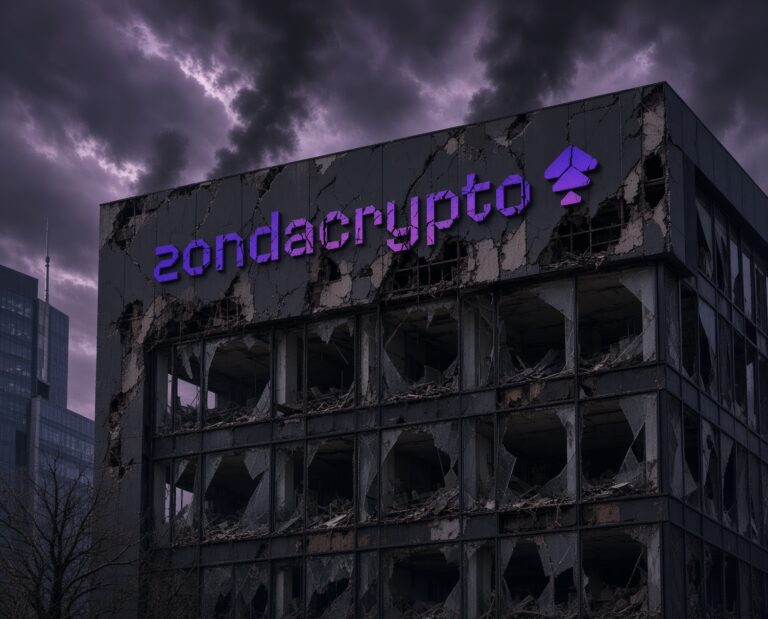
Not every case can be won. Every case can be run so that the client knows where they stand. Since 2006 he has represented the victims in the WGI case (Warszawska Grupa Inwestycyjna, the Warsaw Investment Group), one of the longest criminal cases in the history of the Polish financial market, because some things must not be left half finished, even when they take two decades. In the case of the collapsed cryptocurrency exchange Zonda (Zondacrypto, operated by BB Trade Estonia OÜ), he represents several hundred victims in the criminal investigation conducted by Poland’s National Prosecutor’s Office and in the Estonian bankruptcy proceedings.
Kancelaria Prawna Skarbiec is listed in the rankings of Poland’s largest tax advisory firms published by Dziennik Gazeta Prawna and Rzeczpospolita, and it is a four-time recipient (2015 to 2018) of the European Medal awarded by the Business Centre Club and the European Economic and Social Committee. Robert Nogacki publishes regularly, in the press and on the firm’s website, for people who have a problem rather than a law degree, because a legal opinion the client cannot understand protects only the lawyer.
He believes that the best legal advice is the kind that means the client never has to appear in court.