
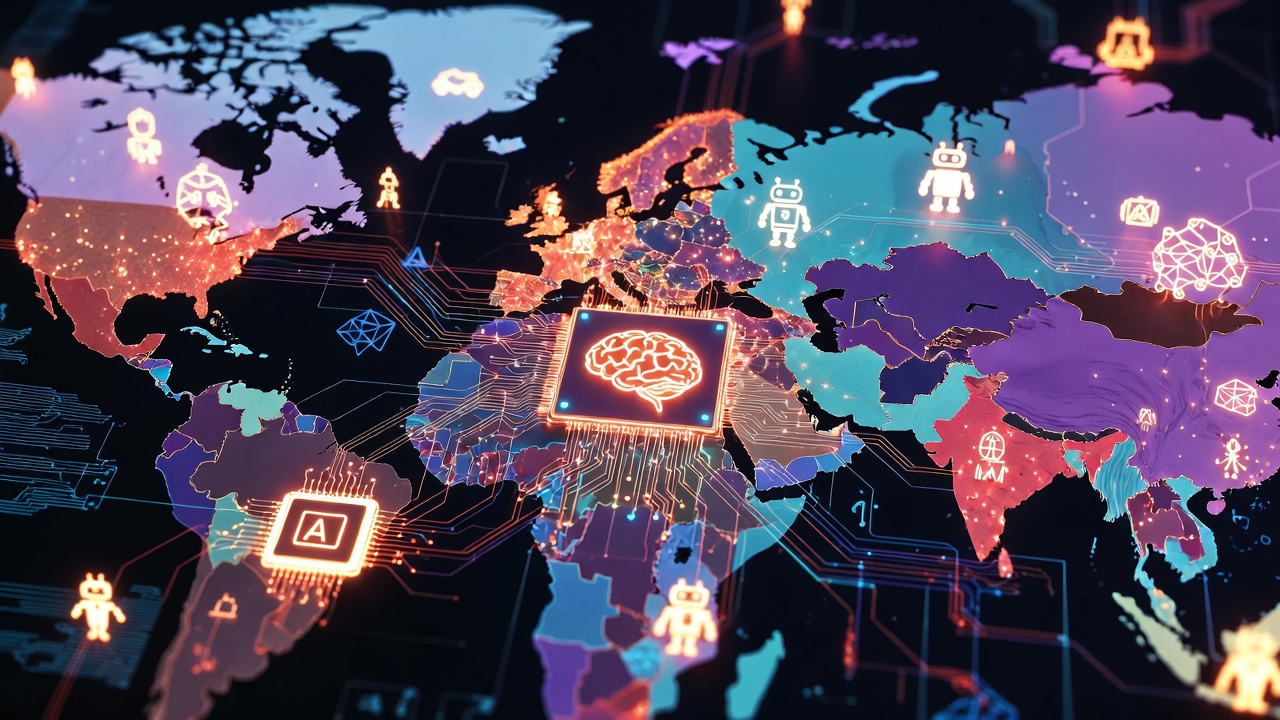
Access to Artificial Intelligence as an Economic Advantage: Malta’s Precedent and the Case for Treating AI as a Guaranteed Good
On 16 May 2026, Malta became the first state to conclude an agreement with OpenAI under which every citizen who completes a short literacy course receives a year of complimentary access to ChatGPT Plus. This Essay argues that the arrangement is best understood not as a curiosity of a small jurisdiction but as an early symptom of a structural shift: generative artificial intelligence appears to be traversing the boundary that electricity, antibiotics, and the internet crossed before it, from luxury to a condition of participation in the modern economy. Drawing on the economics of general-purpose technologies and on recent experimental evidence, the Essay contends that comparative advantage will accrue not to states that build frontier models but to those that diffuse access and competence most broadly. It then transposes onto the AI stack the categories of energy security and classical geopolitics, from the doctrine forged after the 1973 oil embargo to the strategy of chokepoints, before descending from public policy to the firm: the organizational and legal decisions that deployment of AI already compels, the obligations arising under the EU Artificial Intelligence Act, and the allocation of liability where an algorithmic recommendation proves erroneous.
From Luxury to a Condition of Participation
Economic history knows this pattern well. Electricity began as a costly indulgence of affluent districts and ended as a network without which neither production nor ordinary life is conceivable. Antibiotics were at first rationed, only to become, within a generation, a foundation of public health and of a productive labor force. The internet travelled, in two decades, from novelty to the infrastructure upon which labor markets and commerce rest. In each instance, the good migrated from the shelf of luxury toward something approaching an entitlement, and the advantage accrued not to the countries that invented it but to those that diffused it earliest and most widely.
The consequences were, on occasion, decisive. In the second industrial revolution, the economies that electrified broadly and reorganized production around the new power source pulled ahead, while those that hesitated forfeited decades. A comparable divergence separated economies that adopted the internet early from those stranded on the wrong side of the digital divide, with measurable effects on productivity and employment. In each transformation, the window of advantage opened briefly and closed on the latecomers.
The distinction at the heart of the matter is subtle but consequential. The economist Paul David demonstrated, using electrification as his example, that the productivity dividend of a general-purpose technology arrives with a delay of many years, and only once factories have rebuilt their organization around it. A technology that is available is not yet a technology that is used. The benefit flows not from the existence of the tool but from its diffusion, that is, from the number of people and firms genuinely able to work with it. Economic advantage, on this view, is not a function of ownership. It is a function of ubiquity and proficiency.
There is, moreover, a second regularity, one of particular interest to the lawyer. When a good becomes a precondition of ordinary functioning, states cease to treat it as mere merchandise and begin to treat it as an entitlement. Rural electrification proceeded through public programs precisely because electricity had ceased to be a convenience and had become a condition of development and of equal opportunity. Public health and universal vaccination were assumed as tasks of the state because an ailing population is a weaker economy. Access to telephony, and later to the internet, was brought within universal service obligations, and broadband has in several jurisdictions been elevated, expressly, to the catalogue of rights. The Maltese agreement is arguably the first attempt to apply the same logic to machine intelligence. The question whether access to AI belongs in the basket of state-guaranteed goods is therefore no eccentricity. It is the next link in a familiar chain.
Why Artificial Intelligence Is a Good of This Kind
The scale of the potential impact follows from the nature of the technology. Electricity was not an invention with a single application but a layer that entered every branch of the economy. Generative AI, in practice large language models, shares that character, with the difference that it touches not manual but cognitive labor: writing, analysis, programming, client service, design. It is for this reason that economists speak of it in the vocabulary of general-purpose technologies rather than of yet another application. A good that raises productivity in nearly every cognitive occupation ceases to be the concern of a single industry and becomes, sooner or later, the concern of the whole economy and of public policy.
The productivity evidence is by now robust rather than anecdotal. In the study by Erik Brynjolfsson, Danielle Li, and Lindsey Raymond of more than five thousand customer-support agents, access to an AI assistant raised productivity by 14 percent on average, but by as much as 34 percent among the least experienced workers. In the experiment by Noy and Zhang, published in Science, the technology reduced writing time by 40 percent while improving quality. Among consultants of the Boston Consulting Group, the quality of tasks within the model’s capabilities rose by 40 percent. GitHub Copilot enabled programmers to complete a coding task in roughly half the time. These are not promises; they are the results of controlled studies.
What matters most, however, is not the magnitude of the gain but its distribution. The same studies find, with striking consistency, that AI lifts the weaker and less experienced most, because it transmits to them the practices of the best. It is a tool that compresses differences in competence. Herein lies the economic stake for the individual career: in a world in which the tool raises the novice toward the level of the veteran, the worker without access and without proficiency does not merely lose an edge; he exits the game. It will not be artificial intelligence that replaces him. It will be someone who uses it.
For a country such as Poland this is, perhaps counterintuitively, good news. If AI lifts the less experienced most and shortens the distance to the frontier, it hands a catching-up economy a lever it is rarely offered: the chance for the smaller firm, the younger worker, and the less endowed region to operate closer to the world’s best without waiting a generation. The very force that deepens inequality where access is selective can be turned into an instrument of equal opportunity where access is universal. It is a rare case in which egalitarian policy and competitiveness policy point in the same direction.
The greatest gains lie with small and medium-sized enterprises, which form the backbone of the Polish economy. What was once affordable only to corporations with in-house analysts, salaried counsel, and a marketing department is becoming available to a firm of a few people that knows how to wield the tool. AI lowers the threshold of entry to competences that were hitherto the privilege of scale. Should that threshold fall in Poland faster than among its competitors, the smaller Polish firm gains a reach it could not previously afford. Should it fall more slowly, that firm is relegated to subcontracting for those who moved first.
The Question Poland Has Not Yet Asked
Hence the question Malta asked first: whether access to AI ought to be treated as a guaranteed good, much as education, health care, and universal connectivity are guaranteed today. The Maltese model is instructive precisely because it is not a giveaway but a coupling of three elements: a competence course, a path to the tool, and a program embracing the entire population. It is not a subsidy for a gadget; it is an investment in human capital. The question for Poland is not whether it can afford such a policy, but what the failure even to pose the question is costing.
What, concretely, would such a guarantee entail, since a slogan without content is a dangerous thing. Three layers suggest themselves. The first is universal access to tools at a meaningful tier, not to a stripped-down version. The second, and the most important, is mass literacy, from school through adult reskilling, without which access is empty. The third is computing capacity and tooling for small firms and public administration, which is where productivity is actually created. Nor is Poland alone in this race: OpenAI operates a program for governments and is already working with Estonia on its education system. Others are not waiting for the Polish debate to mature.
There remains the question of money, for every public policy is ultimately read through its ledger. The cost of universal literacy and access is real, but it is an outlay rather than a dead expense, and it must be weighed against foregone productivity, which appears in no budget line yet tends to be the costliest item of all. The Maltese example suggests, in any event, that the sums involved are not billions but a matter of intelligent design: a course, a path to the tool, and distribution handled by existing institutions. The scale of expenditure is a function of ambition, not a condition of starting.
One misunderstanding must be preempted, because when a state hears that it should do something about AI, it typically reaches for the wrong lever. The advantage will not come from building a sovereign national model. Europe has already attempted to field a national champion against Google, the Quaero project, and the result was expenditure without a product. The race for frontier models is today a contest measured in hundreds of billions of dollars annually, beyond the budget of a state of Poland’s size. The lever that genuinely translates into growth is universal access and proficiency, which is to say diffusion, not a monument. Value arises at the layer of applications, not in the attempt to outrun the leaders.
The Lesson of 1973
If not construction, then what? The apposite precedent comes not from industrial policy but from energy security. The oil embargo of 1973 taught importing states a lesson they had no wish to hear: the answer to dependence on a capricious supplier is not the fiction of self-sufficiency, for most countries have no oil, but a doctrine. Diversify suppliers. Maintain strategic reserves, the celebrated ninety days of imports. Build interconnections, so that the source can be switched. Preserve flexibility of demand. It was for this purpose that the International Energy Agency was established in 1974. No one calls France energy-sovereign for possessing oil. France is energy-secure, because no single supplier can extinguish its lights.
The transposition to AI requires no straining. Diversify model suppliers rather than binding oneself to one. Maintain a strategic reserve: open-weight models that one is able to run locally and to which one can switch when a provider raises prices or alters terms. Build the interconnections, that is, a genuine capacity to change providers rather than a declaration in a slide deck. Command the demand side: one’s own data, applications, and the evaluation of models. Sovereignty is proclaimed. Resilience is engineered.
The Geography of the Stack and Its Chokepoints
Geopolitics has always possessed a vertical dimension: command of the sea lanes carried one weight, mastery of the continental heartland another, the classic counterpoint of Mahan and Mackinder. The AI stack is likewise layered terrain. The subsoil consists of chips and fabrication plants. The commanding heights are frontier training and computing power. The inhabited surface comprises applications, data, and deployment. The commanding heights a middle power will not take, for a handful of players hold them. But the surface can be governed: through one’s own language, law, sectoral data, and the evaluation and testing of models. This is Liddell Hart’s indirect approach: do not storm the position that cannot be taken; prevail on the ground you can hold.
Every strategist is preoccupied with chokepoints: Hormuz, Malacca, Suez. Computing has its own. ASML, the world’s sole producer of extreme-ultraviolet lithography machines. TSMC, fabricator of the preponderance of the most advanced chips. Nvidia with its CUDA ecosystem, and a handful of hyperscalers. Export controls are the naval blockade of our era. The lesson of chokepoints is old and unvarying: whoever depends on a single passage is hostage to whoever can close it. Resilience does not consist in abolishing the chokepoint, which is impossible, but in ensuring that the closure of no single one is fatal.
There is, finally, a collective dimension. Just as the International Energy Agency coordinated the reserves of many states, and as a defensive alliance converts the weakness of individual members into the strength of the whole, so middle-sized countries gain resilience by pooling resources: shared computing capacity, jointly maintained open models held as a reserve, agreed standards for switching. Singly, we are price-takers. Pooled, we become a party to the negotiation.
The Engineering of Resilience
One must reach, in the end, for reliability engineering rather than heraldry. A resilient system has no single point of failure: no critical process, public or corporate, hangs upon one provider and one interface. It degrades gracefully: when the frontier provider disappears, the service falls back to a locally run open model rather than simply stopping. Its failover is rehearsed, not theoretical; its blast radius is contained; and it practices defense in depth. In Taleb’s vocabulary, such a system is on occasion antifragile: a supplier shock does not merely fail to kill it but compels the diversification that strengthens it.
Candor requires noting where the frame tears. Nuclear deterrence rested on the symmetry of mutually assured destruction; AI offers no clean equivalent, for the capability propagates through open weights and is dual-use by nature. The categories of geopolitics illuminate the problem, but the map is not the territory, and a conscientious analyst marks where it comes apart. The practical conclusion nonetheless stands firm: what one must purchase is not the model but the capacity to change models, and sovereign competences are to be built where they are attainable, in data, in evaluation, and at the layer of applications.
Delay Is Not Neutral
The most common error is the assumption that waiting is safe. It is not, for waiting is also a choice, merely one with a concealed price. It is true that the exuberance requires tempering: at the level of the aggregate economy, the productivity effects of AI remain invisible, an echo of Solow’s old paradox that one sees the technology everywhere except in the statistics. Only a small fraction of firms have deployed it in earnest, and most pilots stall. Yet this is not an argument for delay; it is a description of the battlefield. If the benefit depends on diffusion, and diffusion is difficult, the advantage will be captured by whoever solves diffusion first.
Nor is the problem remote. The Draghi report on competitiveness delivered a stark diagnosis: Europe is losing the productivity race with the United States in large part because it adopts and diffuses new technologies more slowly. AI is merely the most recent manifestation of the same weakness. For Poland, which aspires to advance out of the catching-up cohort rather than slide toward the rear of the peloton, the stakes are doubled: not only the distance to the global frontier, but position within Europe itself.
The consequences are asymmetric. Countries that universalize AI competence now will compound their gains, for an early start pays dividends for years. Those that delay will settle the bill in three currencies: foregone productivity, weakened competitiveness of their firms, and an outflow of talent toward places where the tools, and the culture of using them, are already in place. Most painful of all, the cost does not arrive as a single blow but as a quiet, widening gap, invisible in any given quarter and, after a decade, beyond repair.
It is individuals whom this touches most directly. Careers now unfold at a tempo at which a few years without exposure to AI tools open a gap that is difficult to close, while employers increasingly presuppose a proficiency that no one has systematically taught. That gap can be closed only in advance and only collectively, because the market, left to itself, will strand entire occupational groups and regions. At the level of states the mechanism is identical: the advantage will accumulate where a critical mass of competent users forms early, not where the most elegant strategy document is drafted.
The Price, and Honest Reservations
I do not pretend the thesis is free of risk, and I would rather name the weaknesses than have them named for me. First, free access is rarely free: a year of ChatGPT Plus for a citizenry is also a superb customer-acquisition channel and a risk of dependence on a single, and foreign, provider. Second, access is not proficiency, and a tool in the hands of someone who does not understand its limits is arguably more dangerous than its absence. Third, between the benefit observed in an experiment and the benefit realized across an economy lies the chasm of implementation, which money alone will not bridge.
A graver reservation must also be recorded. The same technology that elevates some workers threatens others, because a portion of tasks it will simply take over. Universal access is therefore no guarantee of employment security; it is, rather, the condition of standing on the right side of the change, as the one who uses AI rather than the one it replaces. This sharpens, rather than weakens, the argument about competence: without it, access alone is a ticket to nowhere.
What This Means for the Polish Firm Today
The argument so far has unfolded at the level of the state. But the same logic, that advantage flows from proficiency and that delay has a price, operates one storey below, in each firm taken singly. The entrepreneur need not wait for the Polish debate to mature, and as a practical matter cannot afford to, since competitors are not waiting. The deployment of AI within an organization is not, however, merely a technological decision. It is an organizational and legal one, and experience teaches that firms discover this at the worst possible moment: after the damage.
Three questions ought to be asked by every organization before AI tools enter its processes. First: who within the firm answers for decisions taken with the algorithm’s participation, since the system suggested it is not, and never will be, a line of defense, and responsibility assigned to no one devolves in practice upon the management board. Second: what happens to the data of clients, counterparties, and employees passed to the model, where it is processed, whether it enters training, and whether professional secrecy, trade secrets, or the General Data Protection Regulation are thereby infringed. Third: what does the vendor contract provide as to rights in the model’s output, who may use it and to what extent, and who answers where the output infringes another’s rights, not least intellectual property. A firm that knows its answers to these three questions is better prepared than most of the market.
This is not theory. Employees already use AI tools on a mass scale beyond the knowledge and control of their employers, a phenomenon common enough to have earned its own name, shadow AI. The firm without an AI-use policy does not avoid the risk. It holds the risk in its worst form: undocumented, unassigned, and invisible until the day it materializes.
The AI Act: Competence Is No Longer Optional
One thread, finally, ties the macroeconomic argument to hard legal reality. When I observe that the Polish debate has not posed the question of access and competence, this is not to say the law is silent. Quite the contrary: the EU Artificial Intelligence Act (Regulation (EU) 2024/1689) has already made competence an obligation. Article 4 requires entities deploying AI systems to ensure a sufficient level of AI literacy among their staff, and it has done so not from tomorrow but since 2 February 2025. The paradox is vivid: what the state has yet to debate as a guaranteed good is, for undertakings, already a legal duty. The European legislature settled this Essay’s thesis faster than the commentariat.
The calendar, moreover, is unforgiving. The principal body of the Regulation becomes applicable on 2 August 2026, including the transparency obligations, while the Polish Act on Artificial Intelligence Systems (ustawa o systemach sztucznej inteligencji), adopted by the Council of Ministers on 31 March 2026 and now before the Sejm, will establish the national supervisory authority (KRiBSI) with powers of inspection and sanction. For firms this means that the inventory of systems in use, risk classification, training, and documentation cease to be good practice and become evidence. How that process is conducted, from audit to deployment, is described at greater length in our guide to implementing the AI Act within an organization (in Polish).
Who Answers When the Algorithm Errs
There remains the question every sober entrepreneur asks upon reading the productivity studies: what if the AI is wrong, and the firm acted on its recommendation. The lawyer’s answer is simpler than the technological aura suggests. Artificial intelligence has no legal personality, and therefore no liability. Liability attaches to the one who employed it: toward the client, in contract; toward the injured party, on general principles of tort; and, in the regulated professions, in disciplinary proceedings besides. The algorithm may be the cause of the harm, but it is never its author in the legal sense, any more than a calculator is. From this follows a practical conclusion: human oversight of the model’s output is not a bureaucratic appendage to deployment but the first line of defense against liability. Firms that design their processes so that every decision has a human author purchase not only compliance but a litigating position, should a dispute arise.
Conclusion
From these reservations flows a conclusion de lege ferenda, directed not against action but at its shape. If the state is to guarantee access, let it do so intelligently: by investing in competence and universal proficiency, in vendor neutrality and the right to switch, rather than in a generous subsidy for a single platform or in a national monument. And let firms not wait for the state, for the obligations have already caught up with them and the competition is not slowing down. The economic advantage of the coming decade will not fall to whoever builds his own power station. It will fall to whoever brings electricity to every socket first. Malta has just begun. The question is when Poland will.
AI Act Implementation
Using AI tools in a business creates information, documentation and oversight duties that grow with the system's risk. We determine which of them apply to your organisation and implement them.

Robert Nogacki is a Polish attorney at law (radca prawny), the founder and managing partner of Kancelaria Prawna Skarbiec (Skarbiec Law Firm), which has operated continuously since 2006.
The law is equal for everyone, but the parties rarely are: on one side stands an organization with time, money, and lawyers, on the other a person with one business, one nest egg, and one life.
Clients rarely come to him with a legal problem. They come with a problem that also has a legal side: an audit that began with a single invoice, money entrusted to someone who has disappeared, a company that has to be passed on before it is too late. Most such matters are decided long before the first letter is written, in decisions made without asking and in deadlines nobody remembered. So he begins by asking how the client got here, not what the client should have done.
He advises entrepreneurs and families from more than a dozen countries, including those whose accounts the tax office has just seized and who do not know what to do tomorrow morning. He defends them in tax audits, customs and fiscal inspections, disputes with the tax authorities, and criminal tax proceedings. He represents victims of investment fraud and Ponzi schemes. He helps families set up family foundations and plan succession, so that a life’s work outlasts a single generation.
Not every case can be won. Every case can be run so that the client knows where they stand. Since 2006 he has represented the victims in the WGI case (Warszawska Grupa Inwestycyjna, the Warsaw Investment Group), one of the longest criminal cases in the history of the Polish financial market, because some things must not be left half finished, even when they take two decades. In the case of the collapsed cryptocurrency exchange Zonda (Zondacrypto, operated by BB Trade Estonia OÜ), he represents several hundred victims in the criminal investigation conducted by Poland’s National Prosecutor’s Office and in the Estonian bankruptcy proceedings.
Kancelaria Prawna Skarbiec is listed in the rankings of Poland’s largest tax advisory firms published by Dziennik Gazeta Prawna and Rzeczpospolita, and it is a four-time recipient (2015 to 2018) of the European Medal awarded by the Business Centre Club and the European Economic and Social Committee. Robert Nogacki publishes regularly, in the press and on the firm’s website, for people who have a problem rather than a law degree, because a legal opinion the client cannot understand protects only the lawyer.
He believes that the best legal advice is the kind that means the client never has to appear in court.