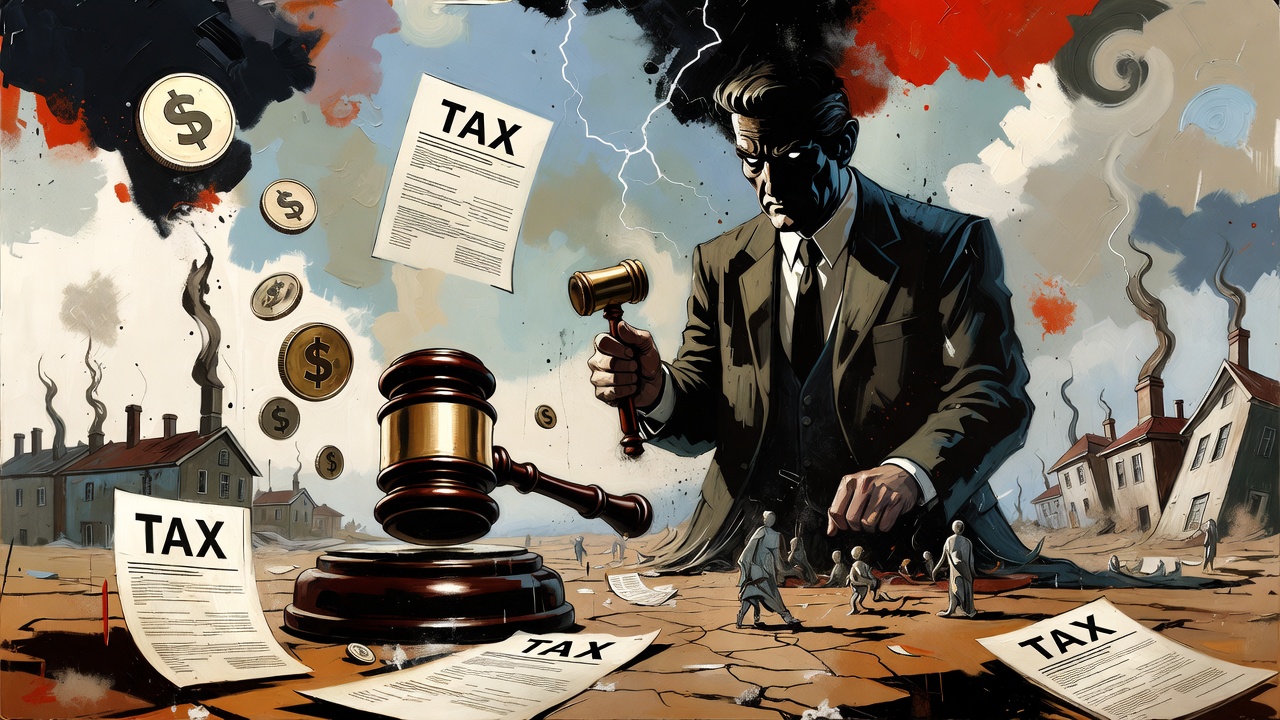
On Wars of Attrition and the Art of Survival
“The state is the coldest of all cold monsters. Coldly it lies; and this lie creeps from its mouth: ‘I, the state, am the people.'”
Friedrich Nietzsche wrote those words in the nineteenth century about the state as abstraction. But the entrepreneur who has received notice of a tax audit encounters the state in its most concrete form: as an official with credentials, as a letter with warnings of consequences, as a demand for payment running to seven figures.
A dispute with the tax authority is a particular kind of conflict. Your adversary has unlimited time, unlimited resources, and the entire machinery of the state behind him. You have a business to run, a family to support, and nerves that are not made of steel.
This is not a fight between equals.
Asymmetry: The Nature of the Conflict
Thucydides, the Athenian historian chronicling the Peloponnesian War, recorded the dialogue between the Athenians and the inhabitants of the island of Melos. Athens demanded surrender. The Melians appealed to justice. The Athenians replied: “Justice exists only between equals in power. The strong do what they can; the weak suffer what they must.”
The quotation is brutal—and true. In a dispute with the tax authority, the entrepreneur is not an equal party. The agency can conduct an audit for years. It can reach back five years, sometimes more. It can challenge transactions that were legal and commonplace at the time they occurred. It can impose liens on assets before it has even issued a decision.
The entrepreneur must respond to correspondence within deadlines. Must produce documents from years past. Must pay accountants, lawyers, advisers—before anyone knows whether the dispute has merit.
Recognizing this asymmetry is the first step toward effective defence. Whoever treats a tax dispute like an ordinary lawsuit—symmetrical, governed by principles of fair play—loses before the fight begins.
Terrain: Where the Battle Is Fought
Antoine-Henri Jomini, the Swiss general who served under Napoleon and later in the Russian army, devoted much of his treatise The Art of War to analysis of terrain. “An army that knows the ground on which it fights has half the victory,” he wrote.
In a tax dispute, the terrain is procedure.
The Polish Tax Ordinance runs to more than three hundred articles. The statutes governing tax audits, administrative enforcement, criminal fiscal liability—hundreds more. Then there is case law: judgments of the administrative courts, interpretations by the authorities, positions taken by the Ministry of Finance.
The entrepreneur, however accomplished in his own field, moves through this terrain like an army in a foreign country—without maps, without guides, without knowledge of the language. The tax authority moves as though at home.
Levelling this advantage requires specialization. A generalist lawyer will not suffice. What is needed is someone who knows every path, every shortcut, every trap.
Who understands that the deadline for a response is not a suggestion but the line between defence and capitulation. That absence from an interrogation can result in a procedural penalty. That an imprecise formulation in a letter may be used against the client three years hence, in an entirely different proceeding.
Strategic Depth: The Art of Buying Time
Mikhail Kutuzov, the Russian field marshal, faced Napoleon in 1812 with an army smaller in number and inferior in equipment. His strategy? Refuse to be destroyed. Retreat, avoid battle, allow space and winter to weaken the invader.
At Borodino, Kutuzov fought a bloody engagement, but not a decisive one. He surrendered Moscow—into which Napoleon marched triumphantly, only to discover it empty and ablaze. The French army disintegrated on the retreat. Russia survived.
In a tax dispute, strategic depth is time.
Audits have deadlines. Statutes of limitations run. Regulations change. Judicial panels change. Lines of interpretation evolve.
A case that in 2020 appeared lost may look different in 2024—because the Supreme Administrative Court has issued a new resolution, because the Court of Justice of the European Union has questioned Polish practice, because doctrine has shifted.
Buying time is not procrastination. It is strategy. An appeal, a complaint, a cassation appeal, a motion to stay execution, a motion to restore a deadline—each of these instruments has its function in the game for time.
Of course, time works against you as well. Interest accrues. Liens weigh. Uncertainty paralyzes. That is why the game for time must be played consciously—knowing what can be gained and what it costs.
Intelligence: What the Authority Knows That You Do Not
Frederick the Great, King of Prussia, used to say: “A diplomat who tells the truth is like a cook who does not season his dishes.” In eighteenth-century Europe, diplomacy was an extension of intelligence—the gathering of information, the construction of a picture of the adversary’s intentions.
In a tax dispute, information is asymmetric to the taxpayer’s disadvantage.
The authority knows what evidence it possesses. The taxpayer learns of it when it is presented—sometimes after years of accumulation. The authority knows its theory of the case. The taxpayer must deduce it from the tenor of questions and document requests.
Levelling this asymmetry requires activity.
The law provides tools: access to the file, participation in audit procedures, the right to demand a statement of the agency’s position. But these tools must be employed—systematically, consistently, from day one.
It also requires analysis: Why is the authority asking about this particular matter? Where did it obtain information about this transaction? What does the direction of questioning suggest? Who else has been audited—and with what result?
The taxpayer who understands what the authority knows can anticipate where it is heading. Can prepare arguments before they are needed. Can—sometimes—preëmpt the charges.
Escalation: When the Fight Is Worth Fighting
Clausewitz wrote of the “culminating point of the attack”—the moment at which the force of the offensive exhausts itself and further action produces more losses than gains.
In a tax dispute, the culminating point exists on both sides.
For the authority: a prolonged audit generates costs, consumes resources, requires justification to superiors. An authority that has pursued a case for five years without resolution has a problem.
For the taxpayer: every successive level of appeal means time, money, stress. There comes a moment when a settlement—even an unfavourable one—is preferable to years more of combat.
The art lies in recognizing on which side the culminating point is nearer.
Sometimes it is worth fighting to the end—because the case has merit, because the precedent justifies the cost, because the adversary is weaker than he appears.
Sometimes it is worth negotiating—because the gain from battle does not justify the expense, because life is too short for a five-year dispute over the interpretation of a regulation.
The decision demands cold calculation, not emotion. It demands a lawyer who will say “fight” or “settle”—and explain why.
Our Approach
We conduct tax disputes like military campaigns—with preparation, with a plan, and with the awareness that no plan survives contact with reality.
Reconnaissance of terrain—case analysis, risk identification, construction of a situational picture.
Active defence—we do not wait for charges. We shape the course of proceedings from day one.
Strategic depth—we exploit procedure, deadlines, appellate remedies. We buy time when time works in our favour.
Intelligence—we know how the authorities operate, what they examine, what their priorities are. We know the case law, the doctrine, the practice.
Controlled escalation—we know when to fight and when to negotiate. We do not prolong disputes for the sake of prolonging them.
The tax authority is not an enemy—it is an adversary. It has its objectives, its constraints, its weaknesses. Whoever understands them can win.
Or at least—not lose.
Tax Litigation in Poland – Further Reading
- Tax Proceedings in Poland: Strategy, Escalation, and the Art of Defense
- Tax Litigation in Poland – The Philosophy of Combat
- Representation in Tax Disputes Before the Courts
- The Eternal Problem of Unchecked Power
Trump’s $10B IRS Lawsuit: Tax Data Breach & the Privacy Question