
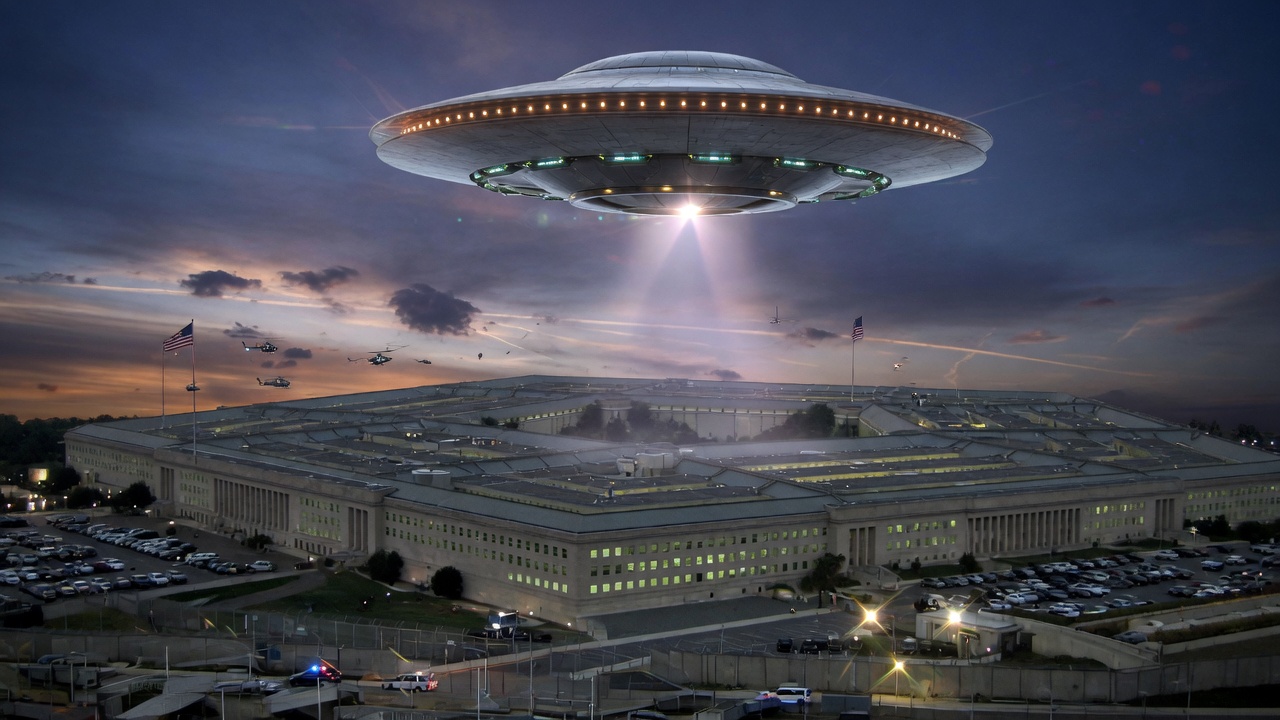
The Pentagon and the UFO Files: What the Department of War Revealed
The intelligence officer’s debrief runs to two pages. Two pages written in the same official prose that reports fuel consumption and the condition of the tyres.
Countless orange orbs swarming in all directions against the backdrop of the mountain, he writes. Two of them eventually flared up right beside his military helicopter and held position, motionless, just above the rotor disk on his right. Oval. Orange. With white or yellow centers. Emitting light in all directions like small, living suns.
The encounter lasted over an hour.
He and the entire crew, as he himself wrote, were virtually speechless after these observations. And then the intelligence officer, who had spent an hour looking at something he could not name, sat down and wrote it up as a service report. The whole affair is in that scene. He saw. He did not understand. He filed.
The report was declassified on Friday, May 22, 2026, and posted online without fanfare, as if it were just another bureaucratic memo, at war.gov/UFO, alongside several dozen other files.
This is not the account of an anonymous witness on an internet forum. It is a service document, submitted up the chain in the manner one submits a report on an equipment failure, and declassified not by its author but by the state that kept it in a drawer for years.
What did he see?
The state that employs him has one word for it, and it stamps that word on every file in the archive: unresolved. This essay is about that word, and about the people in a hurry to fill it in on the state’s behalf.
The scene
The release was the second tranche of PURSUE, the Presidential Unsealing and Reporting System for UAP Encounters, established by President Trump’s February directive and run as an interagency effort involving the Pentagon, NASA, the FBI, the ODNI, and the White House. CBS News broke the contents that evening; the New York Post and the BBC carried the helicopter file in detail by the morning. It was the second of five tranches published by the end of August: May 8 and 22, June 12, July 10 and August 7, several hundred documents, audio recordings and videos in all, with more promised. The Department of War’s own release of May 22 put the portal’s traffic at over one billion hits in its first fortnight.
The agency hosting the portal, and there is no graceful way to elide this, is the Department of War, the additional title President Trump revived by executive order in September 2025. The same Pentagon now wears two names. The orange orbs, presumably, do not care which it uses.
This is an artefact without precedent in the history of American national security, though not for the reason the press gives. For three quarters of a century the U.S. government’s posture toward the question was to manage the secret; since 2017, since the Nimitz videos, it has been to manage the unveiling, in installments and with commentary. The year 2026 brings a third posture. The government is no longer telling us what to think about the documents. It lays them on the table and asks us to tell it. The President greeted the first tranche on Truth Social with the words “have fun and enjoy!”, and a Department of War official told reporters there would be no briefings and no assessments, so that Americans could make up their own minds. The official designation of every file is unresolved. That single word changes the shape of everything that follows.
It can be read in two ways, and the rest of this story depends on the reading. In the first reading it is a confession: the state, after eighty years of investigation by the most expensive evidence-gathering apparatus in human history, admits that it cannot say what these things are and asks the population for an interpretive frame it has been unable to supply itself. In the second reading it is a filing convention. The Pentagon defines “unresolved” as cases in which no determination can be made on the available evidence, and Sean Kirkpatrick, the first director of AARO, has been saying for years that where his office could not produce an explanation it was almost always because the data were missing; the cases he considered genuinely anomalous were two to five percent. In the first reading the archive is a confession. In the second it is a drawer of unfinished files. The archive itself does not settle which reading is correct, and that, as we shall see, is the source of its power.
The evidence
The orange orbs above the rotor are the headline only because they are the most recent. The corpus they sit inside is larger and stranger, and groups naturally into four kinds of material: the nuclear-era files, the early humanoid reports, the diplomatic and space-program material, and the modern sensor data.
The nuclear-era files. Begin with the Sandia report. In 1948 the Armed Forces Special Weapons Project, headquartered at Sandia Base outside Albuquerque, was responsible for the design and stewardship of the second-generation American nuclear arsenal. Over a little less than two years, from the autumn of 1948 to the spring of 1950, the project logged 209 reports describing green orbs, discs, and fireballs over New Mexico, most of them near the base. The Department of War’s own summary quotes the figure verbatim. The observers were security officers, pilots and scientists at the places where the bomb was assembled. The report, all 116 pages of it, was declassified in the second PURSUE tranche, on May 22. Two hundred and nine reports in under two years, around the places where the bomb was assembled. The Roswell incident is from the year before; War of the Worlds (the Welles broadcast) is a decade earlier; the modern saucer panic began the previous summer, when Kenneth Arnold reported his Mount Rainier sighting. So the cultural script existed, and honesty requires saying that the Sandia witnesses were not free of it. What they were was engineers reporting by procedure, and the meteoriticist Lincoln LaPaz, brought in to investigate the green fireballs, maintained to the end of his life that they were not ordinary meteors. Project Twinkle, set up in 1949 to photograph them, closed without a single usable measurement, but with the official conclusion that the phenomena were probably natural in origin. That is the true shape of the case: not the absence of a script but a surplus of reports and a shortage of measurements.
The early humanoid reports. The October 19, 1966 memorandum from the FBI’s San Francisco field office to Director Hoover, available in the Bureau’s online vault for years before it reached PURSUE, forwards a San Francisco Examiner article to Washington and summarises Frank Edwards’s then-notorious book Flying Saucers: Serious Business; among the accounts it summarises are witnesses who saw “crewmen” three and a half to four feet tall, in what looked like space suits and helmets, emerging from a landed craft. The morphology is its own: short, suited, helmeted. It is not the wraparound-eyed grey of the 1980s template (largely supplied by Whitley Strieber’s Communion in 1987), and it is not the large-headed grey of the Betty and Barney Hill abduction literature that Look magazine was already carrying into wide American circulation in October 1966, the month the FBI memo was written, in instalments from John Fuller’s The Interrupted Journey. It would be convenient to say that these witnesses described something for which they had no template. Not so: small men in suits and helmets were the most common template of that decade, from the French wave of 1954, through the “little men” of Kelly-Hopkinsville in 1955, to the two figures in white coveralls that Officer Lonnie Zamora saw outside Socorro in 1964. The memorandum is valuable for a different reason. It shows that in 1966 the Bureau treated a summary of a saucer bestseller as matter for the Director’s attention rather than as folklore. The state collected what it did not understand and put it on a shelf. Shelving is also a method.
Diplomatic and space-program material. Add the State Department reporting on UAP incidents from Papua New Guinea, Kazakhstan, Georgia, Mexico, Iraq, Syria, the United Arab Emirates, Greece, running from the mid-1980s through 2025. Add the Apollo material, flagged in the first-tranche coverage by Fox News and Fortune: the Apollo 17 transcripts in which the crew report bright fragments outside the window, “like the Fourth of July,” and two photographs, from Apollo 12 and Apollo 17, on which the Pentagon has flagged unidentified objects, among them three dots in a triangular formation in the black sky above the Moon, and Buzz Aldrin’s 1969 mission debriefing referencing an unidentified sizeable object and a bright light source observed in deep space. Here the investigator must be careful, because the Aldrin material is a case study in how an archive can be misrepresented in transmission. Aldrin himself, in a 2014 Reddit AMA and in subsequent corrections to outlets that had quoted him out of context, attributed the sighting to sunlight reflecting off an S-IVB rocket-stage panel jettisoned earlier in the mission: “I feel absolutely convinced that we were looking at the sun reflected off of one of these panels. […] It was not an alien.” The Science Channel’s 2005 documentary edited out the panel explanation. The original transcripts are unresolved in their bureaucratic classification; the most credible witness explained his own sighting himself and went on repeating the explanation for decades. The Pentagon has released the transcripts. The honest investigator releases the correction with them. Then the audio reels: NASA astronauts on Mercury and Apollo missions describing objects outside their spacecraft windows as “fireflies” and “snowflakes.” The Pentagon’s 2026 caption notes that NASA “later determined that the ‘fireflies’ are attributable to frozen condensation separating from the spacecraft body.” The fireflies were first seen by John Glenn in February 1962 from Friendship 7, and three months later Scott Carpenter, rapping on the wall of his own capsule and watching them shake loose past the window, settled that they were frost coming off the hull. An astronaut is a reliable witness to what he saw and no witness at all to what it was. Aldrin’s credibility rests precisely on the fact that he understood this.
Modern sensor data. A structural caveat first: the Pentagon’s own caption on much of the video corpus states, with a clerical flatness that becomes funny on a second reading, that “many of these materials lack a substantiated chain-of-custody.” The AARO office’s elaboration is more specific: a substantial fraction of the released clips were uploaded to a classified network by unidentified users and cannot be confirmed as authentic military documentation. This is not a claim of fabrication. It is the admission that the archive’s provenance is less clean than “declassified government files” suggests, and that the investigator who treats every clip as a verified military observation is doing the apparatus a courtesy the apparatus has explicitly refused to do for itself. With that caveat in place: several dozen video clips from recent years, captured by military aircraft sensors, mostly in the CENTCOM and INDOPACOM theatres. This is a fraction of one tranche of one disclosure programme; AARO’s own caseload passed two thousand reports early this year, about a thousand of which, by the Pentagon’s own account, cannot be resolved for lack of data.
A cautionary closing. Among the second-tranche videos is a clip from February 2023 over Lake Huron, showing the moment an F-16 discharged its air-to-air missile into an unidentified object. The intervening years have made this particular case quietly complicated, and the honest investigator must say so. The War Zone examined the released footage and concluded the object is distinctly balloon-like: spherical, with a single line dangling below, bursting in a manner consistent with mylar. The Canadian federal police, who collected debris from the Lake Huron shoreline a few weeks after the incident, wrote in internal correspondence that one of the modules came from a company that sells weather-monitoring equipment, while cautioning in the same email that they could not be certain the debris came from the shoot-down. Former AARO chief Sean Kirkpatrick has been saying since 2024, with characteristic dryness, that the three objects shot down that week over Alaska, the Yukon and Lake Huron were almost certainly balloons. Not every entry in the archive is what it first appears. The investigator may proceed, provided he proceeds with the caveats the archive itself carries.
What has come since May. The archive keeps growing and the stamp does not change. The third tranche brought CIA and FBI material and a memorandum by AARO director Jon Kosloski, dated June 5, 2026, describing an orange orb releasing smaller red ones; the fourth, nineteen military infrared videos with the same status; the fifth, forty-one files, among them FBI witness forms. Anyone who looked in these tranches for a breakthrough did not find one. Neither did anyone who looked for proof that no breakthrough is coming. The archive also corrects itself: four days after publication the ODNI appended to the officer’s report that opens this essay a footnote correcting a typo in the name of a flight profile, “map-of-the-earth” for “nap-of-the-earth.” Four days were enough for the first revision.
The interrogation
The American national security apparatus has, over the eight decades since the 1947 saucer wave, offered the public four theories of what is in these reports. They were not successive and they were not rivals; they overlapped, they came back, and each covered some part of the material. They are worth reviewing not in order to eliminate them, since true explanations are not eliminated, but in order to see what is left when they are done.
The first was mass hysteria. The civilian population, primed by the science fiction pulps and Cold War nuclear dread, was producing false reports. This explanation weakened inside the institutions themselves once radar returns began to accompany the pilots’ testimony, which they did from the late 1940s on. The 1952 Washington flap, when F-94 Starfire interceptors were sent up over the capital after radar echoes, is instructive from both sides: the Air Force explained it as a temperature inversion, that is, as a radar artefact, and the radar operators, men who told weather from aircraft for a living, never accepted the explanation. Fighters are not scrambled after a hallucination; they are scrambled after an echo on a screen, and an echo can be weather as easily as an object. Hysteria explains why people look at the sky. It does not explain what the radars see.
The second was misidentification. Venus. Weather balloons. Swamp gas. The astronomer J. Allen Hynek, scientific consultant to Project Blue Book, supplied the swamp-gas account of the 1966 Michigan sightings and disowned it for the rest of his life. In The UFO Experience, published in 1972, he coined the close-encounter scale, its third kind reserved for reports of occupants near the object, and set apart the residual cases that would not dissolve into Venus, and devoted his later career to arguing for their empirical seriousness. The category has only grown.
The third was foreign technology. Soviet, later Chinese, intelligence platforms operating undetected in American airspace. This is the explanation the recent press cycle has been most attached to, because it sounds sober. It covers some of the archive (the Chinese balloon shot down over the Atlantic off South Carolina in February 2023 is a case in point) but it does not cover all of it. Foreign drones do not operate in 1948 over Sandia. Foreign drones do not exhibit the flight characteristics (instantaneous direction change, transmedium movement between air and water, hovering without observable propulsion) that recur in the pilot reports AARO collects and that the office can neither confirm nor dismiss. A Chinese reconnaissance platform sophisticated enough to do what the more striking residual cases show would be a more terrifying revelation than aliens. We would not be told about it on a Friday evening. We would be told about it in a national address.
The fourth, and current, is atmospheric phenomena and sensor artefacts. This explanation has the advantage of being undismissable, because it is also tautologically unfalsifiable. Any sufficiently strange aerial observation can, with sufficient effort, be attributed to a previously unrecognised plasma effect, a thermal inversion artefact, a parallax error, or an exotic ball lightning. The trouble is that the explanations have become, over the decades, more numerous and more specialised than the phenomena they explain. When the number of ad hoc rescues exceeds the number of original observations, the theory has stopped being a theory. It has become a defensive ritual. Keep that knife in view. It will be needed once more, and not against those it has just been used on.
A note of necessary caution before continuing. Not all of the institutional response to the disclosure has been confessional. Kirkpatrick said of the first tranche that there was nothing unexpected in it, and that without analysis or context it would only feed speculation and armchair pseudoscience; Scientific American rounded up the sceptics under a headline saying they were unimpressed; the historian Jason Colavito observed that most of the material had been public for decades, now merely rescanned in colour. DefenseScoop noted that of the first-tranche files, at least a hundred contained redactions, and much of the material had been widely circulated before. The UAP research community itself, generally the most enthusiastic constituency for disclosure, has been pointed: “Data alone is not disclosure.” The empirical first claim of this essay, that something is in the sky the institutions cannot identify, survives all of these qualifications; the residual unexplained cases have survived the conventional explanations offered so far, and the institutional record on its own admission contains them. But the survival is narrower than the press cycle has implied, and the investigator who treats every released file as an inexplicable wonder is overplaying his hand.
These are the four chapters of the official story. None of them, taken on its own, covers the archive as it now stands, which is why the institutions themselves have stopped telling them with conviction. The 2021 Office of the Director of National Intelligence preliminary assessment classified 143 of 144 examined incidents as unresolved; the ODNI document itself adds that in most of those cases the data were simply insufficient. The Department of War’s posture on the entirety of PURSUE is the same single word. It is tempting to write that the state is not lying, only confessing. But it did lie, and for a long time. In 1997 the CIA’s historian Gerald Haines established that more than half of the UFO reports from the late 1950s and the 1960s were U-2 and A-12 flights, and that the Air Force fed the public explanations it knew to be false; the third PURSUE tranche contains a 1992 CIA document in which the agency concedes that it could not tell letter-writers the true cause of sightings from the 1950s. A state that lied about the sky for half a century now says it does not know. That is not a confession. It is something rarer: an institution that has stopped pretending to understand its own archive.
The suspects
When the official story collapses, the void it leaves is occupied. There are, in the public discourse of 2026, three principal frames competing to replace it.
The first is the extraterrestrial hypothesis. Intelligent biological beings from another stellar system have reached our atmosphere using technology of propulsion, life support, and concealment that has remained, to within an order of magnitude, the same for eighty years. This is the popular frame, inherited from twentieth-century science fiction. It is not, on the present evidence, a particularly good fit. The 2024 AARO report stated in plain bureaucratic English that no U.S. government investigation, academic-sponsored research, or official review panel has confirmed any sighting of a UAP as representing extraterrestrial technology. This is the institutional position. Whatever PURSUE establishes, it does not establish ETH.
Beyond the institutional finding, ufologists themselves have for years pressed structural arguments against the hypothesis. They are worth knowing, if only so as not to overrate them.
First, the shapes. A single technological civilisation along a single developmental trajectory converges on optimised forms. The American F-22, the Russian Su-57 and the Chinese J-20 look broadly alike because they solve the same set of aerodynamic problems. The UAP corpus, in the same period and often over the same territory, shows wild morphological variation: tic-tacs, triangles, orbs, cubes, cigars, discs, discs within discs. Either we are seeing many different visitors from many different civilisations, or we are seeing entities not constrained by engineering optimisation, or, least glamorously, we are seeing a collection of bad observations in which every shape is the shape of something else. The second option carries us outside the extraterrestrial hypothesis as we ordinarily understand it. The third carries us out of the subject.
Second, the physics of flight. The manoeuvres described in the pilot reports are not engineering edge cases; if they occurred as described, they would be violations of the constraints to which any vehicle is subject. The object from the 2004 USS Nimitz incident, the “tic-tac,” is said to have executed accelerations on the order of thousands of g, of which no biological pilot survives a hundredth. What the popular literature omits must be added here: the figure comes from an estimate built on a radar operator’s recollection, not from a published track, which no one outside the Navy has seen. No visible propulsion, no thermal signature, no sonic boom; entry into water without a wave and without a splash. If it is true, the observed objects are not subject to the constraints of matter moving through a medium. If it is an illusion, it is an illusion that has resisted, for twenty years, people professionally trained to tell illusions from targets.
Third, the behaviour. What kind of interstellar mission consists of eighty years of buzzing fighter jets and hovering over nuclear facilities? A civilisation capable of crossing thousands of light-years possesses technology so disproportionately advanced relative to ours that it would either make contact immediately, ignore us entirely, or extract what it wanted and leave. The behavioural pattern, decades of unidentified presence without communication and without intervention, is incoherent for any rational model of exploration or colonisation. It looks more like the observation of something specific (the bomb, consciousness, a threshold moment in the history of the species) or, more disquietingly, like performance. The phenomenon behaves as if it wants to be noticed without being identified.
Each of these arguments has the same weakness: it assumes we know how a visitor from another star ought to look and behave, which is to assume precisely what the extraterrestrial hypothesis cannot supply. They are the arguments of people who grew up inside the hypothesis and went looking for something stranger. It was the dominant position of serious ufologists in 1965. By 1980 the most restless of them had moved on, and the public is now several decades behind them.
The second frame is what Jacques Vallée, the French computer scientist who developed it through the late 1960s in Passport to Magonia and subsequent work, called the interdimensional hypothesis. The entities are real but do not originate in our space-time in the conventional sense; they emerge from a dimensional adjacency we lack the instruments to detect; they have been present throughout human history; they appear in culturally legible forms calibrated to each era’s mythological vocabulary: fairies in the Middle Ages, airships in the 1890s, Venusian Space Brothers in the 1950s, greys in the 1980s, orbs now. This hypothesis has the strength of accommodating the entire historical record, including the parts the extraterrestrial frame cannot touch. It has the corresponding weakness of proposing no mechanism, no falsification criterion, and no positive content beyond the bare assertion that the entities are not what they appear to be.
The third is the demonic hypothesis in its various Christian formulations. The entities are real; they are pneumatic rather than biological; they are oriented against the human good; they manifest in forms calibrated to the receptivity of each age. This is the framework inherited from the Christian tradition: Paul on the principalities and powers in Ephesians 6, the patristic literature on demonology, Aquinas on angelic beings, C.S. Lewis on the strategies of the diabolical mind, Seraphim Rose’s 1975 Orthodoxy and the Religion of the Future, which argued explicitly that “UFO phenomena are simply and precisely demonic in origin.” It has been recovering ground in the American public conversation with startling speed. The sitting Vice President of the United States, asked by the podcaster Benny Johnson in March of this year whether the government would release all the UFO files, said: “I don’t think they’re aliens. I think they’re demons anyway, but that’s a longer discussion.” He said it in passing, like a man who knows the headline is already writing itself; pressed to elaborate, he appealed to a Christian understanding of reality in which both good and evil are operative. In July, on Joe Rogan’s programme, he repeated the thought more carefully: demons or angels. A line tossed off by a Vice President is not the position of the administration. It is, however, something that did not exist a decade ago: one of three options that can be voiced in public without costing the speaker his office.
There is a fourth suspect who declines to be one, and it must be named, because it has been circling the edges of this discussion for years: the physicist’s temptation. Harold Puthoff and Eric Davis, contractors to the Pentagon’s AAWSAP programme, suggested that the observed manoeuvres are not movement through space but manipulation of the metric of space-time itself, for which ready-made mathematics exists: the Alcubierre drive, a class of solutions to Einstein’s field equations published in 1994. Since 2021 there have been subluminal solutions of this class that dispense with negative energy, and the argument over how much negative energy is truly required continues in the literature; none of these papers points to any matter that could produce such a geometry. And here it gets tempting. An entity that does not travel but bends the geometry around itself behaves, from the outside, like Vallée’s entities emerging from an adjacency, and like Augustine’s demons, whom space does not bind as it binds bodies. Three languages, one behaviour, the temptation whispers; physics is arriving where the tradition has stood for fifteen centuries. It must be set aside, and not for want of nerve. Three hypotheses, none of which has predicted anything, are always indistinguishable. This is not a convergence of evidence. It is a convergence of its absence. Nor does the tradition speak with one voice here: Augustine gave the demons airy bodies, and Aquinas took them away.
Now the investigator pauses, because something has become visible that did not have to be. Set the three suspects side by side. None is falsified by anything in PURSUE. None is confirmed by anything in PURSUE. Each is consistent with the documented residual phenomena, and each assumes an intention behind them, which no institution has found. They are structurally identical in their relation to the evidence, and that is the only identity the archive allows us to assign them. The knife from the previous chapter returns: what is unfalsifiable is not thereby false, but neither is it thereby proven.
To choose among them is not, in the present state of the documentary record, a scientific act. It is a metaphysical commitment that one then reads back into the documents as confirmation. The state has said it does not know. The frames are now asking the population to make the confession of faith the state declined.
This is the actual situation. It is not the situation the press is reporting.
The discipline
The Christian reader of the archive has, at this point in the investigation, two temptations and one obligation.
The first temptation is to read the demonic frame as if it had been confirmed by the disclosure. This is the move now circulating widely in the apologetic literature: that PURSUE vindicates the patristic and scholastic tradition, that the documents are document-by-document proof of what Rose argued in 1975. It is the wrong move, and it does the tradition no favours. The empirical first claim (something is in the sky that the institutions cannot identify) does not entail the theological third (the something is demonic in the specifically Christian sense). Between them stands an inferential step the PURSUE archive does not authorise and cannot authorise. The state’s word for what is in the documents is unresolved. To read the documents as resolution is to do what the state declined to do, and to do it by an act of will rather than an act of evidence.
The Lake Huron case is worth holding up here as the single, clean illustration of why this discipline matters. Three years ago, the Lake Huron interception looked inexplicable. Today, after The War Zone’s analysis, the Canadian debris recovery, and Kirkpatrick’s blunt admission, it looks like a balloon. A Christian apologetic that had hung any meaningful theological weight on that particular incident would now be quietly retracting. (The Aldrin material, as the chapter on the evidence noted, is a less dramatic but structurally identical case: spectacular sighting, transmitted forward as inexplicable, eventually resolved by the witness himself.) The lesson is general. The archive is, in significant part, evidence whose meaning will be revised. The doctrine of the principalities and powers should not be hostage to revisions of this kind.
What a hostage looks like, the spring of 2026 showed. Eleven days before the first tranche the Tennessee evangelist Perry Stone told his nine hundred thousand YouTube subscribers that a pastor friend had been among a large group of pastors invited to another state to hear men from the government tell them to prepare their congregations for what the files would bring, among other things about craft and creatures not of this planet; ahead of the June tranche a rumour of “translucent beings” went round the same channels. June came. There were no translucent beings. There was a “translucent kite” in an AARO case file, and August would add a translucent triangle in an FBI witness form: shapes, not beings, and nobody’s prophecy. Whoever had hung his faith on that rumour had to take it down again quietly.
The second temptation is to dismiss the demonic frame as if intellectual seriousness required it. This is the secularist’s counter-move, and it is wrong for symmetrical reasons. The phenomenology of the residual archive, as the literature of residual cases from Hynek to Vallée reports it (persistence across all human history, mutability of form across cultures, interest in human cognition as well as human territory, presence at sites of catastrophic potential), is precisely the phenomenology the Christian tradition has, in continuous use for two millennia, developed a vocabulary to describe. Paul on the principalities and powers; the Johannine prince of this world; Augustine on the airy bodies of demons in The City of God, Book Nine; Lewis on the materialist magician. The vocabulary was developed precisely for the kind of phenomenon now on display. The Christian who finds it applicable is not committing an intellectual crime. He is using the equipment he was given.
The obligation, between these two temptations, is to hold three claims apart and refuse to let them collapse into each other.
The first claim is empirical: something is in the sky, and the institutions whose business it is to identify what is in the sky cannot identify it. This is, after the 2021 ODNI assessment and the 2026 PURSUE release, established by the institutions’ own words: narrowed by Lake Huron, by Aldrin, by the chain-of-custody caveats and by the second reading of the word “unresolved,” but not abolished. Residual unexplained cases persist. The Christian costs himself nothing by granting it. The materialist can grant it too, and the honest one does; it costs him more, because he must leave a window open in a closed world, and the work he puts into not noticing the window is starting to show.
The second claim is sociological: the discourse about what is in the sky has become religion-shaped. Diana Pasulka, who teaches religious studies at the University of North Carolina Wilmington, has documented in American Cosmic that UAP belief in America operates by the same psychological and social mechanisms as religious belief proper: canonical witnesses, an esoteric corpus, a hierarchy of initiates, an eschatological promise of disclosure that will rewrite human history. Pasulka describes it as a new religious form in which technology plays the part of revelation. The PURSUE portal’s billion hits in a fortnight are not a measure of aviation curiosity. They are a measure of metaphysical hunger. The state recognised the hunger and served it a carnival: have fun and enjoy. The pastors recognised it too and served it an apocalypse. Both are answers to the same appetite.
The third claim is theological: the Christian tradition has a vocabulary for non-human intelligences that is neither materialist science nor extraterrestrial fantasy. This vocabulary is theologically available to the Christian reader, and the Christian reader has no need to apologise for finding it serious.
What the Christian must not do is claim that the third claim is confirmed by the first. It is not. The first establishes that something is there. The third asserts what kind of thing it is. The investigation will not bridge the gap; only a theological commitment will, and that commitment must be defended on its own ground.
This matters more than it may seem. A theology of the principalities and powers that depends on the Pentagon’s evidentiary uncertainty is hostage to the next press release. If in 2028 the Department of War announces that the orbs over Sandia were a test platform of its own whose existence was concealed for seventy years, or that the AARO videos can be reproduced by a previously unrecognised plasma effect, or, most embarrassingly, that the whole programme was a deliberate exercise in narrative seeding by an intelligence apparatus interested in how the American public would respond, what then? The doctrine of fallen powers does not collapse. It was never resting on green fireballs. It was resting on scripture, on patristic and scholastic reflection, and on the moral phenomenology of human history. Those grounds remain intact whatever the orbs turn out to be. And as Lake Huron has just demonstrated, the revisions are already arriving.
The Christian who attaches the tradition to the archive risks making the tradition look like the archive’s hostage. The Christian who holds the tradition apart from the archive, who grants the strangeness, declines the metaphysical conclusion, and lets the doctrine stand on its proper grounds, has both the more honest position and the stronger one.
The misdirection
A note before the close. The same government opened two archives this year. In January the Department of Justice laid out more than three million pages from the Epstein case: names, flights, rooms, and fights over redactions. In May the Department of War laid out its files on the sky and attached an invitation to have fun. One does not need to clock the minutes on the evening schedules to see which archive won: one drew a billion hits in a fortnight and the Friday-night broadcasts, the other drew fatigue.
This is not a Pentagon conspiracy. Kirkpatrick, who has heard enough conspiracies in this matter, called the whole programme a distraction for the administration, which is a political judgement. What is at issue here is the more interesting kind of misdirection, the kind that does not need to be designed because the structure of human attention performs it on its own. C.S. Lewis, who had a kind of professional interest in this, wrote in The Screwtape Letters that the senior devil’s preferred method was not the spectacular temptation but the management of focus. The most useful kind of distraction, if one reads the whole of Screwtape’s correspondence, is the one that flatters the patient with a sense of profundity: a great cosmic question, a metaphysical adventure, a sense of being in on something secret. Anything that kept his eyes off the ordinary moral work in front of him.
The orange orbs may be real. The senior principalities do not need helicopters to do their work.
They announce themselves, in the Pauline sense, in the slow institutional corruptions that hide the abuse of children behind the credentials of the powerful, in the cultivated incuriosity of the comfortable, in the misdirection of public attention away from injuries that have actual victims with actual names. There is a discipline, built on what John Henry Newman, in A Grammar of Assent, called the illative sense, that lets the Christian hold the orange orbs as a real and unresolved phenomenon without converting them into either a confirmation of his theology or an excuse to look away from the rooms he is actually responsible for.
The senior intelligence officer in the declassified report was virtually speechless after his observations. That is a defensible response to what he saw. It is also a response that wears off. The longer task, after the speechlessness, is to recover the capacity to speak, and to speak, with the same seriousness, about both stories: the one in the sky and the one in the room.
What was in the sky over the mountain that night, I do not know. Neither does the Pentagon, whose own word for it is unresolved. I am content to leave the question there, and to direct my attention, in the meantime, to the principalities and powers whose names are not classified, whose victims are not classified, and whose work continues in the rooms the cameras are no longer trained on.
The sky is the easier question. It is easier because it cannot be answered, and a question that cannot be answered imposes no duties. The question of the room has an answer, and that is the whole trouble with it.
Further reading

Robert Nogacki is a Polish attorney at law (radca prawny), the founder and managing partner of Kancelaria Prawna Skarbiec (Skarbiec Law Firm), which has operated continuously since 2006.
The law is equal for everyone, but the parties rarely are: on one side stands an organization with time, money, and lawyers, on the other a person with one business, one nest egg, and one life.
Clients rarely come to him with a legal problem. They come with a problem that also has a legal side: an audit that began with a single invoice, money entrusted to someone who has disappeared, a company that has to be passed on before it is too late. Most such matters are decided long before the first letter is written, in decisions made without asking and in deadlines nobody remembered. So he begins by asking how the client got here, not what the client should have done.
He advises entrepreneurs and families from more than a dozen countries, including those whose accounts the tax office has just seized and who do not know what to do tomorrow morning. He defends them in tax audits, customs and fiscal inspections, disputes with the tax authorities, and criminal tax proceedings. He represents victims of investment fraud and Ponzi schemes. He helps families set up family foundations and plan succession, so that a life’s work outlasts a single generation.
Not every case can be won. Every case can be run so that the client knows where they stand. Since 2006 he has represented the victims in the WGI case (Warszawska Grupa Inwestycyjna, the Warsaw Investment Group), one of the longest criminal cases in the history of the Polish financial market, because some things must not be left half finished, even when they take two decades. In the case of the collapsed cryptocurrency exchange Zonda (Zondacrypto, operated by BB Trade Estonia OÜ), he represents several hundred victims in the criminal investigation conducted by Poland’s National Prosecutor’s Office and in the Estonian bankruptcy proceedings.
Kancelaria Prawna Skarbiec is listed in the rankings of Poland’s largest tax advisory firms published by Dziennik Gazeta Prawna and Rzeczpospolita, and it is a four-time recipient (2015 to 2018) of the European Medal awarded by the Business Centre Club and the European Economic and Social Committee. Robert Nogacki publishes regularly, in the press and on the firm’s website, for people who have a problem rather than a law degree, because a legal opinion the client cannot understand protects only the lawyer.
He believes that the best legal advice is the kind that means the client never has to appear in court.