
Private Banking – how to choose a bank and open a foreign account

Private Banking – how to choose a bank and open a foreign account

What is Private Banking and who is it for?

Managing wealth that exceeds several hundred thousand euros is an entirely different discipline from maintaining an ordinary personal account.

This isn’t about safely storing funds and executing wire transfers.

You need:


Standard retail banking—even in its “premium” incarnation—simply doesn’t offer this.

Here begins the world of private banking. It is not a product one purchases by completing an online form. It is a long-term relationship with an institution that will come to know your financial circumstances more intimately than you do yourself, anticipate threats you haven’t yet imagined, and open doors to opportunities whose existence you never suspected.

private banking

Is Private Banking for you?


Quick check:

✓ Assets exceeding €500,000

✓ Need for professional tax planning

✓ Considering business or family succession

✓ Seeking international diversification

✓ Looking for access to alternative investments


If you checked 3 or more—private banking may be your solution.


Where to open a private banking account?

The Geography of Private Money


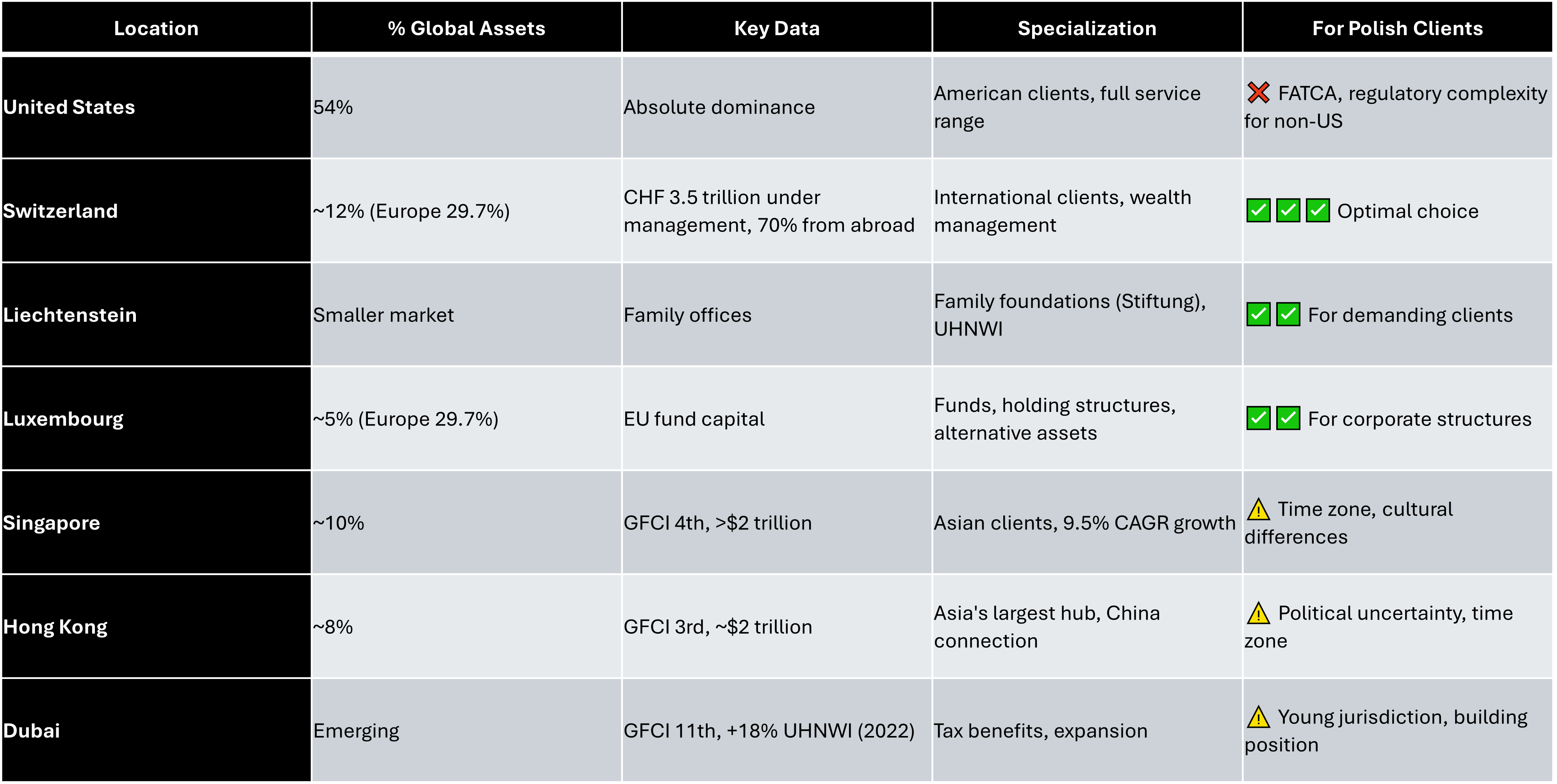
The global private banking market today manages a staggering $162 trillion in assets, with the industry itself valued at over half a trillion dollars. This is no niche sector—it is a formidable financial apparatus serving the world’s wealthiest individuals. But not all markets are created equal.

The United States dominates without question, holding 54% of global assets under management. Yet is an American private bank the right choice for a European client? Not necessarily. FATCA requirements, regulatory complexity for non-U.S. clients, and—above all—cultural differences in wealth management philosophy make it a suboptimal solution for most Polish clients.

Europe manages 29.7% of global assets, its core formed by an unshakeable triad: Switzerland, Liechtenstein, and Luxembourg. Here beats the heart of European private banking. The reasons are compelling.

Switzerland and Swiss bank accounts remains the undisputed leader—managing 3.5 trillion Swiss francs, making it Europe’s third-largest asset management center. Zurich ranks 14th in the Global Financial Centres Index, Geneva not far behind. More significantly, 70% of deposits originate from foreign clients. Swiss banks understand how to serve international clientele; they grasp the specifics of cross-border tax structures and possess deep experience with complex corporate arrangements.

Liechtenstein represents a smaller market, but no less sophisticated. The principality specializes in family offices and family foundation structures (Stiftung), offering solutions for the most demanding clients. Here, minimum deposits begin where they end elsewhere.

Luxembourg serves as Europe’s capital for investment funds and holding structures. If your wealth management strategy requires engagement with alternative assets, private equity, or complex structured instruments, Luxembourg is the natural choice.

Singapore and Hong Kong constitute Asia’s private banking centers, collectively managing over $4 trillion. Singapore holds 4th place in the GFCI, Hong Kong 3rd. These are the fastest-growing markets (9.5% CAGR), though for European clients they introduce additional complexity—time zone differences, cultural distinctions in business approach, and the necessity of understanding local regulations.

Dubai emerges as a rising player, ranked 11th in the GFCI, recording an 18% increase in ultra-high-net-worth individuals in 2022. The tax advantages are undeniably attractive, but is it wise to build a long-term wealth management strategy in a jurisdiction still establishing its position on the global financial map? That’s a question each client must answer.


Minimum deposits in Private Banking


Theoretically, you can open an account with a Swiss neobank for as little as 2,000 francs. In practice, that’s not private banking—it’s retail banking in Swiss packaging.

Authentic private banking begins where standard banking ends. And it requires capital.

Julius Baer—one of the oldest and most prestigious Swiss institutions—requires a minimum of 1 million Swiss francs. Pictet expects 800,000 to 1 million. Lombard Odier similarly. UBS Private Banking formally accepts clients from 250,000 francs, but in practice—if you want access to the full range of services and a dedicated relationship manager—you must think in considerably higher figures.

Mid-sized banks like J. Safra Sarasin, EFG International, and Union Bancaire Privée offer entry points between 500,000 and 1 million francs. These remain significant sums, but more attainable for a broader circle of entrepreneurs and professionals.

A caveat: these are minimums for clients with standard risk profiles. If you’re a politically exposed person, resident of a country with a low corruption perception index score, or operating in a sector deemed high-risk, prepare for requirements reaching 5–25 million Swiss francs. This isn’t discrimination—it’s the economics of due diligence. The bank must invest considerably more time and resources verifying such clients, and those costs must justify themselves.


Entry Thresholds at Major Banks


Private Banking or Traditional Banking

What are the diferences? What Makes a Private Bank “Private”?

This isn’t merely a matter of deposit size. Private banking represents an entirely different philosophy of client service.

In standard banking, you’re an account number. In private banking, you’re a partner in a long-term relationship. Your relationship manager isn’t a financial product salesperson—they’re the architect of your wealth strategy. They know your family, your goals, your anxieties. They know you plan to transfer your company to your son in 5 years and are already constructing a structure that will enable this with minimal tax costs. They know your daughter is studying in London and proactively propose opening a sterling account to fund her education.

This is bespoke service. You don’t receive a standard “balanced” or “aggressive” portfolio. You receive an investment strategy accounting for your tax situation, life plans, risk tolerance, short- and long-term objectives, and liquidity needs. And this strategy evolves alongside you.

Research from the University of St. Gallen reveals that two business models perform optimally in private banking. First: large, international banks with comprehensive service offerings—their average return on equity (ROE) reaches 11.4%. Second: small, highly specialized niche banks achieving 9.6% ROE. Intriguingly, mid-sized banks attempting to be everything to everyone barely exceed 4.4% ROE.

What does this mean for you as a client? Seek either at the top or in the niches. Either choose a global giant like UBS, J.P. Morgan, or Julius Baer—with reach, technology, and capacity to handle the most complex requirements. Or select a small, highly specialized player who thoroughly understands your specific situation—whether that involves managing wealth from tech exits, succession planning for family enterprises, or asset structuring for individuals with multiple tax residencies.


The reference system in Private Banking

– why You need it


Why You Can’t “Apply Online”


Try finding an “Open Account” button on Julius Baer’s website. You won’t. This is no accident.

Elite private banks don’t accept clients “off the street.” Not because they’re snobbish (though a certain element of that exists), but because onboarding a new client is a complicated, time-consuming, and expensive operation. The bank must conduct comprehensive due diligence, verify the source of wealth, assess risk profile, and ensure the client doesn’t generate excessive compliance risk. This demands resources—resources banks won’t waste on clients who may prove unsuitable for various reasons.

Hence private banks operate on a reference system. You need someone to introduce you. Someone the bank knows and trusts. Someone who can vouch that you’re an appropriate client—that your wealth derives from legitimate sources, that you understand the rules of engagement, that you’ll be a valuable, long-term partner.

This may sound archaic in the era of digital banking. But it makes profound sense. The reference system serves as a quality filter—a pre-selection mechanism saving time for both the bank and prospective client. Without appropriate references, you might spend months preparing an application only to receive a polite “no, thank you.”


The Role of Professional Advisory: Why Intermediation Pays Off


This is where Kancelaria Prawna Skarbiec enters the picture. For 20 years, we’ve maintained formal partnership relationships with over a dozen financial institutions in Switzerland, Liechtenstein, and Luxembourg. These aren’t casual acquaintances—they’re long-standing, proven partnerships built on mutual trust and documented quality of the clients we introduce.

When you come to us, you don’t need to:

  • Guess which bank suits your situation
  • Waste time on applications destined for rejection
  • Worry about documentation gaps
  • Risk compliance problems


We already know which bank specializes in real estate sector clients, which offers the finest service for technology entrepreneurs, which is most receptive to Central and Eastern European clients.

Our offer


But our role extends far beyond simple introductions. We prepare you for the process.


Situation Analysis: We first conduct a thorough analysis of your wealth, tax, and life circumstances. Where does your wealth originate? What’s your tax residency? Do you have connections to high-risk jurisdictions? Are you a PEP, or is any family member? What are your goals—asset protection, growth, succession planning, geographic diversification? These answers determine which bank and solutions will prove optimal.


Documentation Preparation: Each private bank has slightly different documentary requirements. We know precisely what each institution expects and in what form. We prepare a comprehensive document package that leaves no questions unanswered—not just standard identity documents and address confirmations, but detailed wealth origin narratives, professionally prepared CVs, income verification documents, company ownership structures, and tax returns. Everything formatted to minimize follow-up questions and accelerate the process.


Tax Compliance Verification: Before you even submit an application, we ensure your tax situation is crystal clear. A Swiss account poses no problem if you report it correctly in Poland. But if you have any arrears, undeclared income, or ambiguities in your filings—these must be resolved BEFORE, not AFTER, opening an account. CRS and FATCA mean automatic information exchange. The bank will report your account to Polish tax authorities. If gaps exist in your filings, they will surface. We help identify and close these gaps before they become problems.


References: This is the key that opens doors. Our letters of recommendation aren’t formalities. Banks know that when we recommend a client, it means they’ve passed our own due diligence, their situation is transparent, they understand the rules and will be a valuable, long-term partner. This dramatically increases your acceptance chances and accelerates the process.


Communication Support: Even if you speak fluent English, private banking language is a distinct dialect. We serve as translators—not just linguistic, but cultural. We help you understand what the banker is really asking, which information is crucial, how to present your situation in ways that build trust.


Long-term Strategy: Account opening is merely the beginning. Private banking’s true value reveals itself through a multi-year relationship. We help build this relationship from the start—selecting structures that will serve not just today, but 5, 10, 20 years hence. Succession planning, tax optimization, corporate structures—all require a holistic approach considering not just current circumstances but future scenarios.


ESG in Private Banking


Passing Trend or Permanent Shift?

ESG is no longer a niche concern for idealists. It’s mainstream in global private banking.


Why ESG Matters:

  • Younger clients (Millennials and Gen Z) demand investment alignment with values
  • Older generations understand ESG as long-term risk management
  • Companies ignoring ESG criteria represent riskier investments


Companies disregarding climate change, social tensions, or weak corporate governance are simply riskier investments over the long term. Corporate scandals, ecological disasters, consumer boycotts—all translate into share value. ESG isn’t about sacrificing returns—it’s intelligent portfolio management.

The finest private banks have already built sophisticated ESG platforms offering not just exclusion of “sin” sectors but active impact investing—investments generating measurable positive social or environmental impact while maintaining attractive returns.

Trends in Private Banking

What to watch when choosing foreign bank


The Future: Consolidation and Specialization

The number of private banks in Switzerland is declining—from 85 at the start of 2024 to fewer than 80 by end of 2025. Major consolidation transactions are underway. UBS acquired Credit Suisse in the sector’s largest merger ever. J. Safra Sarasin purchased 69.71% of Saxo Bank. UBP acquired Société Générale Private Banking.

This isn’t a random wave—it’s structural industry transformation. Amid rising compliance costs, declining margins, and growing technological importance, only the largest players possess the scale to invest in necessary infrastructure. Small and medium banks must either find a specialization niche or be absorbed by larger entities.

For clients, this means the private banking landscape in 5–10 years will look entirely different from today. Some institutions you work with may cease to exist in their current form. Therefore, when selecting a bank, you must assess not just the current offering but long-term stability and strategy.

5 Steps to Private Banking

Your path forward


If you’re considering private banking as an element of your wealth management strategy, here are practical steps:


Assess your situation realistically. Do you have assets justifying private banking (minimum €500,000–1 million)? Is your tax situation transparent and current? Are you prepared for a due diligence process lasting several weeks?


Define your objectives. What do you expect from a private bank? Asset protection? Growth? Succession planning? Access to alternative investments? International diversification? Different goals point to different institutions.


Organize your documentation. Gather all potentially needed documents—identity documents, address confirmations, tax returns for the last 3–5 years, documents confirming wealth sources, corporate structures, business agreements. The better prepared you are, the faster the process.


Consider professional advisory and strategic consulting. Attempting to apply independently to a private bank without appropriate references and preparation is a recipe for frustration and wasted time. A professional advisor can save you months of wandering and dramatically increase your chances of success.


Think long-term. Private banking isn’t an account you open and close based on momentary need. It’s a long-term relationship, the foundation of your wealth management strategy for years, if not decades. Choose an institution with which you can build such a relationship.


Private Banking—for whom?


Private banking isn’t for everyone. It’s not a necessity for someone with a few tens of thousands of euros in savings.

But if:

  • Your wealth has crossed the threshold where standard banking no longer suffices,
  • Your tax and asset situation demands professional, comprehensive attention,
  • You’re planning for years and generations, not quarters,
  • You’re seeking peace of mind and certainty that your assets are in capable hands


Private banking may be one of the finest investments you’ll ever make.

Not in the sense of direct financial return—though that matters too. But in the sense of peace of mind, certainty that your wealth is in capable hands, that your strategy is optimal, that you’re prepared for whatever the future brings.

And proper preparation with professional support at the outset can determine the success of the entire endeavor.


Why Kancelaria Skarbiec?


Kancelaria Prawna Skarbiec has supported clients for 20 years in accessing premier private banking institutions in Switzerland, Liechtenstein, and Luxembourg. Our long-standing partnership relationships with leading private banks enable us to offer not just advisory services, but above all references and support that open doors to institutions reluctant to accept clients without appropriate introductions.

20 years of experience in private banking

15+ formal partnerships with premier institutions

We don’t guess—we know which bank suits whom

We don’t try—we provide access through proven references

Over 200 satisfied clients

Proper preparation and professional support at the outset can determine the success of the entire endeavor.


Contact


Don’t waste time and money on experiments. Work with professionals who know the terrain.

🔑 HOW CAN WE HELP?

✅ References to banks in CH, LI, LU (20 years of partnerships)

✅ Matching the right bank to your profile

✅ Compliance documentation preparation


Complete the form and discover how you can benefit from private banking services and foreign accounts.