A foreign company is not a decision made once. It is a structure that demands fees, filings, renewals and decisions every year, and neglecting it costs more than running it. Since 2006 we have been forming foreign companies and, what matters more in practice, keeping them in good legal standing year after year: from Cyprus and Malta, through Estonia, the Czech Republic and the United Kingdom, to the United Arab Emirates and Delaware. This page describes both services, together with the rules of Polish law that determine the fate of every such structure; a fuller treatment of foreign companies is offered in our guide, available at the end of the page.
Formation and Maintenance
Two Distinct Services
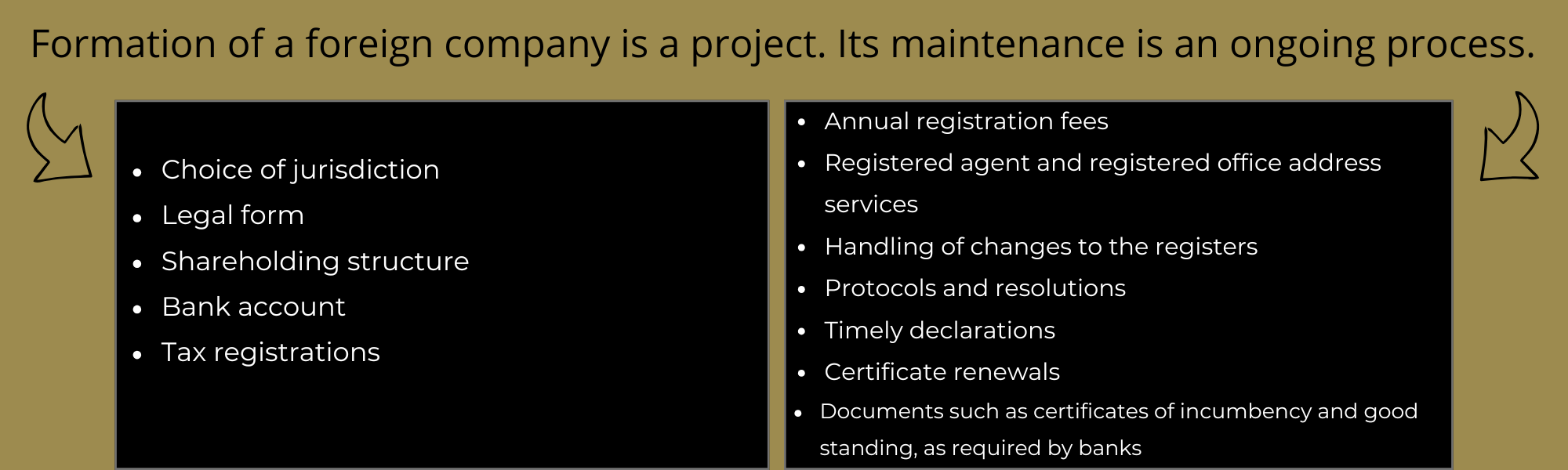
We separate two things the market tends to merge. The formation of a foreign company is a project: choice of jurisdiction, legal form, shareholding structure, bank account, tax registrations. Maintenance is a stream: annual registry fees, registered agent and registered office services, changes in the registers, minutes and resolutions, timely filings, certificate renewals, documents such as certificates of incumbency and good standing whenever a bank requests them. A client who buys only the project discovers two years later that the company has been struck off the register for unpaid fees and that restoration costs a multiple of the arrears. We handle both stages of foreign company administration and take over structures formed elsewhere.
When a Foreign Company Makes Sense, and When It Does Not
Honesty requires a sentence one will not hear from sellers of shelf companies: registration abroad does not, by itself, change the tax residence of either the foreign company or its shareholder. A company managed from Poland may be subject to Polish tax regardless of its place of incorporation, and a Polish shareholder remains within the controlled foreign company rules. Automatic exchange of information under the CRS covers more than one hundred jurisdictions and, as of 2026, extends to cryptoassets. Every structure we design therefore begins with the question of substance: who actually manages, where decisions are made, what economic purpose the structure serves. We do not defend shell companies, because their defense ends in proceedings rather than in a registry. It also happens that, once all costs are counted, the better answer proves to be an ordinary Polish company; an adviser who has not considered that variant has not done the work.

Taxation of foreign companies in Poland
Four Institutions That Determine the Fate of a Foreign Company
The fate of a Polish entrepreneur’s foreign company depends on four institutions of domestic tax law. Each operates independently of the others, and each on its own can deprive the structure of its purpose; the authority need not prevail on every front, since one suffices.
 Place of Management: Is the Company Foreign at All
Under Article 3(1) of the Polish Corporate Income Tax Act (ustawa o CIT), a taxpayer whose registered office or management is located in Poland is taxed here on its worldwide income. Since 1 January 2022, Article 3(1a) of that Act has made clear that management in Poland includes conducting the company’s current affairs from Poland in an organized and continuous manner. An Estonian or Emirati company run from a Polish home, on a Polish laptop and according to a Polish calendar is therefore, it appears beyond serious dispute, a Polish tax resident, and the evidence in such cases is mundane: the locations from which online banking is accessed, the places where signatures are executed, correspondence showing who in fact decides. The starting point of any analysis is accordingly tax residence, not the price list for registration.
 CFC: a Regime That Follows the Owner
Even a foreign company whose residence survives scrutiny may still be taxed in Poland at the level of its owner. The controlled foreign company provisions (Article 24a of the CIT Act and Article 30f of the Personal Income Tax Act, ustawa o PIT) require a Polish shareholder to pay, on a current basis, 19% of the entity’s income irrespective of any distribution, inter alia where the tax actually paid abroad is lower by at least one quarter than the hypothetical Polish tax, and, by definition, where the entity is seated in a listed tax haven. The regime extends expressly to foreign trusts and foundations. The genuine defense is the exemption for real economic activity conducted within the EU and the EEA, and it is around that exemption that sensible structures are designed.
 Beneficial Ownership and Withholding Tax
A structure begins to be tested the moment it begins to move money across borders. Treaty and directive preferences in withholding tax are available only to the beneficial owner of the payment (Article 4a(29) of the CIT Act), conducting real activity in its state of residence, and where payments to a related party exceed PLN 2 million in a tax year the pay and refund mechanism applies: the payer withholds at the statutory rate and recovers the difference only afterwards. A conduit company no longer reduces withholding tax; it increases, instead, the personal exposure of the payer’s management board.
 The General Clause and Full Visibility
The system is closed by the general clause against tax avoidance of Article 119a of the Tax Ordinance (Ordynacja podatkowa) and by the principal purpose test written into tax treaties under the MLI: an artificial construction held together solely by a tax benefit fails regardless of the formal correctness of each element taken separately. All of this operates against the background of automatic information exchange, extended from 2026 to cryptoassets under DAC8; the tax authority no longer needs to ask, because it receives a report. A structure is designed today on the assumption of full visibility, not in the hope of its absence.
Two Defenses: Substance and the Effective Rate
Four questions receive, in practice, two answers.
The first is substance: premises that are more than an address, personnel who are more than a signature, decisions actually taken locally, and costs commensurate with functions. Substance alone works against all four institutions at once, which is why we review the economic substance of existing foreign companies before an authority or a bank does.
The second is the effective tax rate: what counts is the tax actually paid, not the nominal rate. The low taxation condition is met where the tax paid abroad is lower by at least one quarter than the hypothetical Polish tax, so the line runs at 14.25%; neither the Emirati 95 nor the Irish 12.5% reaches it on its own. The advantage of a real rate over zero lies elsewhere: tax paid abroad reduces the Polish CFC charge, while release from the regime comes only from taxation above the threshold or from genuine activity within the EU and the EEA. Zero offers neither a credit nor an exemption; it triggers, instead, jurisdiction lists and banking procedures. For the same reason classic tax havens today play a specialized role rather than a universal one.
Selecting a Jurisdiction for a Foreign Company
We compare two or three jurisdictions for the foreign company against the client’s purpose, total costs over a horizon of five years, a projection of the effective rate after reliefs, substance requirements, realistic access to banking, and a calculated exit path.

Cyprus
On that map Cyprus remains a holding jurisdiction of the first rank, from 2026 with a 15 percent rate and a firm expectation that management take place locally.
Malta
Malta offers its refund system with an effective burden of roughly 5 percent, which shifts the entire weight of the defense onto genuine activity.
Estonia
Estonia taxes profit only upon distribution, a model Poland later imported into its own corporate income tax (The Estonian CIT model in Poland).
Dubai
A company in Dubai has paid, since 2023, corporate tax at 9 percent, which is still below the Polish CFC threshold; the tax paid in the Emirates does, however, reduce the Polish charge, and the real value of that jurisdiction lies in the Gulf market and in substance on the ground, not in the rate itself.
USA
A Delaware LLC is transparent for tax purposes, so its income flows directly into the Polish shareholder’s return: an excellent instrument of access to United States banking and payments, not a tax shield.
Offshore
The classic offshore world, exemplified by the BVI, has retained the role of a legal layer for funds and joint ventures.
United Kingdom
The United Kingdom levies no withholding tax on outbound dividends and allows a company to be incorporated within a day, and its rates are real, so an operating company sits comfortably above the CFC threshold.

Maintaining a Foreign Company Year After Year
For us, maintaining a foreign company mean:
- keeping the calendar of registry fees and filings in every jurisdiction,
- corresponding with registered agents,
- preparing resolutions and changes (management, address, shares, articles),
- updating beneficial ownership registers on both sides of the border,
- handling economic substance reporting where it applies,
- providing corporate documents with an apostille together with certificates whenever banks request them,
- and conducting periodic bank reviews and account renewals (foreign bank accounts).
When a foreign company is no longer needed, we carry out its orderly closure: liquidation or striking off, with settlement on the Polish side, including analysis of the exit tax on unrealized gains where assets are moved.
Forming a Company Abroad
How We Work
 We begin with an opinion, not a form: naming the true purpose, comparing jurisdictions, projecting the effective rate, and mapping the Polish consequences, from the place of management, through CFC, to withholding tax.
 Then come the registration of the foreign company, the constitutional documents, beneficial ownership filings, the bank account, VAT registrations where needed, and the handover of the structure to annual administration with a single point of contact at the firm.
 Substance is built before operations begin, because documentation reconstructed after the fact does not hold up in proceedings.
A Guide to Companies Abroad (Free PDF)
A full treatment of forming companies abroad is offered in our guide “Spółka za granicą. Sztuka budowania struktur, które przetrwają” (A Company Abroad: the Art of Building Structures That Endure): 34 chapters on the history of international structures, the four Polish institutions, substance and the effective rate, a 2026 map of jurisdictions with a comparative table, banking as the bottleneck of every structure, and a catalogue of typical mistakes. Legal status: January 2026, verified against primary sources in July 2026. Download the guide in PDF; the publication is free of charge and currently available in Polish.

Related Pages
Withholding tax in Poland: rates, preferences, due diligence of the payer.
Withholding tax agent obligations: pay and refund in practice.
The GAAR clause in Poland: proceedings and protective opinions.
DAC8 in Poland: reporting of cryptoasset transactions.
Foreign bank accounts: an account for the structure.
Trust taxation and BVI companies under the CFC rules: the offshore layer from the Polish perspective.
Company formation in Poland: the domestic alternative.
Thematic services on Cyprus, Dubai and Maltese tax residence are available in Polish.
Legal status of this page: July 2026.
Speak to a tax adviser
Skarbiec Law Firm sets up and provides services to foreign companies, and assesses the suitability of such structures. Tell us about your situation, and we’ll let you know if and how we can help.