The Tate Brothers’ Rented Wealth: Inside the Court Filings
To fight extradition, the Tate brothers are dismantling their own legend in court: the yacht was borrowed, the Bugattis rented, the billions a bit. On wealth as costume, from 50 Cent’s prop money to politics in the TikTok register.
By Robert Nogacki
In February, 2016, a bankruptcy judge in Connecticut put to the rapper 50 Cent a question that has since entered the casebooks and the culture in equal measure: if you are insolvent, what are those stacks of cash doing on your Instagram, arranged, in one photograph, to spell the word BROKE? The answer, given under penalty of perjury, was: props. Stage money, borrowed for the image, because in entertainment you have to play rich in order to earn for real.
Ten years later, on August 21st, lawyers for Andrew and Tristan Tate filed a brief in federal court in Miami that is the same sentence stretched across twenty-eight pages. The brothers, whose prosecutions across three countries I mapped in a July guide to the case, have sat in a Miami detention center since U.S. Marshals arrested them on a British extradition request that now runs to fifty-nine charges, including rape and human trafficking, all of which they deny. To fight for bail, they have had to do something stranger than deny. They have had to dismantle, on the record, their own legend: the yachts, the Bugattis, and the billions were, the defense now says, a performance. The criminal charges remain charges, and the presumption of innocence holds; this piece is not about guilt. It is about the costume: what it costs to take it off, and why it always comes off in the same room. The record here is current as of August 30, 2026.
The Inventory of a Costume
The sequence is textbook. On August 10th, federal prosecutors, arguing for continued detention, built their flight-risk case largely out of the brothers’ own material: their declarations of billionaire status, of a custom fifty-million-dollar superyacht and unrestricted access to cryptocurrency, of multiple passports and identities, including a Mexican document in the name Vladimir Scorpius. On August 21st, the defense replied with a twenty-eight-page brief itemizing its own scenery: the superyacht Obsidian Blade, per industry reporting a forty-one-meter hull still under construction at a Turkish yard, does not belong to the brothers, who were paid to promote it; the Bugatti valued at five to seven million dollars and the Aston Martin at 2.1 million were rented; the valuation of the watch collection comes from an enthusiast publication; and the market capitalization prosecutors cited for the meme coin DADDY describes every coin in existence, while the defendant, the brief says, did not create the coin and holds about one per cent of it, worth some seventy thousand dollars by the brief’s own arithmetic. The furthest-reaching argument, though, concerns authorship: the passport-and-identity posts the government cites most, the brief says, came from a parody account Andrew never ran, while what he did publish was “obvious satire, hyperbole and promotion”, and in the courtroom defense counsel compared the creation to Sacha Baron Cohen’s Ali G. The American complaint adds a counterpoint the defense will have to dislodge: the messages Complainant A exchanged with Andrew in 2015 ran, per the document, through @CobraTate, the same account that posted the brothers’ photograph outside the Capitol on July 14, 2026, and pointed the Marshals their way; one account, eleven years, two roles in the record. The purpose is stated outright: to appear influential and excessively rich in order to sell their products, Hustler’s University memberships first among them. That sentence will come back to us.
On August 27th came the detention hearing: nearly eight hours, with both brothers testifying, a rarity in extradition practice, since every word under oath can travel to three jurisdictions at once. The brothers, brought in shackled, argued that their fame makes flight impossible; the government answered with the strong presumption against bail in international extradition cases. Magistrate Judge Lauren Louis will rule in writing; Britain has until September 16th to deliver its evidence to the State Department, and no date has been set for the extradition hearing itself. For the record: the inventory of scenery is, for now, the defense’s account, not a court’s finding.
The procedural paradox is visible to the naked eye. One cannot be a billionaire for the algorithm and a man of modest means for the judge; both messages are party statements, and each works against the other. The prosecution quotes the boasts, the defense quotes the leases, and between the two hangs the credibility of everything the brothers have ever said in public, protestations of innocence included. In the July guide I quoted the passage of the Romanian indictment in which Andrew Tate brags of passports from several countries and bank accounts in nineteen; prosecutors in three legal systems are now reading the same tapes, and the defense has one answer for all of them: it was theatre. The reply addresses that very tape: the video in which Andrew lists passports from Estonia, Nigeria, Poland, the U.K., and the U.S. was, it says, a joke, delivered in a fake Nigerian accent. The real inventory, declared in the same brief, also numbers five, only different ones: an American and a British passport per brother, plus Andrew’s Vanuatu document, all of them, counsel assures the court, sitting in the lawyers’ custody, ready to be surrendered. Five passports in the sketch, five in the firm’s safe; the distance between the two sets is the whole case. Even the Mexican document in the name Vladimir Scorpius turns out, in the reply, to be a cardboard prop from a Halloween costume, christened after the villain of a 1988 Bond novel: the costume, for once, literal. A law-office Occam’s razor predicts what follows. When the choice is between the brand and liberty, the brand goes under the hammer.
Finally, the reply reaches for the brothers’ own sworn testimony, given in April, 2026, in the Florida civil case and attached as exhibits. Top G, Andrew testified, is a character who exaggerates for comic effect; the trillionaire title is hyperbole; and he supplied the punch line himself: “I also said I was an astronaut, but I’ve never been to the moon.” Tristan testified that he publicly backed his brother’s claim to be the world’s first trillionaire, and that, of course, it was a lie. On the other pan of the scale the brief sets numbers the government does not dispute: 1,193 days under judicial supervision, thirty-four international departures and thirty-four returns, zero failures to appear, and the observation that most of the estate sits seized by the Romanian authorities anyway. It is hard to imagine better cross-examination material than a sworn statement that one’s own words are not to be believed; and hard to imagine a better defense answer than a calendar in which every one of thirty-four trips ends in a return.
Three Jurisdictions, One Appraisal
Miami is not the first room where the costume has come apart. Romanian investigators, combing the brothers’ finances in 2023, identified and seized assets worth around twelve million dollars, properties, cars, watches, cash, and company shares, a fraction of the figures claimed in public; the first January tranche alone included a fleet of cars and assets worth nearly four million, and some of the freezes were later lifted on appeal. In London, in December, 2024, came the hardest financial finding of the whole saga: Chief Magistrate Paul Goldspring ruled, in civil proceedings on the balance of probabilities, that the brothers had paid no tax at all on twenty-one million pounds of revenue earned between 2014 and 2022 through War Room, Hustlers’ University, the Cobra Tate brand, and OnlyFans accounts; what looked like a complex financial matrix he called a “straightforward cheat” of the revenue, long-standing and deliberate. Police in Devon and Cornwall collected nearly £2.7 million from seven frozen accounts, including money routed through an account in the name of a person identified only as J. August, 2025, brought the encore: the forfeiture of a £180,000 deposit on an Aston Martin Valhalla, placed back in July, 2021, and paid from a cryptocurrency account with funds on which no tax had been paid. The brothers did not even oppose the orders. And there is a fourth room, with irony to match the other three: on June 26th, London’s High Court, refusing the brothers the complainants’ identities before surrender, held the rejection of their financial undertakings obviously rational in part because the brothers, in Mr Justice Chamberlain’s words, “give every appearance of having considerable resources” (paragraph 43 of [2026] EWHC 1600 (Admin)). In June, the appearance of wealth was a rational basis for judicial caution; by August, in Miami, the same facade was being filed as scenery. Both propositions cannot be true at once, but both have already done work in the record.
Set the four scenes side by side and one observation generalizes. The attention market prices the narrative; the court prices the estate. The spread between the two can run to two digits, and settlement always falls due at the least convenient moment, because a court, unlike an audience, asks its questions under oath.
The Mannequin: A Sociology of the Shop Window
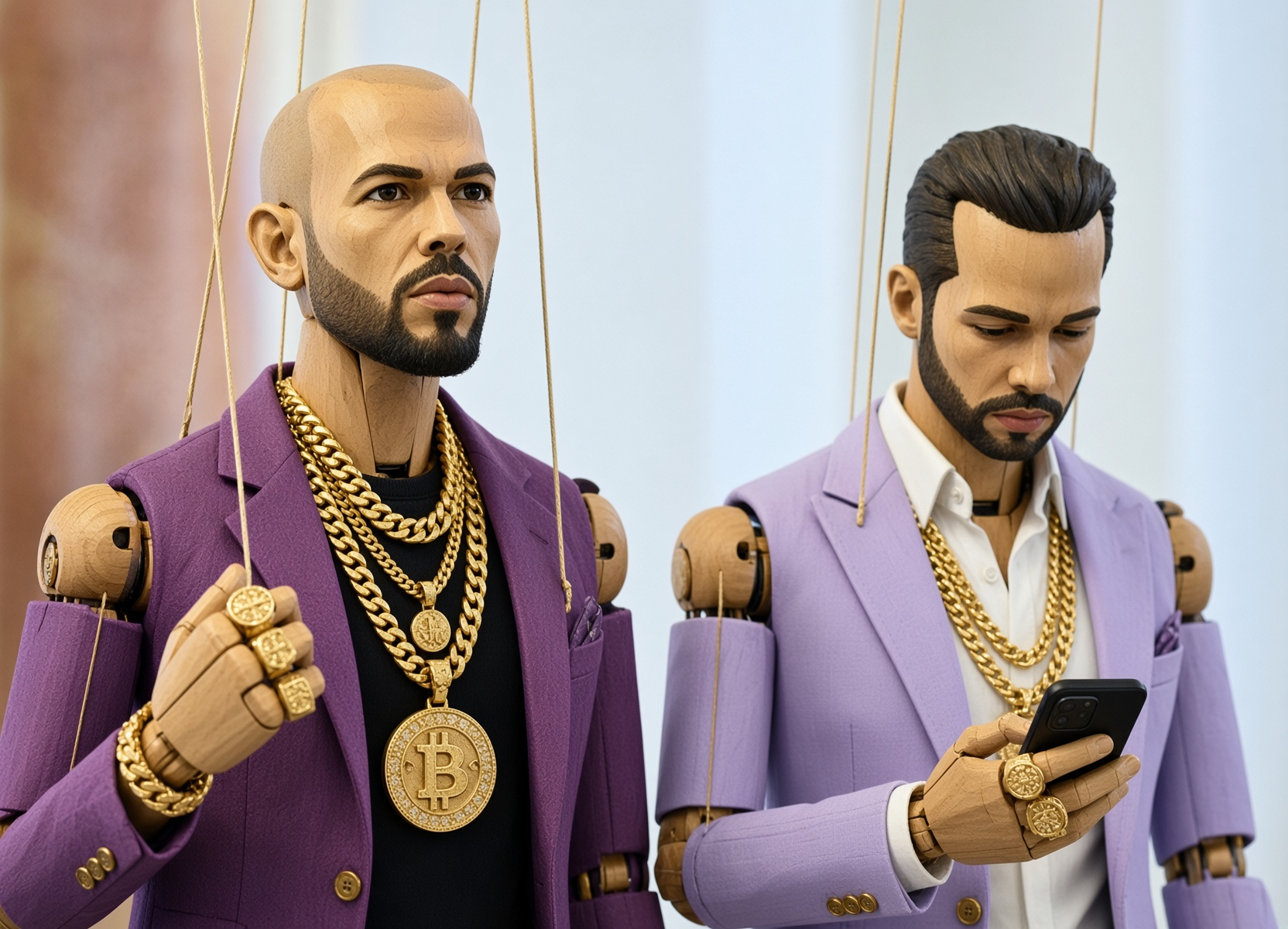
Let us name the thing precisely, because legal liability depends on the precision. An influencer in the attention economy performs the function of a mannequin: not the owner of the display but its carrier. The mannequin in the window does not own the suit it wears; its job is to make a passerby buy one. Thorstein Veblen described conspicuous consumption as a signal of status more than a century ago; the platforms made one correction to his theory, and it is fundamental. The signal stopped being a consequence of wealth and became a customer-acquisition cost. A rented Bugatti is not a caprice; it is an expenditure on credibility, booked where advertising used to be. In July I reached for Erving Goffman and his total institution; this month his earlier book, on the presentation of self, is the useful one. There is a front stage and there is a backstage, and the influencer’s profession consists in making sure the audience never sees the second. Professional wrestling has a word for the pact this requires, kayfabe: a fiction maintained jointly by performer and audience, because it pays them both. The parasocial viewer is not buying facts. He is buying access to a character.
And here we reach the boundary that sociology cannot draw and law can. A mannequin does not lie; a mannequin displays. The lying begins when the shop sells passersby a course titled How to Become the Mannequin, assuring them that the suit belongs to the mannequin and that anyone can have one just like it. The Miami brief, recall, states that the performance of excess wealth served to sell memberships. Marketing calls that building aspiration. The civil and criminal codes of several jurisdictions have other names for inducing payment by misrepresentation.
Who the man in this window is depends on the room in which he is read. Under oath, a comedian playing a character; in the Romanian experts’ reports, a patient player who made financial dependence the price of trust; in London, a man with every appearance of considerable resources; in Bucharest, in his own last word of March, 2024, a son and father staying to prove his innocence for his daughters’ good name. The shop window has four panes and a different man in each; who the Tates are according to the files is a subject I take up separately, and it is enough to note here that none of these images was produced off the record.
Precedents: 50 Cent’s Bankruptcy and the School of Props
The history of costume removal is worth knowing, because it repeats in the details. Curtis Jackson, professionally 50 Cent, filed for bankruptcy in July, 2015, days after multimillion-dollar judgments landed in two separate cases; during the proceedings he kept posting photographs of banded cash in his refrigerator and on his bed, until Judge Ann Nevins demanded to know how this squared with declared insolvency. The answer, on the record and noted by the Times: the bills were props, standard equipment of video sets, because the industry requires the playing of wealth. A confirmed plan of some twenty-three million dollars followed; he paid roughly twenty-two million ahead of schedule and was discharged in February, 2017, and the lesson stayed in the docket: the bankruptcy court is the only audience that demands receipts. Anna Sorokin, who performed as the heiress Delvey, showed the opposite pole of the same phenomenon. Her display of wealth was not advertising; it was collateral, against which hotels and banks extended real credit, which is why it ended in felony convictions rather than mere embarrassment. Ramon Abbas, Instagram’s Hushpuppi, closed the trilogy: his daily exposition of jets and watches was simultaneously the marketing of his frauds and, as it turned out, a ready-made evidentiary record, which investigators read like a ledger. He got a hundred and thirty-five months, a little over eleven years.
The legal common denominator matters more than the anecdotes. Social media posts are party statements. They may remain harmless exaggeration only so long as nobody makes financial decisions in reliance on them and their author does not assert the opposite before a tribunal. The Anglosphere polices this with estoppel; the Continent, with the old prohibition on coming against one’s own prior act, venire contra factum proprium. Both reduce to a sentence that ought to hang over every recording studio: you may not be rich for the audience and poor for the creditor on the same set of facts.
What This Means in Practice
First, archiving. The performance disappears faster than the assets: posts get deleted, accounts scrubbed, and it is precisely the adversary’s display that makes the best material in asset-concealment cases, in freezing applications, in solvency disputes. Anyone litigating against a debtor who lives out of a shop window should be preserving the exhibition as it happens, in a form a court will accept, before it vanishes. Second, the tax authorities. Polish law, where I practice, taxes income from undisclosed sources at a punitive seventy-five per cent, and the gap between an on-screen lifestyle and the filed returns is a natural point of entry for an audit; the British saga shows that the civil standard of proof is quite enough for the costume to be appraised and collected. Third, enforcement. A rented empire is an empty estate: the creditor who sues the mannequin discovers that the suit belongs to the shop, which is why verifying title to displayed assets should precede any decision to extend credit, invest, or settle with a counterparty of this species. Fourth, the students. Since the defense brief itself ties the fabrication of wealth to the sale of memberships, plaintiffs’ lawyers in many jurisdictions will now ask a simple question: is “get rich like me,” coming from a man who now says he was not, still permissible puffery, or a misrepresentation of the very trait on which the whole transaction was built? The answer will arrive case by case. But the source material has just been produced, by the interested parties themselves.
Politics in the TikTok Register
One observation reaches past this case, though the case illustrates it better than a textbook could. On August 27th, outside the courthouse in Miami, supporters of the brothers did push-ups for the cameras; inside, at the same hour, counsel was explaining that the entire aesthetic of strength and riches had been satire, never meant to be taken literally. It is hard to imagine a purer miniature of the era: the performance continues outside at the exact moment it is being retracted inside, because the audience and the court are two markets, trading in two currencies.
The trouble is that the logic which bred this model did not stop at influencers. Contemporary political communication, across divides and across borders, has absorbed the grammar of the platforms: the clip beats the transcript, engagement beats accuracy, and kayfabe, the jointly maintained fiction, has become a technique for governing attention. A politician optimized for the next clip and an influencer optimized for the next subscription practice the same trade in different costumes; both answer to an algorithm that rewards the performance, and both, sooner or later, meet a room in which the performance is subject not to monetization but to a transcript. In July I wrote that in cases on the border of law and politics the noise is the press conferences and the signal is who signs the requests. August supplied the rule’s second half. The courtroom is one of the last rooms where reach is not a currency, and that is why the independence of that room is not constitutional decoration. It is critical infrastructure, on both sides of every dispute.
What comes next: Judge Louis’s written ruling on bail, the British evidence at the State Department by mid-September, a certification hearing after that. What is certain: the brothers remain in custody, and their finances now exist in two mutually exclusive versions, both of their own authorship. What is probable: the modest version will follow them for years, because every creditor, tax office, and victims’ lawyer will quote it from now on. What is uncertain: whether an audience that paid for the show will keep paying once its directors have stated, on the record, that the scenery came from a rental house.
Further reading on Tate brothers
Robert Nogacki is an attorney and the managing partner of Kancelaria Prawna Skarbiec, a Warsaw law firm whose practice includes representing victims of large-scale financial fraud. This account reflects the court record and public reporting as of August 30, 2026 (United States v. Tate, S.D. Fla., Nos. 1:26-mj-03259 and 1:26-mj-03260; the docket and the defense reply are available on CourtListener; deposition quotations follow Exhibits 10 and 11 to the August 21st reply; the full judgment in [2026] EWHC 1600 (Admin) and the Bucharest Court of Appeal’s sentence of March 12, 2024, the July 22 complaints, and the government’s August 10 detention memorandum are on file with the author). The findings of the British tax proceedings are a final civil ruling, made on the balance of probabilities; the criminal charges in all three countries remain allegations, which the brothers deny. The history of Curtis Jackson’s bankruptcy is drawn from the widely documented record of 2015 to 2017. Claims resting solely on press reporting are flagged and linked in the text.

Robert Nogacki is a Polish attorney at law (radca prawny), the founder and managing partner of Kancelaria Prawna Skarbiec (Skarbiec Law Firm), which has operated continuously since 2006.
The law is equal for everyone, but the parties rarely are: on one side stands an organization with time, money, and lawyers, on the other a person with one business, one nest egg, and one life.
Clients rarely come to him with a legal problem. They come with a problem that also has a legal side: an audit that began with a single invoice, money entrusted to someone who has disappeared, a company that has to be passed on before it is too late. Most such matters are decided long before the first letter is written, in decisions made without asking and in deadlines nobody remembered. So he begins by asking how the client got here, not what the client should have done.
He advises entrepreneurs and families from more than a dozen countries, including those whose accounts the tax office has just seized and who do not know what to do tomorrow morning. He defends them in tax audits, customs and fiscal inspections, disputes with the tax authorities, and criminal tax proceedings. He represents victims of investment fraud and Ponzi schemes. He helps families set up family foundations and plan succession, so that a life’s work outlasts a single generation.
Not every case can be won. Every case can be run so that the client knows where they stand. Since 2006 he has represented the victims in the WGI case (Warszawska Grupa Inwestycyjna, the Warsaw Investment Group), one of the longest criminal cases in the history of the Polish financial market, because some things must not be left half finished, even when they take two decades. In the case of the collapsed cryptocurrency exchange Zonda (Zondacrypto, operated by BB Trade Estonia OÜ), he represents several hundred victims in the criminal investigation conducted by Poland’s National Prosecutor’s Office and in the Estonian bankruptcy proceedings.
Kancelaria Prawna Skarbiec is listed in the rankings of Poland’s largest tax advisory firms published by Dziennik Gazeta Prawna and Rzeczpospolita, and it is a four-time recipient (2015 to 2018) of the European Medal awarded by the Business Centre Club and the European Economic and Social Committee. Robert Nogacki publishes regularly, in the press and on the firm’s website, for people who have a problem rather than a law degree, because a legal opinion the client cannot understand protects only the lawyer.
He believes that the best legal advice is the kind that means the client never has to appear in court.