In Defence of Moses. What the Torah knows about Egypt, and who could have known it
The critics proved that Moses did not write every word of the Torah, and they were right. This essay asks a different question: how a book supposedly composed in Jerusalem six centuries later knows how bricks were counted under Ramesses II, the name of a city dead for hundreds of years, and the name Yhw, written by Egyptians on a map of the desert before Israel appears in any record. From that knowledge an author can be reconstructed, and he is more real than his critics allow.
The clerk and the bricks
In the fifth year of Ramesses II, the same year in which the pharaoh fought the Hittites at Kadesh and afterwards had a poem about his victory carved on the walls of five temples, a clerk at the other end of the kingdom sat down with a leather roll and recorded that a brickmaker called Paherypedjet, son of Paser, had failed to deliver his two thousand bricks. Forty junior officers appear on the same roll, each answerable for the same figure, and the document survives in the Louvre because leather is durable and bureaucracy is patient. The year is 1274 BCE. Nobody remembers Paherypedjet for anything he did. He is remembered, three thousand years on, for falling short.
I begin with him because the Egypt of the Book of Exodus is his Egypt before it is anyone else’s. It is not, in the first instance, a land of sorcerers and plagues. It is a land of quotas. The Hebrew foremen are beaten because the count is low. The people scatter across the fields to gather stubble because the straw has been withheld and the quota has not been reduced. Moses’ first confrontation with Pharaoh is a petition for time off to hold a religious festival, and Pharaoh’s first reply is the reply of every site manager in history: you are idle, that is why you want a holiday. Exodus may be the only sacred text in the world in which the shortage of a building material is a matter of theological consequence. A papyrus of the Anastasi collection, a set of model letters on which apprentice scribes practised at the end of the same century, preserves an official’s complaint that there are no men to make bricks and no straw in the district. The author of the model was not thinking of the Hebrews. That is rather the point.
The question I want to ask is not the question usually asked about Moses, which is whether the sea parted. It is a smaller and more answerable question: who knew about the straw? Who knew the name of the city the slaves were building, the price of a dead slave, the address of the god who lived among the desert nomads south of Canaan? The Torah knows these things. Somebody put them there.
For the question to make sense, the quarrel it enters needs a word of introduction. The Torah, in Greek the Pentateuch, is the first five books of the Bible: Genesis, Exodus, Leviticus, Numbers and Deuteronomy. For more than two thousand years Jews and Christians took it for granted that Moses wrote them, the man who led the Israelites out of Egypt and gave them the law at Sinai; people simply said “the law of Moses.” Doubts had been raised for centuries, but they were put into a system only in the seventeenth century and then in the nineteenth. Baruch Spinoza wrote in 1670 that the Pentateuch was compiled by Ezra, a priest of the fifth century BCE, rather than by Moses. Two hundred years later the German scholar Julius Wellhausen, in his Prolegomena to the History of Israel (1878), took the Torah apart into four documents written in different centuries and woven together by later editors; the youngest of them, the so-called Priestly source, concerned with ritual, genealogies and the sanctuary, he placed after the return from the Babylonian exile, which is to say some seven hundred years after the age in which Moses was supposed to have lived. His pupils and his opponents still quarrel about the number of documents and their order, but on one thing they agree: the Torah as we have it grew in layers, and its final edition is usually dated to the Persian period, between 539 and 332 BCE. That is the position of most biblical scholars in the universities today, and it is the position I mean to argue with. Many have gone further and concluded that Moses himself is a figure of legend, like Romulus; others allow a historical figure behind the traditions while rejecting his authorship.
To argue with, not to shout past. My claim is that when you reconstruct the man who knew about the straw, from the knowledge alone and without any help from piety, he turns out to look a great deal like the man the book says he was. I do not defend him because he stands in the Bible. I defend him because he stands in the bricks, in the name of a dead city and in words that nobody in Jerusalem knew. But first the reasons why so many intelligent people think otherwise deserve to be laid out fairly.
The case against Moses
Give the other side its due, because it has earned it, and because a case that hides the strength of its opponent is a case that expects to lose.
The strongest argument against Moses does not come from Wellhausen or from his method, which is called source criticism: the detection of several older documents inside one text by differences of style and vocabulary and by stories told twice in divergent versions. The strongest argument comes from the Torah itself. Christopher Rollston, an American epigrapher, which is to say a scholar of ancient inscriptions, who happens to believe in a historical Moses, has made it with admirable economy. The Pentateuch never says that Moses wrote the Pentateuch. It says he wrote particular things: a memorandum about a battle with the Amalekites, the words of the covenant, the terms of its renewal, a list of desert campsites, a song, and “this torah,” which in Deuteronomy means the law Deuteronomy expounds. Everything else is told about him, in the third person, some six hundred times. The Book of Numbers (12:3) informs us that Moses was the humblest man on the face of the earth, which is not a sentence a humble man writes. The last chapter of Deuteronomy buries him and adds that no prophet like him has arisen since, and that “since” needs a good deal of time to mean anything. Genesis remarks that the Canaanites were “then” in the land (12:6), and lists the kings of Edom who reigned “before any king reigned over the Israelites” (36:31), though Israel’s first king, Saul, lived two centuries after Moses. Deuteronomy points to the bed of Og, king of Bashan, as a curiosity still to be seen in Rabbah of the Ammonites (3:11), the way a provincial museum keeps a giant’s boot. The book cites its sources, among them a Book of the Wars of the Lord (Numbers 21:14) that nobody has opened for three thousand years.
Behind this stands source criticism with its two creation stories, its two floods braided into one, its three law collections that revise each other (the Covenant Code in Exodus 20 to 23, the laws of Deuteronomy, and the so-called Holiness Code in Leviticus 17 to 26), and its Priestly voice with a vocabulary of its own. Behind that stands archaeology. No Egyptian text mentions an exodus of Israelites. No camp in Sinai has been identified as a camp of that migration. Israel, when it finally appears in the land, looks like a people that grew out of hill villages around 1200 BCE rather than one that marched into them. There are Philistines in the story, even in Abraham’s day, though that people arrived on the coast of Canaan only around 1175. There is a Ur “of the Chaldeans” (Genesis 11:28), though the Chaldeans appear in Babylonia only in the ninth century. The child in the basket on the river recalls the birth legend of Sargon of Akkad, a Mesopotamian king of the twenty-third century whose mother also committed him to the river. And there is, most recently, the matter of Moses’ name, to which I will come, because the one Egyptian thing about Moses that everybody agreed on has just been taken away.
All of this is true, and, what matters more, none of it is new or foreign to the tradition. One opinion recorded in the Talmud gives the last eight verses of the Torah, the account of Moses’ death, to his disciple Joshua; another has Moses write them in tears. Abraham ibn Ezra, a Spanish grammarian and commentator of the twelfth century, hinted at his “secret of the twelve,” listed half a dozen verses Moses could not have written, and went on believing Moses wrote the rest, which is roughly what I shall end by believing too. Spinoza took the hints and made a system of them. The critics have won the argument they set out to win, and they have won it by reading the Torah with a care its friends have not always shown it: Moses did not write every word of the book that bears his name. What interests me is what happens next. Rollston, having proved that the Torah does not claim Moses as its author, adds in the same breath that he takes Moses to be a real and literate man and the exodus of slaves to be an event. The two camps, it turns out, are divided less by evidence than by a word. That word is worth fighting for. Moses was struck out of history not because evidence was found against him but because none was found for him, and of Bronze Age men who were not kings we usually have none at all. This one left a trace in a language, in a law and in the memory of a people who would have preferred to remember something more comfortable.
The word “author” and the rules of the game
The word is “author,” and lawyers know something about it that literary critics have forgotten. A code belongs to the authority that gives it force, not to the clerks who drafted it or to the later clerks who annotated it. Hammurabi, a Babylonian king of the eighteenth century BCE whose laws stand carved on a stela in the Louvre, did not cut them into the black stone himself, and they did not stop being his when schoolboys were still copying them a thousand years later. The Digest of Justinian, the Byzantine emperor of the sixth century, was compiled by a commission under Tribonian from the writings of earlier jurists, and it is Justinian’s. The Code Napoléon was written by Portalis and three colleagues, has been amended without pause for two hundred years, and nobody thinks its name is a lie. The Latin auctor is the man who confers authority. When the books of Joshua, Kings and Ezra speak of “the law of Moses,” this is the kind of thing they mean: that Israel’s law took its force from the lawgiver who received and promulgated it, and that a written deposit going back to him existed and was kept. Whether his own fingers formed every letter is a question the ancients would have found odd, as we should find it odd to ask which of Napoleon’s fingers held the pen. The analogy explains what authorship without an autograph could mean. It does not show that the act of promulgation took place in Moses’ lifetime; that has to be argued separately.
So the question becomes: is there a deposit, and does it carry fingerprints? Here is how I propose to look. Imagine three candidates for the author of the Torah’s core, and give them names. The first is the Levite: a member of the tribe from which the Torah draws its priests, a man who had lived in Egypt under the Ramessides, the pharaohs of the Nineteenth and Twentieth Dynasties who ruled from about 1295 to 1070 BCE, and who stands on the plains of Moab, on the east bank of the Jordan opposite Jericho, in the thirteenth century, dictating to someone who can write. Whether he grew up at Pharaoh’s court, as the story of the child in the basket has it, I do not assume; I will come back to that as an auxiliary hypothesis. The second is the Scribe: a learned writer in Jerusalem in the seventh century, or in exile in Babylon, or in the little Persian province of Yehud into which Judah turned after the return from exile, working from imagination and from the general knowledge of Egypt that any educated man of his day possessed, six or eight centuries after the Levite. The third is the Heir: the same late writer, but a compiler of older material, oral and written, documents of various ages none of which need come from Moses, which he believes and whose colour he preserves. The Heir is a more serious rival than the Scribe, and it should be said at once, so that the frame is not rigged for a win: everything that distinguishes the Levite from the Scribe distinguishes the Heir from the Scribe as well, and between the Levite and the Heir only one question decides, whether what came from Egypt came as memory or as a document. I come to that question at the end; until then, when I write “Scribe” I mean the writer without a tradition, and where the evidence fits the Levite it fits the Heir too. Take everything the Torah knows and ask, of each item, which of them is more likely to have known it.
The rules of the game are set in advance, so as not to change them while playing.
First: I do not ask who could have known something, since a sufficiently determined Scribe could have known anything; I ask who is more likely to have known it. A fact both would know equally, the mere Egyptian colour available to any inhabitant of the Levant in any century, counts for nothing. A fact that had no living referent after 1100 BCE counts for a great deal.
Second: I sort the evidence into three classes and I name the class of each item. There is evidence that discriminates between the two candidates. There is evidence that fits the Levite but that the Scribe could have known too, and so decides nothing. And there is evidence that tells against the Levite. The easiest cheat in this genre is to pass off consistency as proof.
Third: the facts come out of different drawers, place names, labour practice, vocabulary, personal names, the address of a god, and a rival must open each drawer separately. “Canaanites traded with Egypt” explains the loanwords and not the Levite names; “scribes like to sound archaic” explains the missing Jerusalem and not the surviving city that no scribe had heard of. The price of the rival theory is the product of its excuses, unless one channel explains every drawer at once; the only channel that does is inherited old material, and that is the Heir’s case, not the Scribe’s.
Fourth: of every detail from the age of Ramesses I ask what it would have cost the Scribe to get right and what it would have earned him. The answer is sources he would have had to go looking for, for an audience that could not check him and would not have cared, in a literary culture that placed no value on period accuracy. A writer working from imagination takes pains where his readers can check him and none where they cannot. High cost and no payoff is not how imagination works; it is how memory works.
Fifth: I ask where the mistakes are. If the book is an old core with later notes, the anachronisms should fall where the annotators lived and be absent where they did not. If it is a late fiction, the mistakes should be everywhere, or thickest in Egypt, where the fiction writer knew least.
Sixth: I say in advance what would sink me. A demonstration that the name Rameses was in use in the seventh century for a city in the Delta. An attestation of the Egyptian name for a certain papyrus marsh, of which more below, in texts of the first millennium. A Persian loanword in the Covenant Code. A demonstration that the three Levite names I treat as Egyptian are not Egyptian. A demonstration that the legal corpus of Deuteronomy, chapters 12 to 26, is wholly a composition of the seventh century rather than older material reworked then. A demonstration that the Covenant Code of Exodus was composed wholly in the monarchy or later, with no older material in it, for instance from the Laws of Hammurabi in the Assyrian age, as David Wright argues. And one constraint on my own theory: the narrator’s notes I allow must stay few, short and detachable; a reworking of the law by custodians is a different thing, one I allow and one the book itself announces in Deuteronomy as a second exposition, but every such allowance shrinks what I defend and must be counted, because a theory that can call any inconvenient verse a note has stopped being a theory and become a habit.
What discriminates: Egypt
Begin with the map. The slaves build a store city called Rameses, and the exodus departs from Rameses (Exodus 1:11; 12:37). The city is Pi-Ramesses, “the House of Ramesses,” the capital Ramesses II raised in the Delta near the modern village of Qantir, on a site his father Seti I had begun, and made his capital around 1270 BCE, on the eastern, Pelusiac branch of the Nile. The branch silted up, the city was left stranded, and by the early eleventh century it was deserted; its statues and columns were carted to the new capital, Tanis, which the Bible knows as Zoan. When later Hebrew writers wanted the Delta capital they said Zoan (Psalm 78:12; Isaiah 19:11), because Zoan existed. The Torah, by contrast, plants Rameses even where it does not belong: Joseph settles his family “in the land of Rameses” (Genesis 47:11), centuries before any Ramesses reigned. Critics call this an anachronism, and so it is, exactly as it is an anachronism to say that Caesar invaded Britain. It is the anachronism of a writer naming a district by its current name. A writer in the Persian period had no reason to reach for a name six hundred years dead. Even if the verse is a note, it comes from someone who knew the name as a living one; when that was is exactly what is in dispute.
This argument has an opponent, and he should be named. Donald Redford, a Canadian Egyptologist, held that the name of Ramesses lived on in Egypt longer than the city did, in cultic memory, and could have entered the biblical tradition centuries after the city’s fall; he pointed to cults of “the gods of Pi-Ramesses” attested as late as the fourth century. James Hoffmeier, an American Egyptologist, and Gary Rendsburg, a Hebraist, reply in a study of 2022 that those cults are a late foundation and that as the name of an existing city Rameses expired in the eleventh century; they call the toponym in the Torah an authentic and datable memory. Bernd Schipper of Berlin adds that the Hebrew spelling of the pharaoh’s name follows first-millennium conventions, and even the cautious Rainer Albertz allows the name no more than the shadow of an old memory. I weigh it thus: remembering the gods of a place is not the same as using its name as an address at which something is built and from which people set out; Rameses in the Torah is an address. But that is an inference about how names behave, not a documented fact about Egyptian usage in the first millennium, and I mark it as such: probable, not certain.
The second name is less famous and for that reason more valuable. The sea the Israelites cross is called in Hebrew yam suph, literally “the sea of reeds” (older translations say “the Red Sea”). Egyptian texts of the Ramesside age, among them Papyrus Anastasi III describing the surroundings of Pi-Ramesses, know in the same region a papyrus marsh called pa-tjufy, and tjuf is the Egyptian word from which Hebrew suph is borrowed. The attestations I know are Ramesside; if someone finds the name in a text of the first millennium the argument weakens, which is why I put it on the list of what would sink me.
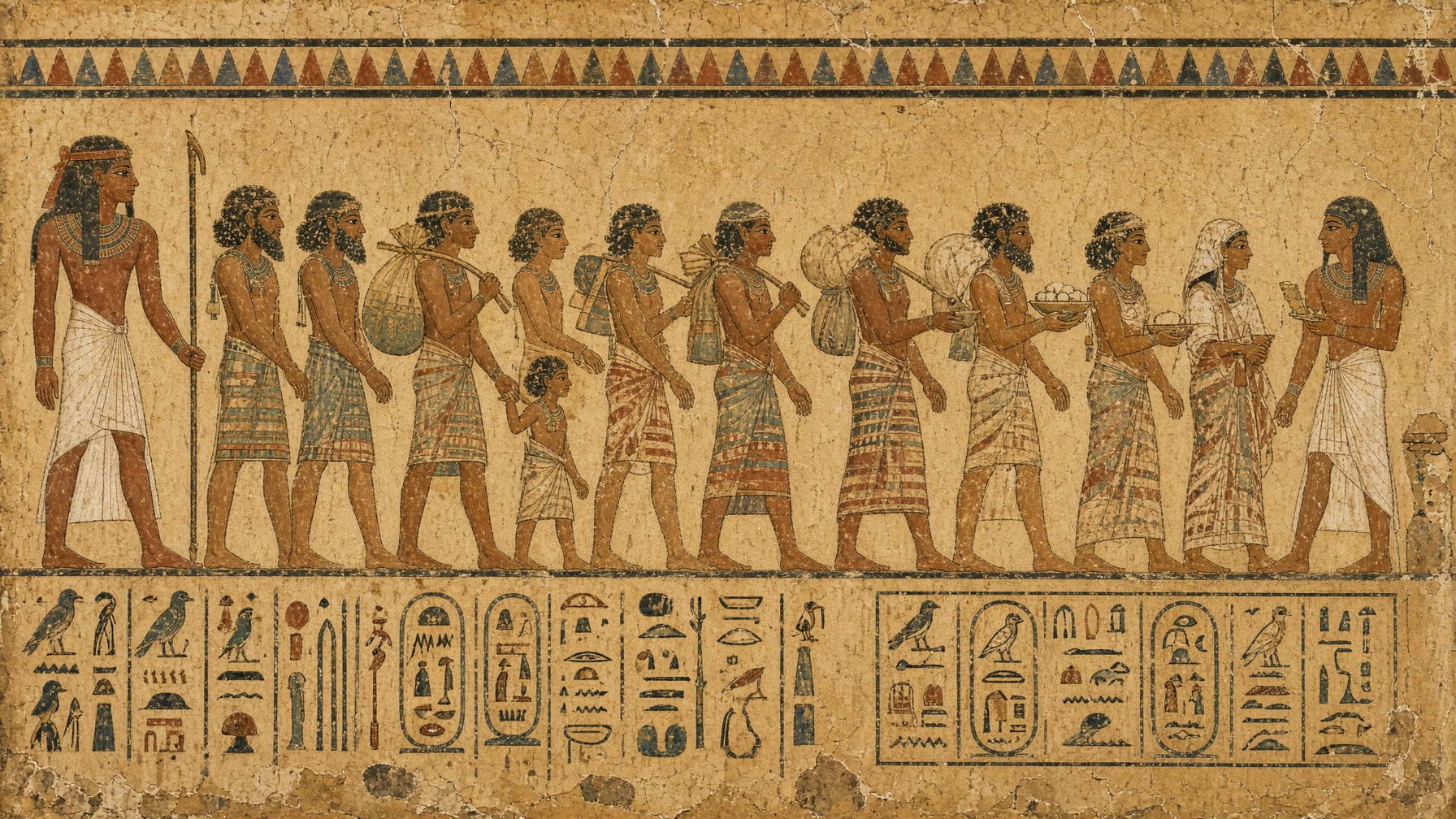
Then the labour, which is where I began. The Louvre roll gives the quota of two thousand bricks per gang. The Anastasi complaint gives the missing men and the missing straw. A papyrus in Leiden records people called Apiru, foreign labourers of low status whose name some have set beside “Hebrews,” dragging stone for the great pylon of Ramesses. Papyrus Anastasi VI, from the reign of Merneptah, son of Ramesses II, records frontier officials letting the Shasu, nomadic tribes of Edom, pass the fortress to the pools of Pithom to keep them and their cattle alive, which is the story of Joseph feeding his brothers in Egypt seen from the Egyptian side of the desk. None of these documents mentions Israel. All of them describe the world Exodus assumes, at the place and in the century Exodus names. Let me say how much this weighs, so that the opening of this essay does not promise more than it proves. That bricks in Egypt were made with straw and counted out to gangs was known to anyone who had ever built there, including a Judean of the Saite diaspora; the straw is texture, not proof, and “who knew about the straw” is a figure, not an argument. What discriminates is not that the Torah knows bricks. It is that the Torah knows Rameses.
Then the small things, which are the things liars forget. Deuteronomy contrasts the promised land, watered by rain from heaven, with Egypt, where a man sows his seed and waters it “with his foot” (11:10), like a gardener in the Nile valley shifting the sluice of a channel with his toe. Numbers remembers, with the precision of homesickness, the fish, cucumbers, melons, leeks, onions and garlic that were free in Egypt (11:5). Genesis gives forty days for embalming and seventy for mourning, has Joseph die at 110, which the Egyptians regarded as the ideal span of a life, and knows that Egyptians will not sit at table with Hebrews. Each detail is small enough to be an accident. It is their density that is not.
And one more thing, which is not in the Torah and is as eloquent as what is. The Scribe knew the Egypt of his own age, called Saite after the capital at Sais, where the Twenty-sixth Dynasty ruled in the seventh and sixth centuries and where a Jewish diaspora took refuge after the fall of Jerusalem in 587. Its addresses are known to the prophet Jeremiah: Migdol, Tahpanhes, Noph, which is Memphis, the land of Pathros (Jeremiah 44:1). The Torah knows none of them except Migdol, and Migdol, as we shall see, existed in both ages. A Scribe filling in the map of the Delta from memory would have used the names he knew; those names are not in the Torah. This is an argument from silence, and I weigh it as one, with a single proviso: the silence falls exactly where the Scribe would have had reason to speak. The route of the exodus runs through the northeastern frontier of the Delta, and there, in the Saite age, stood the great frontier fortress of Tahpanhes, the Greek Daphnae, garrisoned by Pharaoh Psammetichus’s mercenaries. A writer reconstructing a flight across his own frontier would have run into it. The Torah does not know it. This is not decoration. Nobody decorates with production quotas and dead addresses.
Now leave Egypt, as the book does. The God of Israel has, in the oldest texts, an address, and it is a surprising one. Two Egyptian lists of peoples and lands, one in the temple of Soleb in Nubia, today’s Sudan, under Amenhotep III (about 1390 to 1352), the other at Amara West under Ramesses II, name a “land of the Shasu of Yhw” among the lands of the Shasu nomads, and the Amara West list sets at its head a name usually read as Seir, the mountains of Edom south of the Dead Sea, which Soleb does not have. Here precision is owed. The Egyptian text lists Yhw as it lists the other Shasu lands: as the name of a place or a people, not of a god. That it is the same name Israel gave its God, and that the people bore the name of their god or the god the name of his people, is an inference, widely drawn but not forced by the grammar; some Egyptologists accept the reading and deny it any theological meaning. Daniel Fleming’s Yahweh before Israel begins from these two texts as the place where any history of the divine name must begin. The Bible’s oldest poetry agrees with the Egyptians: the Lord comes from Sinai, dawns from Seir and shines from Paran (Deuteronomy 33:2); he marches from Seir and the field of Edom (Judges 5:4); he comes from Teman (Habakkuk 3:3). And the Torah has Moses meet him not in Egypt and not in Canaan but in Midian, in the far south, in the household of a Midianite priest who later offers sacrifice to the Lord with Aaron and the elders looking on. Biblical scholars call this the Midianite hypothesis: that the worship of Yahweh came to Israel from the south, from the desert tribes. It was built without a shred of faith in Mosaic authorship, and it arrives at the same address the Torah gives.
Here I need one of the historians’ tools, and it is worth naming because I will use it again. It is called the criterion of embarrassment: a detail inconvenient to the community that preserved it is more credible than a detail flattering to it, because nobody invents inconveniences for himself. The tool comes from the study of the Gospels and has its critics there, right in so far as it works only when we know what embarrassed the people who kept the text. Here we know, because they wrote it down themselves. Consider, then, what the Scribe would have done with the southern address of God. Judah loathed Edom (read the prophet Obadiah, or Psalm 137) and had slaughtered Midian in its own sacred story (Numbers 25 and 31). A Scribe inventing the origins of his God would have put them anywhere but there. This one left them there. It is the criterion of embarrassment applied to a map.
The author’s ignorance is as eloquent as his knowledge. Jerusalem is never named in the Torah; Deuteronomy speaks only of “the place the Lord will choose,” and stages its covenant ceremonies on Mount Ebal and Mount Gerizim by Shechem, sixty miles north of Jerusalem. There is no David, no Solomon, no temple, no Zion. There is no Assyria as a menace, no wars with Aram, no Elijah, no Isaiah, and no king except in one law about a king who does not yet exist (Deuteronomy 17:14 to 20), which critics read as a seventh-century insertion and the pious as foresight and which is, either way, thin. Mesopotamia the author knows only as the patriarchs’ memory: Ur, Haran, Shinar, and one note, “of the Chaldeans,” that belongs to the Iron Age. The critics answer that “the place the Lord will choose” is Jerusalem veiled, and that a writer of Josiah’s day could not name it without breaking the fiction of Moses; they are right, so the silence about Jerusalem does not by itself discriminate. The mountain does. A writer working for Jerusalem would not have staged the covenant on Gerizim, the holy mountain of the future Samaritans and Zion’s rival, and the Torah does. On the Levite theory that needs no explaining at all.
What discriminates: words
First the names. Richard Elliott Friedman, an American biblical scholar known for the book Who Wrote the Bible? and no friend of Mosaic authorship, has pressed an observation that cuts across the debate: Israelites with Egyptian names come from one tribe. Phinehas is Egyptian Pa-nehesy, “the Nubian,” by universal consent; Hophni and Pashhur are Egyptian by broad consent; Merari and Mushi are argued. These are names from different centuries: Phinehas, Merari and Mushi belong to the generation of the exodus, Hophni to the family of the priest Eli in the eleventh century, Pashhur to a priestly house of Jeremiah’s day, and all of them are Levites. One exception must be named: Hur, grandfather of the craftsman Bezalel, bears a name Hoffmeier also takes for Egyptian, and he is of the tribe of Judah (Exodus 31:2). The rule is not without exception; it is nonetheless plain. A late writer painting Egypt from imagination over his national epic would have splashed the colour everywhere or nowhere. It is confined to the tribe the book says came out of Egypt with Moses, and to nobody else. One may answer that Egypt ruled Canaan for three centuries and could have left Egyptian names behind without any exodus from the Delta. It could; but it would have left them where its garrisons stood, at Gaza and Beth-Shean, among people of every tribe, and not in a single priestly line. The datum is the concentration, not the presence.
And the name of Moses himself? Here I must say what has changed and pay for it. For a century and a half the one thing every scholar agreed about Moses was that his name was Egyptian: msy, “born of,” the same element as in Thutmose and Ramesses, only without the god’s name. Rudolf Smend drew the natural inference: Israel would never have given its founder a name in the language of its oppressors, so the name must be a genuine memory. That argument has been seriously challenged. Kenneth Kitchen, a British Egyptologist nobody ever accused of liberalism, rejected the Egyptian derivation as early as 2003. Thomas Schneider, an Egyptologist in Vancouver, in a study of 2023 restated at the end of August for a general readership, has set out why. The Hebrew name is spelled with the letter shin; but when the Torah spells Ramesses (Exodus 1:11) it uses the letter samekh, as a Hebrew scribe rendering Egyptian s should, so the scribes knew the difference. The reconstructed Egyptian vowels do not fit, nor does the stress. And although the Jewish writers of the first century, Philo and Josephus, took the name for Egyptian, they derived it from words for water and rescue; no ancient author ever connected Moshe with the mose of Ramesses, even when the two had come to sound alike. Schneider concludes that the name is Hebrew, from the root meaning to draw out or gather, which is the very root the Torah gives in the story of the princess (Exodus 2:10). The princess’s etymology was not a folk etymology after all. It was merely a slightly ungrammatical one, since Moshe means “one who draws out” rather than “one drawn out,” a fault a great many parents have committed. Schneider himself writes that he defends a minority position; most Egyptologists keep the Egyptian derivation. The dispute is open.
Since the etymology is disputed I build nothing on it, and I say what that costs. Schneider draws from the same philology the opposite conclusion to mine. Following the German biblical scholar Erhard Blum, he holds that the Egyptian name was the one independent thread tying the figure of Moses to Egypt, so that if the name is Semitic, “Moses the Egyptian” may be a later construct. Against Blum’s method that conclusion is correct: a case hung on a single fact falls with it. This essay never hung on it. It ties the tradition to Ramesside Egypt by what the text knows, and the Levite group to Egypt by the names it carries, and neither depends on how Moshe is spelled. But the name did carry the only purely onomastic evidence for the existence of the person, as distinct from the group and from the tradition. Without it, the historicity of the man rests on indirect arguments alone. Something is lost on the other side as well: the need for “Moses the Egyptian.” The Levite of my hypothesis lived in Egypt and came out of it; whether he was raised at court I do not need to know. And Schneider, in passing, makes an observation more useful to me than to my opponents: the names of Israel’s founding generation are old and opaque. Aaron and Miriam have no agreed etymology, Egyptian or Semitic; Jacob rests on a root that Biblical Hebrew had stopped using; Isaac and Abraham occur nowhere but on these two men. Opacity does not prove that these people existed; it suggests only that the names were not coined later, since whoever invents a hero usually gives him a name that means something.
Then the vocabulary. A loanword is the fingerprint of a contact: English has thousands of French words because the Normans conquered England in 1066, and one could guess as much from the words alone if the chronicles were lost. Benjamin Noonan, an American Hebraist, counted the Egyptian loanwords in the Hebrew Bible, and since his figures are usually garbled in transmission I give them as he gives them. Exodus, Leviticus and Numbers contain twenty-seven Egyptian loanwords, used 381 times, which is 0.59 percent of their running words; Exodus alone runs to 1.39 percent. The rest of the Hebrew Bible, several times larger, contains fifty-one such words used 450 times, or 0.12 percent, and some of those are quotations of the exodus. The gap is far beyond chance, and I say at once what it proves: contact with Egypt, intense and concentrated in these narratives, not the date of the manuscript, since a word borrowed in the Bronze Age can stay in use for centuries. For comparison: the Persian loanwords in Esther and Ezra-Nehemiah, which everyone accepts as proof that those books cannot be older than Persian rule, are relatively fewer (0.45 percent) than the Egyptian words in Exodus. The comparison is not symmetrical: the presence of a loanword gives a date before which a text cannot have been written, and its survival does not date the sentence it stands in. Some of the words can be dated by their shape. Egyptian shed its feminine ending -t gradually from the Old Kingdom onwards, and Hebrew zeret (a hand-span) and tabbaʿat (a signet ring) still have it, which Noonan reads as borrowing between the Middle Kingdom and the Ramesside age; a separate change, of final -a to -i around 1200 to 1000, left its mark on the words Aramaic borrowed in the first millennium, and none of the Hebrew loans shows it; and one of them, tachra, was borrowed early enough for the Egyptians to borrow it back in a new form before 1200. Noonan adds that most of the words cannot be dated at all, and the word “Pharaoh” alone accounts for 115 of the 381 occurrences, so I do not oversell this either. And notice where the words for things fall: the linen and the acacia, the poles and the rings, the cups and the leather cluster in the chapters on the tabernacle, the portable sanctuary of Exodus 25 to 40, which is to say in the very Priestly layer that Wellhausen dated to the Persian period. The layer the classical theory made the youngest is the one soaked in datably early Egyptian.
The negative fact is blunter. There is not one Persian loanword in the Pentateuch, though Persian words are the surest mark of Persian-period Hebrew. Avi Hurvitz, an Israeli linguist, spent a career showing that the vocabulary of the Torah’s Priestly texts is systematically replaced by synonyms in Ezekiel, Chronicles, Ezra and Nehemiah, which puts those texts before the exile; Ian Young, Robert Rezetko and Martin Ehrensvärd doubt that Hebrew can be dated by its vocabulary at all. The sceptics have one strong point: the prophets of the Persian period, Haggai, Zechariah, Malachi, use practically no Persian words either, so their absence does not date a short text. The Pentateuch is not a short text; it is some eighty thousand words about law, ritual and administration, the very subjects that attract Persian vocabulary in Esther and Ezra, and it contains none. Take the sceptics’ side entirely and the negative result still stands: the Torah is not written in the Hebrew of the books that are supposed to have written it. It decides less than I would like; it decides more than nothing.
One mark, and the wall I lean on. The Covenant Code, the collection of laws in Exodus 20 to 23 which Exodus 24 says Moses wrote down, read aloud and had the people ratify, is the text on which my thesis of a written deposit rests; I must therefore say how that wall stands, and it stands less well than I would like. The Code passes for the oldest collection of law in the Bible and for earlier than Deuteronomy, which reworks it. But earlier is not Mosaic. Half a century ago Albrecht Alt and Martin Noth dated it to the tribal age, before the monarchy; today most place its compilation in the monarchy, in the ninth to eighth centuries, David Wright in the Assyrian age, between 740 and 640 BCE, as a reworking of the Laws of Hammurabi, and John Van Seters as late as the exile; Bruce Wells replies to Wright that the two texts breathed a common legal air rather than one being copied from the other. What I defend is not the date of the compilation but the claim that the Code’s casuistic material, the laws on the goring ox, on deposits, on the slave, is older than the collection and could have come out of the desert; even those who date the collection late do not exclude that, but they do not prove it either, and neither shall I. The argument from the price of thirty shekels I move down among the things that fit but do not decide.
And a large mark: could anything have been written at all, in Sinai, in the thirteenth century? The alphabet, ancestor of nearly every alphabet in the world, was invented, so far as we can tell, by Semitic-speaking workers in Egyptian service, who scratched it on the rocks of the turquoise mines at Serabit el-Khadim in Sinai and at Wadi el-Hol in Egypt between about 1850 and 1500 BCE. A Canaanite ivory comb from Lachish, published in 2022, carries the earliest complete sentence in the script, a wish that the comb root out the lice from hair and beard, dated by its editors to about 1700 to 1550 and still argued over. Ugarit was writing epics in an alphabet in the fourteenth century. Sinai is where the alphabet was born, among people of exactly the Levite’s description, centuries before him. That removes the objection from impossibility; it does not show that this particular Semite could write, or that his document existed.
What fits but does not decide
Now the second class of evidence: things that fit the Levite but that the Scribe could also have learned. They are not proof. They are colour, and I present them here as such, together with the people who see more in them and the people who see nothing.
The road. God, we are told, did not lead the people by the way of the land of the Philistines, “although that was near,” lest they see war and turn back (Exodus 13:17). That is the coastal military highway the Egyptians called the Ways of Horus, fortified from end to end and drawn fort by fort on a relief of Seti I at Karnak; at Tell el-Borg in Sinai Hoffmeier excavated two of those forts. The Torah’s reason for the detour is exactly the reason a man who knew the frontier would give. But the frontier was fortified in the Saite age too, and the road’s name is a century early, since the Philistines had not yet landed. It fits; it does not decide.
The nameless Pharaoh. The Torah never gives the king of Egypt a name; it says “Pharaoh,” which is “Great House,” a title the Egyptians began applying to the king himself in the Eighteenth Dynasty. Until the tenth century the title stood alone, and the combination of title and personal name, “Pharaoh Shoshenq,” appears only then; the Bible runs parallel, since the Pentateuch says “Pharaoh” while Kings and Jeremiah say “Pharaoh Necho” and “Pharaoh Hophra.” Hoffmeier takes this as a mark of antiquity. But the bare title lived on in later everyday usage too, so this also fits and does not decide.
The frontier place names. The Israelites camp “before Pi-hahiroth, between Migdol and the sea, before Baal-zephon” (Exodus 14:2). All three have counterparts in New Kingdom Egypt, and that is a half-truth. Migdol, a Semitic word for a tower, was a name the Egyptians gave to frontier forts: a papyrus from the reign of Seti I knows that pharaoh’s Migdol, but Jeremiah and Ezekiel know a Saite Migdol, and Hoffmeier himself writes that there were at least three Migdols, because the name moved with the frontier. Baal-zephon, “Baal of the North,” was a Canaanite god worshipped in Egypt from the time of Ramesses II (Papyrus Sallier IV) to the age of the Phoenician merchants of the sixth century who blessed one another “by Baal-zephon and all the gods of Tahpanhes”; a Ptolemaic text even knows a fort called “Migdol of Baal-zephon,” which is the pair from Exodus. Pi-hahiroth nobody can explain. Redford concluded from this that the toponymy of the exodus is Saite, since these places were prominent in the seventh century; Hoffmeier and Rendsburg reply that they were prominent in the thirteenth as well. Both are right, and that is why these names decide nothing. What decides is what I said above: the papyrus marsh has a Ramesside name, and the specifically Saite names are absent from the Torah.
Pithom. The second of the store cities (Exodus 1:11), Egyptian Per-Atum, “House of Atum,” has two candidates in the Wadi Tumilat, the valley that leads east out of the Delta. Tell el-Retaba, where Ramesses II built a fort and a temple of Atum, and where a mission of the University of Warsaw and the Slovak Academy of Sciences under Sławomir Rzepka and Jozef Hudec has been digging since 2007, is the candidate of Hoffmeier and Rendsburg. Tell el-Maskhuta, some ten miles farther east, resettled in the seventh century by Pharaoh Necho II after a long gap since the Hyksos period and still called Pithom on a stela of Ptolemaic times, is the candidate of Redford, Holladay and Schipper; a tomb of the Nineteenth Dynasty was found there in 2010, however, so even this site is not purely Saite. The name itself existed in both ages and decides nothing. What would decide is a pair: Papyrus Anastasi VI, from Merneptah’s reign, speaks of “Pithom, which is in Tjeku,” and Tjeku is the Egyptian name of the whole valley, which the Torah knows as Succoth, the first stop after leaving Rameses. That pair, Pithom beside Succoth, the Torah has. It is a hint, not a proof.
The list of campsites. Numbers 33 lists forty-two stations from Rameses to the Jordan and says that Moses wrote them down. Charles Krahmalkov set its closing stretch beside the lists of towns that Ramesses II carved at Karnak and found the same order of four stations east of the Jordan. That proves the Egyptians knew the road in the thirteenth century, not that Moses wrote the list; Angela Roskop takes the list for a late scribal composition imitating Assyrian campaign reports, and Juan Manuel Tebes links its desert names to the Arabian campaigns of the Assyrian king Ashurbanipal in the seventh century. One thing follows from the list regardless of date, and I will return to it: a list is a written genre. Nobody composes forty-two campsites for pleasure; a clerk writes them down because he has been told to.
The price of a slave. The Covenant Code makes the owner of a goring ox pay thirty shekels for a slave it has killed (Exodus 21:32); that is a statutory compensation, not a market price, and Kitchen set the figure beside the rates of Nuzi in Mesopotamia and Ugarit in Syria in the fourteenth and thirteenth centuries, against twenty in Hammurabi’s day and ninety to a hundred and twenty under the Persians. But slave prices depended on age, sex and market, and the spread within any one period was wide, so a single figure does not date a text; even Kitchen’s critics grant it no more than that it sits badly with the Persian period. It fits; it does not decide.
The tent. The tabernacle, the portable sanctuary of Exodus 25 to 40, is in its bones an Egyptian object. Kitchen and Michael Homan (Bible Review, 2000) set it beside Ramesses II’s war camp at Kadesh as the sculptors of Abu Simbel drew it: a rectangle twice as long as it is wide, the royal tent at the centre, the army on four sides, which is the plan of Israel’s camp in the Book of Numbers. Tutankhamun was buried inside gilded wooden shrines nested one within another, beside chests fitted with rings for carrying poles, which is the joinery of Exodus. At Timna, in the copper mines south of the Dead Sea, Beno Rothenberg excavated an Egyptian shrine of the goddess Hathor which the Midianites, after the Egyptians left in the twelfth century, turned into a tent, and in its sanctuary a copper serpent with a gilded head; Moses in Numbers makes a bronze serpent in the same region, and his father-in-law is a priest of Midian. A coincidence with a postcode. But the mainstream of biblical scholarship reads the tabernacle as a Priestly projection of the Jerusalem temple backwards into the desert, and the existence of the technology in the thirteenth century does not refute that. The parallels show only that the description draws on a tent tradition with Egyptian and desert precedents, not solely on the temple; they support an older background; they do not exclude later Priestly composition and they do not date the text. The harder argument here is Noonan’s vocabulary from the previous section.
The poem. Joshua Berman of Bar-Ilan University argues that the account of the crossing of the sea in Exodus 14 and 15 follows, motif by motif, the Kadesh Poem, Ramesses II’s official account of the battle of 1274: an army surprised by chariots and breaking ranks, the hero alone with his god, the enemy discovering it fights a divine power and fleeing into water, the survivors’ hymn, the king’s homecoming, the cowed nations, the grant of eternal rule. The “mighty hand” and the “outstretched arm,” the enemies burned “like chaff,” are the idiom of the Egyptian court before they are Hebrew. Ronald Hendel of Berkeley takes the parallels for the commonplaces of royal propaganda, shared across the ancient Near East, and the dispute is not settled. I do not claim that the Poem could not be known after Ramesses; the temple walls at Karnak, Luxor and Abu Simbel stand to this day. The difference concerns access: a Judean did not read hieroglyphs on the walls of Thebes; he would have needed a copy on papyrus or an Egyptian intermediary, and the papyrus copies we know are Ramesside. An intermediary in Saite Egypt is conceivable; it is an added assumption, not an impossibility. If Berman is right, to praise your God in Pharaoh’s own court idiom for drowning Pharaoh’s own chariotry is a joke, and a joke requires an audience that knows the original. If Hendel is right, there is no joke. It fits; it does not decide.
And finally the treaty, which is the place where my hypothesis is most exposed. Deuteronomy has a shape resembling an ancient international treaty between a great king and a vassal: a preamble, a recital of shared history, terms, the deposit of the text in a temple and its public reading, witnesses, blessings for the faithful and curses for the faithless. Meredith Kline and Kitchen argued in the 1960s that this is the Hittite pattern of the fourteenth and thirteenth centuries, since the Assyrian treaties of the eighth and seventh centuries lack the historical recital and the blessings, and that Deuteronomy is therefore old. That argument can no longer be maintained and I do not maintain it. In 2009 a copy was found at Tell Tayinat in Turkey of the treaty by which the Assyrian king Esarhaddon in 672 bound his vassals to swear loyalty to his son’s succession; the copy had been displayed in the temple of a provincial town, exactly as Deuteronomy orders its own text displayed, and Hans Ulrich Steymans called the match between the curses of Deuteronomy 28 and the curses of Esarhaddon the “Archimedean point” for dating the beginnings of Deuteronomy to the seventh century. Mark Francois showed in 2025, in a journal of evangelical theologians, which is to say on the home ground of Kline’s defenders, that the Hittite structure of the whole book can be maintained only by imprecise summary. What remains is a narrow dispute over chapter 13, the laws against incitement to apostasy: Berman holds that the closer parallel is a Hittite treaty, Bernard Levinson and Jeffrey Stackert reply that it is the Assyrian one, and Carly Crouch rejects direct dependence on Esarhaddon without coming down for the Hittites. I can add that the treaty Ramesses II made with the Hittite king in 1259 was carved on the walls of Karnak and the Ramesseum, so the treaty form was a public monument in the Egypt of the thirteenth century; but my reviewer is right that availability is not use.
The consequence is serious and I state it plainly. Chapter 13 lies inside the legal corpus, chapters 12 to 26, so the dispute about it is a dispute about the corpus, and I cannot save the corpus by separating it from the curses of chapter 28. If Levinson and Stackert are right, Deuteronomy has a seventh-century layer in its law and not only in its sanctions. The model I defend can absorb this, since custodians of a deposit reworking a “second exposition” of the law in the idiom of their own age is exactly what the model expects; but every such absorption shrinks what I defend, and early material in Deuteronomy can be claimed only passage by passage. So I shift the weight to where it stands more firmly, though not there without risk: to the Covenant Code of Exodus, of which the text says that it was written, read out and accepted, and whose material is the oldest law in the Bible whatever one thinks of the date of the collection; and to the Song of the Sea in Exodus 15, whose archaic grammar Frank Moore Cross and David Noel Freedman assigned to the oldest layer of Hebrew poetry, though a song, unlike a law, can travel in memory without writing. I defend a Moses smaller than the one in the stained glass and larger than the one in the footnotes. The first cannot be defended; the second cannot be removed.
Was there a Moses
Begin with what the sceptics give away. Rollston believes in a literate Moses and an exodus of slaves. Friedman believes in an exodus of Levites led by a Moses. William Dever, an American archaeologist who is nobody’s fundamentalist, allows a “Moses-like figure” in southern Transjordan in the thirteenth century. Martin Noth, who doubted nearly everything, granted him a hand in the preparations for settlement. Jan Assmann, a German Egyptologist, put the difficulty in an epigram: the pharaoh Akhenaten is a figure of history but not of memory, and Moses a figure of memory but perhaps not of history. No inscription names him. The case is indirect and cumulative, and without the name it is weaker than it used to be.
Consider nonetheless what Israel chose to remember. A founder of slave ancestry. A leader who married a Midianite when Midian was an enemy. A lawgiver barred from the land he had promised, for a fault at a rock. A man quarrelled with by his own brother and sister, buried outside the country in a grave that “no man knows to this day” (Deuteronomy 34:6), leaving no royal dynasty, no shrine and no relic. Descendants he did leave, and tellingly: the Book of Judges (18:30) makes his grandson Jonathan and his sons priests of an idolatrous shrine at Dan, and later scribes were so ashamed of that line that in the Hebrew text they altered the name of Moses to Manasseh with a letter added above the line. Whoever invents takes pains to be convincing. The Torah takes pains to be inconvenient. Legends have tombs, and tombs have ticket offices; nations that invent their founders invent them with better luck than this. I add what weakens the argument: Moses’ failures also serve literary and theological ends, showing that even he stood under God, and the argument from embarrassment is a consideration, not a proof. Add the fixed points that owe nothing to the text. The Merneptah Stele, a monument to the victories of Ramesses II’s son set up at Thebes around 1208, names Israel as a people in Canaan and so closes the window on Israel’s emergence, though not on the later arrival of a small group such as I describe (a claimed earlier “Israel” on a fragment of a statue base in Berlin is disputed, and I do not lean on it). The city of Rameses lived only inside that window. The name Yhw stood on Egyptian lists of the southern deserts in the fourteenth and thirteenth centuries, exactly where the book sends Moses to meet his God. The Iron Age villages of the hill country of Canaan look like an indigenous people absorbing a small group with Egyptian experience, which is what Friedman’s Levites and Dever’s reconstruction describe from opposite directions. Let me say it plainly, since the title might suggest more: I defend a small exodus. None of my arguments takes on the six hundred thousand men on foot of Exodus 12:37, and the archaeology of Sinai and the hill country does not allow the number. Even the Greeks and Egyptians who wrote about Moses after Alexander the Great, Hecataeus of Abdera, the Egyptian priest Manetho, the geographer Strabo, wrote about him with hostility or indifference but never as a fiction; they argued about what kind of Egyptian he had been. And the basket in the reeds? Sargon of Akkad and Romulus had a basket, Cyrus a herdsman ordered to expose him. The legend of the endangered child is a frame that ancient peoples put around men both real and legendary, so by itself it decides nothing. Frames do not write law codes. Moses can be struck out of history; Egypt cannot be struck out of the Torah. Out of Egypt came somebody who taught this people its law, and the people who kept the law called him Moses. To call him “somebody” today is not caution. It is a change of name to a less convenient one.
The chain of custody
Rollston is right that the Torah’s notices of Moses writing are specific, and I want to read them as a lawyer reads a file, because specificity is what a file is for. Moses writes the words of the covenant and reads the book aloud to the people, who accept it (Exodus 24:4, 7). He writes the renewed terms (34:27). He writes the list of campsites (Numbers 33:2). He writes “this torah” and hands it to the priests who carry the ark (Deuteronomy 31:9); he finishes it and orders it laid beside the ark (31:24 to 26); he provides for it to be cut into plastered stones after the crossing of the Jordan (27:3, 8), which the Book of Joshua (8:32) records as done; for a copy to be made for any future king from the priests’ exemplar (17:18); and for the whole to be read aloud every seventh year (31:10 to 13). Centuries later a book of the law is found in the temple (2 Kings 22) and read out to a crowd in Jerusalem (Nehemiah 8). Authorship, acceptance, deposit, controlled copying, periodic proclamation, rediscovery: that is a chain of custody as the book itself narrates it. A lawyer knows that a document’s account of its provenance and proof of that provenance are two different things; the first is part of the evidence, the second would still have to be made out. Here there is only the first.
And the notes that so exercise the critics are the fingerprints of the custodians. Scholars call them glosses: a scribe’s remark in the margin which the next copyist wrote into the text; some may instead be deliberate additions, and each would have to be judged on its own. “Hebron, formerly Kiriath-arba.” “Dan,” for a town that was called Laish until the Danites took it. “To this day.” “Before any king reigned over the Israelites.” The bed of Og in a museum in Rabbah. The thirty days of mourning and the verdict that no prophet like him has arisen since. These are the notes of people who kept a text, modernised its place names for readers, and closed it with the death of its author. Josephus, who believed Moses wrote the whole, thought Moses had written his own obituary to forestall rumours of an ascension (Antiquities 4.326). One opinion in the Talmud gave the last eight verses to Joshua (Bava Batra 15a). Ibn Ezra, with his secret of the twelve, extended the same courtesy to five more passages and kept everything else, which is a theory of the same shape as mine, stated in the twelfth century by the greatest grammarian of medieval Judaism, though his Moses wrote nearly everything and mine less. A consolidated statute carries marginal notes, renumbered sections and later amendments, and remains the act of the parliament that passed it. The presence of amendment proves that a law was kept and used. It does not prove that it was never enacted.
Now the test of my fifth rule. Where are the anachronisms? Make the list and look at the addresses. A Canaanite town renamed (Dan, Hebron). An Israelite monarchy assumed. A conquest completed. A giant’s bed in the capital of a neighbour. A coastal road named for its later occupants. A Mesopotamian people of the Iron Age. Every one of them lies inside the world of later Israel. On the Egyptian side the cases are disputed, not settled: Migdol and Baal-zephon, which Redford reads as a Saite insertion and Hoffmeier as names alive in both ages; Pithom, with its two candidate sites; the spelling of Rameses, which Schipper takes for late. Disputed both ways is not the same as anachronistic. Apart from these the Delta stands untouched: nobody changed Rameses to Zoan, nobody added Tahpanhes or Noph, somebody even planted Rameses in Joseph’s Egypt. Custodians correct what they know and leave alone what they do not, for the same reason a man corrects the spelling of his own street and not of a street in a city he has never seen. On the Scribe theory this pattern is upside down: a writer inventing in Jerusalem would get Judah right and Egypt wrong, and his mistakes would lie in the Delta. On the Levite theory, and on the Heir’s, it is exactly what should happen; separating those two I leave to the next paragraph. The argument in this form is narrower than it might be, and for that reason more robust.
Here the Heir returns. The strongest rival to my theory is not invention but inheritance: a tradition carried for centuries, by mouth and in older documents, its Egyptian colour intact, and written down anew by scribes who believed it. Most biblical scholars hold something like this, and Redford, Hoffmeier and Rollston agree at least that something true from Egypt is in the tradition. Inheritance explains the colour. What separates it from my Levite is not genre, since lists and laws could have been written down by intermediaries too, but only the question whether the first document was written when and where the book says. Songs are carried; lists and tariffs travel badly by mouth, though not impossibly, as the catalogue of ships in the Iliad shows; law travels worse. The covenant is described as accepted, deposited and copied under priestly control, which is how documents are handled and not how songs are; but that is the book’s own description, and a written precursor need not have been Mosaic. The natural division of labour is the one the book itself draws: memory carried the story, documents carried the law. Rollston’s reading, that an anonymous author later built the Pentateuch around texts written by Moses, is the same division described from the other side of the table; the difference between us is that he knows those texts can no longer be pointed to, and I am trying.
Three kinds of knowledge
There are three kinds of thing one can say about Moses, and the honest essay says which is which.
Certain is the following. The Pentateuch we have is a composite, edited book with notes in its margins. Its Egyptian vocabulary is concentrated in Exodus to Numbers, partly in forms the Egyptians themselves had stopped using before the Iron Age, and it contains not one Persian word. Phinehas, Hophni and Pashhur are Egyptian names borne by Levites, with Hur of Judah as the exception. The city of Rameses was a capital from about 1270 to the early eleventh century, and the Torah knows its name and uses it as an address. Egyptian kings of the fourteenth and thirteenth centuries listed a land of the Shasu of Yhw, as the name of a place or a people. Israel was in Canaan by 1208. The book’s undisputed anachronisms lie in Canaan; the Egyptian indicators are disputed both ways.
Highly probable: the Egyptian colour of the Torah is a substratum from the age of the Ramessides, not a decoration of the seventh century. Probable: a group of Levites came out of Egypt in the thirteenth century; the Torah’s Hebrew is older than Ezra’s; the name Rameses in the Torah is a fossil, not a late reminiscence; the material of the Covenant Code is older than the collection in which we have it. Possible, and no more: that this material was written down in the desert; that at the head of that group stood a man called Moses, and that the law was ascribed to him because he gave it.
And some things nobody knows. Whether anything in Genesis is his. Whether he wrote or dictated. Whether he grew up at Pharaoh’s court. Whether the Song of the Sea knew the Kadesh Poem. Whether the legal core of Deuteronomy is his or his custodians’ of the seventh century. Whether Pithom is Retaba or Maskhuta. Whether the list of campsites is a record from the road or a late composition of scribes. Whether Yhw on the Egyptian lists is already the name of a God or only yet the name of a land. What his name means.
Reconstruct not the man, since the evidence does not allow it, but the knowledge that had to pass through somebody’s hands, and see where those hands stood. They knew the Delta of Ramesses by its Ramesside names and called a district by a name that died before David. They knew how a quota worked, what the onions tasted like, how long the embalmers took. They did not know the names under which the Judeans of Jeremiah’s day knew Egypt. They worshipped a God whose name the Egyptians had already written down as a place among the nomads, before Israel appears in any record, furnished a sanctuary with Egyptian words in Bronze Age shapes, wrote a Hebrew older than the men who are supposed to have invented all this, and set the covenant on Gerizim, not on Zion. The custodians corrected their Canaan and left their Egypt alone, because they could not correct what they did not know.
Let me say plainly how much of this the evidence carries and how much is inference. It carries, as a high probability, that beneath the Torah lies a substratum from the age of the Ramessides: words, names, institutions and silences that the Scribe could not have produced. It carries, as a probability, that this substratum was brought by a group of Levites who came out of Egypt. The step from substratum to deposit, that is, to a text written down then and kept, is a further step, and it stands on one leg: on what the book itself says about the writing, acceptance and deposit of a document, since a written precursor could also have been written by someone else, later. That is a leg of reasoning, not of excavation. The step from deposit to a lawgiver who gave it his name is further still, and it stands on nothing but how inconveniently Israel remembered its founder. I defend all three steps. I do not pretend they stand equally firm: the first stands on evidence, the second on probability, the third on possibility.
Tradition overreached when it gave him every word. Criticism overreached when it took every word away. The truth, as usual, is less comfortable than either: somebody knew this, knew it early, and the people who kept it called him Moses.
Moses is the author of the Torah in the sense in which Hammurabi is the author of his laws and Napoleon of his Code, and in one sense more, because nobody ever claimed to have watched Hammurabi write. The Pentateuch is not his manuscript. It is his deposit, kept, arranged, annotated and closed by men who thought it was his and said so in the only way that mattered to them, by calling it the torah of Moses. For them that was a description. For us, on the evidence, it is an admissible conclusion, and one more respectful of the critics’ findings than the critics have been of their own. They found the editor’s pencil in the margins and ruled that there was nothing underneath. But pencil marks are what happens to books that people keep.

Robert Nogacki is a Polish attorney at law (radca prawny), the founder and managing partner of Kancelaria Prawna Skarbiec (Skarbiec Law Firm), which has operated continuously since 2006.
The law is equal for everyone, but the parties rarely are: on one side stands an organization with time, money, and lawyers, on the other a person with one business, one nest egg, and one life.
Clients rarely come to him with a legal problem. They come with a problem that also has a legal side: an audit that began with a single invoice, money entrusted to someone who has disappeared, a company that has to be passed on before it is too late. Most such matters are decided long before the first letter is written, in decisions made without asking and in deadlines nobody remembered. So he begins by asking how the client got here, not what the client should have done.
He advises entrepreneurs and families from more than a dozen countries, including those whose accounts the tax office has just seized and who do not know what to do tomorrow morning. He defends them in tax audits, customs and fiscal inspections, disputes with the tax authorities, and criminal tax proceedings. He represents victims of investment fraud and Ponzi schemes. He helps families set up family foundations and plan succession, so that a life’s work outlasts a single generation.
Not every case can be won. Every case can be run so that the client knows where they stand. Since 2006 he has represented the victims in the WGI case (Warszawska Grupa Inwestycyjna, the Warsaw Investment Group), one of the longest criminal cases in the history of the Polish financial market, because some things must not be left half finished, even when they take two decades. In the case of the collapsed cryptocurrency exchange Zonda (Zondacrypto, operated by BB Trade Estonia OÜ), he represents several hundred victims in the criminal investigation conducted by Poland’s National Prosecutor’s Office and in the Estonian bankruptcy proceedings.
Kancelaria Prawna Skarbiec is listed in the rankings of Poland’s largest tax advisory firms published by Dziennik Gazeta Prawna and Rzeczpospolita, and it is a four-time recipient (2015 to 2018) of the European Medal awarded by the Business Centre Club and the European Economic and Social Committee. Robert Nogacki publishes regularly, in the press and on the firm’s website, for people who have a problem rather than a law degree, because a legal opinion the client cannot understand protects only the lawyer.
He believes that the best legal advice is the kind that means the client never has to appear in court.