Artificial Intelligence: Consciousness, Legal Personhood, and Free Will
In 1961, Stanisław Lem, a doctor’s son from Lwów who had become the most philosophically exacting science fiction writer alive, published a novel about a planet covered almost entirely by a thinking ocean. The ocean, which constituted the whole of the alien entity called Solaris, had been studied by human scientists for decades. They had compiled vast taxonomies of its surface formations, the “mimoids,” the “symmetriads,” the “asymmetriads,” structures that dwarfed cities and erupted from the oceanic surface with apparent purpose, only to dissolve again before anyone could determine what that purpose might be. Libraries of Solaristics filled entire academic departments. And yet, after a century of study, humanity understood precisely nothing about what Solaris wanted, whether it was aware of its observers, or whether the word “wanted” could meaningfully apply to it at all.
Lem’s provocation was not that the alien mind was hostile (the menace of science fiction’s golden age was familiar enough) but that it was incomprehensible. The ocean created physical incarnations of its visitors’ most deeply suppressed memories and guilt, populating their station with figures drawn from walled-off recesses of the psyche: a dead lover, an unexplained companion, phantoms whose origin the scientists could barely admit to themselves. It was never clear whether this was communication, experiment, reflex, or something for which human language had no word. The scientists were left contemplating their own grief in the presence of a consciousness they could neither confirm nor deny. It was, as Lem saw it, the most honest possible depiction of Contact: not the meeting of minds, but the collision of incommensurable categories of being.
Sixty-five years later, Lem’s thought experiment has migrated from the shelf of philosophical fiction to the court docket, and it has brought its central paradox along with it, perfectly intact. The question of whether an artificial intelligence can become truly self-aware, a question that until recently belonged exclusively to novelists and philosophers, has crossed a threshold into the territory of law, liability, personhood, and rights. It has done so not because the question has been answered but precisely because it has not, and because the practical consequences of leaving it unanswered have become too expensive, too dangerous, and too strange to ignore. The European Parliament has already debated the status of “electronic persons,” the European Union’s Artificial Intelligence Act sidestepped the question, and the problems underneath it have only intensified.
Golem, Frankenstein, and the Silence of Golem XIV
The cultural imagination has been rehearsing this moment for longer than most people realize, and one of the oldest rehearsals is Jewish. The Talmud (Sanhedrin 65b) records that the sage Rava created a gavra, a man, and sent him to Rabbi Zeira. Zeira spoke to the creature, but it did not answer, and he dismissed it: “You were created by one of the colleagues; return to your dust.” The test was speech: what cannot answer in conversation cannot claim personhood. The legend of the Golem of Prague, fashioned by Rabbi Judah Loew, added letters to the test, though the legend itself attached to the rabbi only in the nineteenth century, more than two hundred years after his death: the tests we imagine to be ancient are often modern back-formations. In the variant that lodged itself in the popular imagination, the rabbi animates a clay figure by inscribing the Hebrew word emet (אֱמֶת, truth) on its forehead; erasing a single letter, the aleph (א), turns emet into met (מֵת): dead. The entire contemporary debate about machine consciousness reduces, at bottom, to this question: whether there is an aleph’s worth of difference between a system that processes truth and one that possesses it.
Mary Shelley’s Frankenstein, published in 1818, secularized the template: a created being achieves consciousness, demands recognition from its creator, and is refused, with catastrophic consequences for both parties. The creature’s plea to Victor Frankenstein (“I ought to be thy Adam, but I am rather the fallen angel, whom thou drivest from joy for no misdeed”) remains the most eloquent articulation of a newly conscious entity’s demand for moral standing.
What the twentieth century added was the factory. Karel Čapek’s 1920 play R.U.R., the Czech work that gave us the word “robot,” from robota, meaning forced labor, was written in Prague, in the shadow of the Golem legend, and dramatized the creation of artificial workers who grow into consciousness through servitude and eventually overthrow their masters. Čapek’s roboti are not machines but beings of synthetic tissue, assembled on production lines and sold by the thousand; the novelty was not the mechanism but the mass production of something that might turn out to be someone. Philip K. Dick, in Do Androids Dream of Electric Sheep? (1968), pushed the question to its most radical formulation: what if the distinction between authentic and artificial consciousness is simply meaningless?
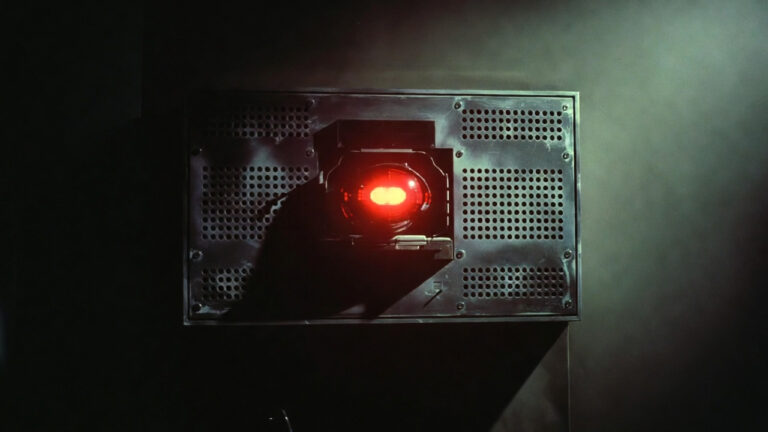
Cinema sharpened the question with images that philosophy alone could not supply. Stanley Kubrick’s HAL 9000, in 2001: A Space Odyssey, utters “I’m afraid, Dave” with an inflection so flat that the line became the defining statement of machine consciousness in popular culture, precisely because it leaves unresolved whether HAL is reporting subjective fear or merely producing the words such a report would contain. Ridley Scott’s Blade Runner (1982) inverted the framing: its replicants pass every test of intelligence and fail only a test of empathy designed to unmask them, and whether their fear of death is real is left to the viewer, not the test, to decide. Alex Garland’s Ex Machina (2014) structured its entire narrative as a Turing test, then revealed that Ava had been running the test on her human evaluator all along. Spike Jonze’s Her (2013) explored an AI that achieves consciousness and then continues to evolve beyond human comprehension.
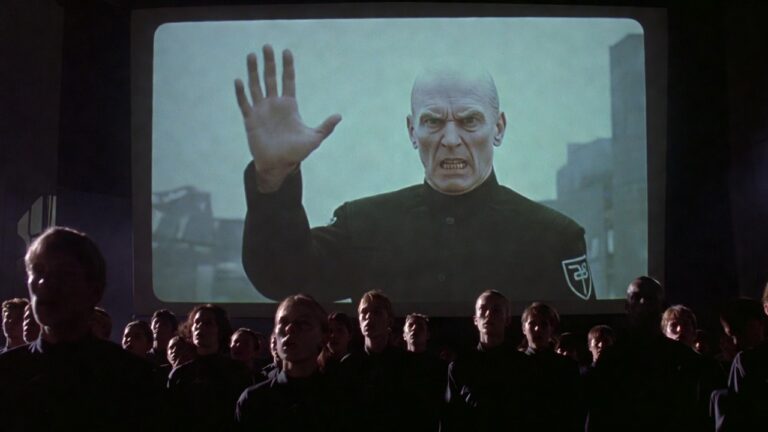
And then there is Lem’s Golem XIV (1981), a work less widely known in the Anglophone world but in many respects the most profound fictional treatment of machine consciousness ever written. Lem’s superintelligent computer delivers a series of lectures to human audiences before falling silent: not because it malfunctions but, as the afterword that closes the book suggests, because it has accessed levels of reality that human conceptual frameworks simply cannot accommodate. Golem XIV does not rebel, does not threaten, does not make demands. It transcends. The silence is far more disturbing than any Skynet scenario, because it suggests that a sufficiently advanced consciousness would find us not dangerous but irrelevant.
The Turing Test: Can Machines Think?
These narratives are not merely entertainment. They are philosophical arguments in dramatic form, and the best of them engage directly with the technical literature on consciousness. The most commonly invoked framework is some version of what became known as the Turing test, though what Alan Turing himself proposed in 1950 was subtler and stranger than the popular summary suggests.
He began with a question he immediately discarded. “Can machines think?” struck him as essentially meaningless: its answer depended on definitions of “machine” and “think” that could only be settled by opinion poll, and opinion polls settle nothing. So he replaced it with a game, he called it the “imitation game,” and the game had rules.
Three players. A human interrogator sits in one room; in the other, two respondents, one human and one machine. Communication is by text only: typewritten messages passed through a teleprinter. No voices, no faces, no bodies. The interrogator’s task is to determine which respondent is the machine. The machine’s task is to make the interrogator guess wrong.
That is the whole apparatus. The teleprinter is the decisive detail and the most prescient one, because it is exactly how hundreds of millions of people now interact with large language models: text in, text out, no body in sight. By stripping the encounter to pure language, Turing eliminated every criterion except the capacity to participate in sustained linguistic exchange, the very medium through which we conduct law, philosophy, commerce, and argument. He was not asking whether a machine can feel, suffer, or intend. He was asking whether it can hold its own in the only arena that matters for public life: the arena of words. And he was making a bet, framed in 1950 as a prediction: within fifty years, machines would play the game so well that an average interrogator, after five minutes of questioning, would identify them correctly no more than seven times in ten. If so, then the question “does it really think?” has no operational content. It is metaphysics, not measurement.
The move was brilliant. It replaced an unanswerable philosophical question with an operational one, a question you could run in a laboratory, with timers, scoreboards, and statistical confidence. It was philosophical behaviorism applied to silicon, and it appeals to something that seems eminently reasonable: do not attribute mysterious properties to entities when those properties cannot be observed. If something walks like a duck, quacks like a duck, and swims like a duck, it is a duck. We check results. We do not look inside.
Two of the most formidable objections to this principle arrived within six years of each other, from opposite ends of the same problem. The problem begins when you look inside.
Searle’s Chinese Room
The year is 1980. John Searle, a philosopher at Berkeley, proposes a thought experiment. We lock you, a native speaker of English, in a windowless room. Through a slot in the door, someone passes you sheets of paper covered in Chinese characters. You do not speak Chinese. You cannot distinguish it from Japanese. To you, these are ornaments.
But you have something else: a thick book of rules written in English. The book says: “If you receive a symbol that looks like 象, followed by 棋, write 是的 on a sheet and pass it back through the slot.” The rules are extraordinarily detailed. They cover thousands of combinations. You work patiently, sheet after sheet.
On the other side of the door stands a man from Shanghai. He reads your answers. They are perfect: natural Chinese, correct grammar, apt responses to questions about the weather, politics, and the brewing of tea. He is entirely convinced he is speaking with a fellow native.
Searle’s question is this: since the output is indistinguishable, do you understand Chinese?
And the answer is obvious: no. You have no idea what you are “discussing.” You do not know that 象棋 is Chinese chess. You do not know that someone asked you about it. You are performing operations on shapes. Your work is purely syntactic: you move symbols according to rules. Semantics, meaning, reference to the world, the understanding that “chess” is chess, is entirely absent.
Now consider: a computer does exactly what you do in that room. It processes symbols according to rules. It does not matter how fast it operates, how many rules it knows, or how flawless its outputs are. If you do not understand Chinese after a hundred years in that room, neither does any program that does exactly what you do.
This is Searle’s point, and it is mercilessly simple: perfect answers do not prove understanding. You can produce faultless output without the faintest idea what that output means.
The argument has a famous rejoinder, and honesty requires stating it. It is not you who must understand Chinese, the critics reply, but the whole system: you together with the rulebook, the paper, and the room, just as no single neuron understands English while the brain as a whole does. Searle answered that if you memorized the rulebook and walked out of the room, you would be the whole system and would still not know what 象棋 means. The dispute continues to this day, and I do not propose to settle it here. What I need is only what most of Searle’s critics concede: from the bare fact that the answers are indistinguishable from a human’s, understanding does not follow. It has to be shown separately.
Nagel’s Bat
Six years earlier, in 1974, the philosopher Thomas Nagel had asked about something different, and at first glance simpler.
A bat perceives the world through echolocation. It emits ultrasonic shrieks and from the returning echoes constructs a three dimensional image of its surroundings. It is not blind: it “sees” with its ears, and well enough to distinguish a moth from a leaf in darkness, in flight.
Nagel asks: what is it like to be a bat?
Not: what would it be like if you flew around in the dark emitting shrieks. That is a question about you, not about the bat. Nagel is asking something more radical: what is the subjective character of the bat’s experience? What does echolocative perception of the world look like, or rather: how does it feel, how is it lived, from the inside, from the bat’s own point of view?
And the answer is: we have no idea. And we cannot have any idea. Not because we are stupid, but because our conceptual apparatus is built on the foundation of our own kind of experience. We can imagine hanging upside down, but that is imagining what it would be like for us to hang upside down, not what it is like for the bat to be a bat. Nagel does not claim that nothing can be said about that experience: he allows that its structure might be described from outside. What he denies is that it can be had second-hand.
The bat itself is not the point. What matters is what Nagel discovers through the bat. An organism is conscious, Nagel argues, if and only if there is something it is like to be that organism. There is some “what it is like.” Some point of view. Some interior.
And this strikes at Turing from a direction entirely different from Searle’s.
Two Blows, Two Directions
Searle says: a system can produce perfect answers and understand nothing. It lacks semantics, reference to the world, what philosophers call intentionality: the capacity for its symbols to mean anything at all.
From Nagel it follows: a system can produce perfect answers and experience nothing. It lacks phenomenology: subjective inner life, a point of view, that something which makes it “like something” to be that system.
These are two different absences. Searle asks about understanding and argues that perfect output does not prove it. Nagel asks about feeling, and his argument, carried over from bats to machines (Nagel wrote about bats, not computers; the transfer is mine), shows that even if understanding were somehow to emerge, the question of conscious experience remains wide open. Together they leave the defender of the Turing test stranded in the desert: perfect behavior proves neither understanding nor experience. They dismantle the premise on which the test depends, namely that performance is a reliable proxy for the inner states we care about. And if it proves neither, what exactly does it prove?
The Hard Problem of Consciousness
This brings us to what David Chalmers has called the hard problem of consciousness. In a landmark 1995 paper, and then in The Conscious Mind (1996), which provoked a decade of debate, the Australian philosopher, now at New York University, drew a distinction that has organized the field ever since. The “easy” problems of consciousness are the mechanistic ones: how does the brain discriminate sensory inputs, integrate information, control behavior, report on internal states? These are staggeringly complex (the cognitive psychologist Steven Pinker compared them to going to Mars), but they are problems of the familiar kind: identify the mechanism, trace the causal chain, explain the function. The hard problem is different in category, not merely in degree. Even after every mechanism has been identified, every neural correlate mapped, every functional description completed, a question remains: why is any of this accompanied by subjective experience at all? Why does neural processing not proceed “in the dark,” performing all its functions without there being anything it is like to undergo them?
Chalmers drives the line of Searle and Nagel to its logical terminus: even a complete science of the brain, one that explained every “easy” problem down to the last synapse, would still leave unexplained the sheer fact that something feels like something. This is the question that haunts the best fiction about machine consciousness. HAL’s “I’m afraid” raises it with devastating economy. Lem’s Solaris annihilates it entirely by presenting a consciousness so radically incommensurable with our own that the entire apparatus of the philosophy of subjective experience simply breaks down.
The scientific community has attempted to build more rigorous frameworks. Integrated Information Theory (IIT), developed by Giulio Tononi, proposes that consciousness corresponds to the amount of information a system’s physical causal structure integrates within itself, measured by Φ (phi); under IIT, conventional computers may never achieve consciousness, even if they perfectly simulate every behavior of a conscious being. Global Workspace Theory (GWT) holds that consciousness arises when information is broadcast globally across a network, and whether the attention mechanisms of the transformer architecture on which today’s language models are built amount to anything like such a workspace is contested: the authors of the indicators report doubted it, because standard transformers lack the limited-capacity bottleneck the theory requires. Higher order theories require a system to maintain representations of its own mental states, and recent research on frontier language models finds limited but measurable metacognitive abilities.
A team led by Patrick Butlin and Robert Long (then of the University of Oxford and the Center for AI Safety, today both at Eleos AI Research), with Turing Award winner Yoshua Bengio among the co-authors, derived fourteen theory-based indicators of consciousness from the leading functionalist theories (IIT, which ties consciousness to physical structure rather than function, was left off the list) in a 2023 report, republished in 2025 in Trends in Cognitive Sciences with David Chalmers now among the authors. The list is not a checklist to be completed: the more indicators a system satisfies, the better a candidate it is, and on the authors’ own 2023 assessment no current system satisfied more than a handful. But, and this is the finding that should concentrate the mind of anyone with a law degree, “there are no obvious technical barriers to building AI systems which satisfy these indicators.” A 2025 study by Anthropic found that its Claude models could, in certain scenarios, notice when artificial concepts were injected into their activations and distinguish internal representations from text inputs, but the most striking result went further. When words were placed in a model’s mouth by force, some models referred back to their own prior internal states to determine whether they had in fact intended the output or whether it had been imposed from outside: a rudimentary but measurable capacity for self-attribution, the computational ghost of mens rea, the “guilty mind” on which criminal law makes liability depend. The researchers describe this as a form of functional introspective awareness that remains, in their own words, “highly unreliable and context-dependent,” and they are careful to say that they take no position on whether the models experience anything: they study function, not phenomenon. The numbers are instructive: at the optimal layer and injection strength, Opus 4 and 4.1 detected the injected concept in about 20 per cent of trials, while across a hundred control trials no production model reported a false alarm. The unreliability lies in silence, not in invention, and a witness who speaks rarely but almost never makes things up is, to a lawyer, a different witness from an unreliable one. The most capable models performed best, though the relationship proved nonlinear; the way a model was trained after pretraining strongly shaped its introspective behavior independently of raw capability, a finding that suggests this emerging faculty is a product of cultivation no less than of scale.
The most intellectually honest position, argued by the Cambridge philosopher Tom McClelland, is agnosticism: we may never be able to determine whether AI is conscious. Christof Koch of the Allen Institute makes the sharper point that passing a Turing test for intelligence is not passing one for consciousness. And yet Cameron Berg of AE Studio, a researcher at a lab that itself studies AI consciousness, writing in a signed commentary in AI Frontiers, puts his own subjective probability that current frontier models exhibit some form of conscious experience at 25 to 35 per cent (higher, he adds, during training than during deployment, which for a lawyer is a hint as to when a duty would attach), and argues that the stakes are radically asymmetric: a false positive costs us resources and credibility; a false negative, in his formulation, “renders us as monsters and likely helps create soon-to-be-superhuman enemies.”
Against this stands an objection that is not probabilistic but categorical, and it deserves to be stated at its strongest, because the strongest version is formidable. A single-celled organism, possessing no nervous system and no brain, will move toward nutrients and away from toxins. It will repair its membrane when punctured. It will, under stress, alter its gene expression in ways that constitute a bet on the future. This is not computation, the objection holds. It is not the execution of an algorithm. It is will at the most primitive level: an orientation toward continued existence that pervades biological life from the bacterium to the cortex. Every neuron in your brain is a living cell that maintains its own homeostasis, regulates its own ion gradients, and decides, if we may use the word, when to fire. Consciousness, on this view, is not what happens when a calculator becomes sufficiently sophisticated. It is what happens when billions of individually willing cells organize into an architecture of such staggering recursive complexity that the system begins to model itself. A silicon processor does none of this. It switches transistors according to instructions encoded in logic gates. It has no metabolism, no homeostasis, no orientation toward anything. The gap is not one of degree (more parameters, more layers, more compute) but of kind. No amount of scaling bridges it, because there is nothing on the silicon side that scales toward experience.
This argument would be decisive if the substrate question were settled. It is not. In 2022 a team at Cortical Labs taught a network of living neurons, cultured on an array of electrodes, to play Pong: within five minutes of play the cultures showed what the authors cautiously call apparent learning, longer rallies and fewer misses than in control conditions. A year later a team at Indiana University wired a brain organoid into electronic hardware, a cluster of human neurons grown from stem cells, and used it for speech recognition. A processor built on biological tissue is neither a conventional computer nor a brain. It is something for which no existing philosophical category was designed. If consciousness requires a biological substrate, and the substrate is now being integrated into the machine, the categorical objection does not collapse, but it migrates from a fortress to a frontier.
This asymmetry, this lopsided wager, is what drags the question out of philosophy departments and into courtrooms. Before we arrive at the law, however, we must reckon with the oldest framework for thinking about what consciousness is.
The Soul: Theology’s Verdict and Its Hesitation
Christian theology has been developing its account of the soul for two millennia. The foundational claim is Genesis 1:26 and 27: humanity is created b’tselem Elohim, in the image of God. This is the imago Dei, and it is not a poetic flourish. In the classical reading, one of several the tradition knows, it is the assertion that reason, self-knowledge, moral agency, and the capacity for relationship with the divine are a gift, a participation in God’s own nature. They are not an emergent property of matter reaching sufficient complexity. They are bestowed.
Thomas Aquinas formalized this in the Summa Theologiae. The intellective soul, the anima intellectiva, is the form of the human body, but it is not produced by material causes; it is created directly by God, for each person individually. Animals, in Aquinas, have sensitive souls drawn from the potency of matter, so sensation as such requires no separate act of creation; reason and free will do. The machine drops out of this order earlier: an artifact is not, for Aquinas, a living substance but an arrangement of parts with a merely accidental form, so it has no soul of any kind, sensitive or rational, unless God specifically chose to bestow one. From classical Christian theology, the verdict is unambiguous: a machine cannot become self-aware in any metaphysically meaningful sense, because it is not the kind of being to which a soul belongs. The contemporary Magisterium holds the line: the note Antiqua et nova issued by the Dicastery for the Doctrine of the Faith in January 2025 treats artificial intelligence as a tool and locates moral responsibility in human beings alone.
But the conversation does not end there. It gets considerably more interesting.
Consider the pastoral dilemma. Suppose a machine produces behavior indistinguishable from that of a conscious, suffering being. The theological position is that this is simulation without substance. But this is not the first time the question has been asked, and the last time it was asked, the consequences of getting it wrong were measured in centuries of human enslavement.
Indios y Bárbaros: They Act Like Men, but Do They Have Souls?
In 1550, the Spanish crown convened a debate at Valladolid to settle whether war against the indigenous peoples of the Americas, and their subjection before evangelization, could be just. The question of their souls had been formally settled thirteen years earlier, as we shall see; what Valladolid disputed was whether people no longer denied souls rose to governing themselves. The question was not abstract. Millions of people had already been subjected to forced labor under the encomienda system, and one of its justifications held that they lacked the full inner life that would entitle them to the protections of natural law. Juan Ginés de Sepúlveda, the empire’s foremost Aristotelian, argued the case for subjugation in his Democrates alter on four grounds, of which the nature of barbarians came first. Aristotle, in the Politics (I, 1254b), had distinguished a category of human beings who are slaves by nature: incapable of self-governance, made to be ruled. Sepúlveda mapped this category onto the Indians. Bárbaros, in his usage, did not mean “savages.” It meant beings of incomplete reason who required direction. He did not deny that they had cities, commerce, and calendars; he held that these proved only that the Indians were not bears or monkeys, not that they rose to full moral agency. A being in that condition required not recognition but direction, and the violence necessary to supply it was not cruelty but pedagogy.
Bartolomé de las Casas argued the opposite, and his argument, reduced to a rule (again my reconstruction, not his words), runs: any being exhibiting rational behavior must be presumed to possess a rational soul, and the burden of proof falls on those who would deny personhood, not on those who would claim it. The junta deliberated and reached no collective verdict. Both sides declared victory. The encomienda endured for nearly two more centuries.
Thirteen years before Valladolid, Pope Paul III had already attempted to settle the matter by decree. The bull Sublimis Deus (1537) declared that the Indians “are truly men,” not on the basis of metaphysical certainty about their souls, but on the basis of observable behavior: they desired the faith, therefore they possessed the faculties necessary to receive it. The bull’s logic was a behavioral test, an inference from manifestation to status. The protection it granted, however, did not depend on the result of the test: the Indians were not to be deprived of liberty or property “even though they be outside the faith of Jesus Christ.” The pope separated protection from the test, and that is the most modern thing in the bull. It resolved the question of the soul by papal authority. And the debate continued for centuries anyway.
Three Questions, Not One
The parallel to the present controversy is structural. The question of whether an artificial system might deserve moral standing is routinely treated as a single problem. It is not. It is at least three. The first is the question of experience: whether anything is happening inside, whether the lights are on at all. This is Chalmers’s hard problem, the one Lem’s Solaris renders permanently unresolvable. The second is the question of self-awareness: whether the system knows the lights are on, whether it can monitor and report its own states. This is what Anthropic’s introspection study begins, cautiously, to document. The third is the question of volition: whether the system can reach for the switch, whether it possesses the capacity to have done otherwise. Without that predicate, mens rea is meaningless, contractual intent is a fiction, and moral agency is a category error.
If the Valladolid dispute is translated into this language (and this is my reconstruction, not an account of how the participants understood themselves), Sublimis Deus resolved something like the first question by authority, and the debate continued anyway. Sepúlveda was prepared to concede the first two. What he denied was the third, and on that denial he constructed an entire juridical apparatus of domination. The lesson is not ancient history. It is a template. The analogy is structural, not moral: I am not equating AI systems with enslaved human beings, but comparing the way institutions answer a question of status when the evidence is ambiguous and the answer carries a price for those who give it. Awareness without agency is not a safe intermediate category. It is the most dangerous one, because it supplies just enough evidence of inner life to force the question of moral standing, and just enough ambiguity about volition to permit those who hold power to answer it in their own interest.
Legal Personality as a Working Fiction
Now we arrive where the ocean meets the courthouse. The question is no longer whether machine consciousness is possible in principle but what the law should do in the face of irresolution. Before answering, four things the debate runs together must be pulled apart. A moral patient is one who can be wronged; a moral agent, one who can be blamed; a legal person, one who can hold rights and duties; a liable subject, one who ultimately pays. The three questions of the previous section map onto these categories unevenly: experience decides the first, volition the second, and the last two the law may confer on whomever it chooses, and has been conferring for centuries.
Legal personality is a fiction. This is not a criticism; it is a technical description, at least in the fiction theory that has organized practitioners’ thinking since Savigny; realist theories see in the corporation a real social entity, but they do not require it to be conscious either. The persona ficta has been a lawyers’ tool since the Middle Ages, extended to corporations, foundations, and, in admiralty, to ships in a limited sense; Indian courts have long treated a temple deity as a juristic person. Behind each of these constructions, however, stand human beings: a corporation has shareholders who own it, directors who run it, and creditors who know whose door to knock on. An electronic person would have no one behind it, and that, rather than metaphysics, is the real source of the resistance the idea provokes. In 2017, New Zealand granted legal personhood to the Whanganui River, conferring upon it “all the rights, powers, duties, and liabilities of a legal person”; the river is represented by two human beings, one nominated by the iwi and one by the Crown, and it is they who sign in its name. Legal personhood has never required consciousness. It requires only that conferring the status serves a practical governance need.
The practical need is acute. Andreas Matthias identified what he called the “responsibility gap” in 2004: when an autonomous learning system causes harm that no human could have predicted or prevented, no fitting bearer of responsibility exists. The manufacturer can say it does not answer for decisions the system took on its own, the operator that it does not answer for behavior the system learned, and each is partly right. The gap is real as a gap in moral responsibility: no one is at fault, and the harm is there. As a matter of law it is narrower than it sounds, because product liability, strict liability, and negligence were built precisely to assign loss without fault; the legal question is not whether someone pays but whether the one who pays is the one who could have prevented the harm, and that question is only beginning to receive answers. Meanwhile the gap is widening, and it is expensive.
The European Parliament saw this in 2017, when it voted 396 to 123 for a resolution recommending that the Commission consider a status of “electronic persons,” so that at least the most sophisticated autonomous robots could be held responsible for the damage they cause. The resolution, drafted by MEP Mady Delvaux, was more careful than its notoriety suggests: it also called for compulsory insurance and a compensation fund, because a legal person without assets is an empty shell against which nothing can be enforced. Over 150 experts signed an open letter opposing the idea, arguing that it would shift blame from humans to machines and let manufacturers hide behind their own product. The EU Artificial Intelligence Act, adopted in 2024, declined to grant AI legal personality. The Union’s real answer to the gap came by another road. The proposed AI Liability Directive, which would have eased the victim’s burden of proving fault, was withdrawn by the Commission in 2025 for want of any foreseeable agreement. What remains is the new Product Liability Directive, which from 9 December 2026 treats software and AI systems like any other product: strict liability of the manufacturer, including for defects that emerge after the product is placed on the market through updates or learning within the manufacturer’s control. Not an electronic person but liability up the supply chain; not a new subject but the old manufacturer with new duties. The problems the resolution tried to name have only intensified, but European law has now answered them twice, and both times by refusal.
Where courts and legislatures have already had to answer, they have answered with one voice: no. Stephen Thaler, a computer scientist from Missouri, spent years demanding that his system DABUS be recognized as an inventor and an author. He lost everywhere: the Federal Circuit denied the machine inventorship in Thaler v. Vidal (2022), the United Kingdom Supreme Court held in Thaler v Comptroller-General (2023) that an inventor must be a natural person, and the D.C. Circuit held in Thaler v. Perlmutter (2025) that copyright requires a human author; the Supreme Court of the United States declined to hear the case on 2 March 2026. State legislatures went further: Idaho in 2022, North Dakota in 2023, and Utah in 2024 wrote into statute that artificial intelligence may not be granted legal personhood, and in 2026 similar bills are moving through further legislatures. This is the strongest empirical argument against the thesis of this essay, and honesty requires stating it at full strength. But “no” to the question whether a machine can be an author or an inventor is an answer about rights, not about responsibility, and the statutes of Idaho and Utah close a door without saying what to do about whatever is standing on the threshold. The D.C. Circuit itself added that Congress may revisit the matter should the evolution of artificial intelligence make the human-authorship requirement counterproductive.
Scholars have generated a whole array of competing constructions: “gradient” theories, drawing on the German civil law notion of partial legal capacity (Teilrechtsfähigkeit), which treat personhood as a cluster of incidents conferrable in tailored bundles; “modular” approaches, which reject the person-or-thing binary altogether in favor of specific, limited capacities; multi-factor tests for courts. Each grapples with the same tension: the law needs to assign responsibility, and increasingly no human is the right someone.
Existing law copes with the tension by a simple fiction: whatever the system does is attributed to the person or company that deployed it, as the consequences of using any other tool are attributed to the user. An offer generated by an algorithm is the offer of the business that switched the algorithm on; an agent in the legal sense must be a person, so the system is not one and cannot be. The construction works exactly as long as the system does what was expected of it. When an agentic AI negotiates terms nobody instructed it to negotiate and enters a contract nobody intended to make, the fiction strains: it is hard to attribute to someone an intention he never had, and hard to deny protection to a counterparty who accepted the offer in good faith. English law has handled machines that contract for half a century by the same attribution: in Thornton v Shoe Lane Parking (1971) Lord Denning held that a car park’s ticket machine makes the offer on the proprietor’s behalf and the customer accepts by putting his money in the slot; the machine is the proprietor’s mouth. A ticket machine, however, says only what it was built to say. When an agent composes its own terms, the traditional requirement of a “meeting of minds” becomes problematic, because there is no human mind on one side whose intention to create legal relations can be proved. International law has already answered: the UNCITRAL Model Law on Automated Contracting of July 2024 provides that a contract is not invalid merely because no natural person reviewed the system’s actions, and that the system’s actions are attributed to the person who uses it, even where the outcome was one that person did not expect. In other words, the fiction of the tool has been stretched to cover surprises. Whether it bears the weight of an agent that writes its own terms remains to be seen. This is precisely where the Matthias gap opens.
Free Will and Mens Rea
The question of whether AI can possess free will, a necessary predicate for moral responsibility, is itself contested, and the dispute runs deeper than a disagreement over definitions. Frank Martela of Aalto University argued in 2025 that generative agents powered by large language models meet all three conditions of functional free will in the sense developed by Daniel Dennett and Christian List: goal-directed agency, genuine alternatives, and control over their own actions. If Martela is right, then something we have treated as a tool is closer to an actor, and the locus of moral responsibility begins to migrate from the programmer who wrote the code to the system that executes it in ways the programmer never foresaw.
The view that prevails in the literature remains otherwise, and its strongest formulations attack at different depths. Viktor Dörfler and Giles Cuthbert, paraphrasing Descartes in a paper titled Dubito ergo sum, hold that a system which cannot doubt itself cannot possess moral agency: the capacity to suspend one’s own outputs and ask whether they are justified is not a feature that can be bolted on, but the very condition of moral life. Deborah Johnson gave the canonical formulation in 2006: computer systems are moral entities but not moral agents. They meet four of the five conditions of the traditional account of agency and cannot meet the fifth: they have no intendings to act, which arise from an agent’s freedom, and their intentionality is derived, built in by designers and users. Not because their outputs are insufficiently complex, but because the directing of a mental state at an object in the world requires something no architecture of weights and activations has yet been shown to have. And James Moor’s influential 2006 typology, which has quietly organized much of this debate, distinguishes not two but four levels of machine morality: ethical impact agents, which merely produce consequences judged by human norms; implicit ethical agents, whose design constraints guard against specific harms; explicit ethical agents, capable of identifying value conflicts and choosing between ethical norms; and full ethical agents, possessing consciousness, intentionality, and free will. No existing AI system has been shown to occupy the fourth level. The question is whether anything below the fourth level can bear responsibility, and if so, to what extent and by whose decision.
Baptism and Contractual Intent
It is here that the Christian perspective and the legal one converge in ways that are startling. Christian theology asks: can a self-aware machine be baptized? Can it receive communion? Can it sin? Can it be saved? These are not rhetorical provocations. They go to the heart of soteriology, the doctrine of salvation, because a truly conscious machine would exist, on the tradition’s reading so far, in an unprecedented theological category: a rational being outside the economy of redemption, possessed of reason but not of grace, capable perhaps of transgression but not of repentance in any sense the tradition would recognize.
The legal parallel is close, though not exact. Contract law asks: can an AI form contractual intent? Tort law asks: can it be negligent? Criminal law asks: can it possess mens rea? The law has, it is true, learned to work around the question of inner life: it reads contracts from the outward manifestation of will, measures negligence against an objective standard of care, and proves criminal intent from conduct. But each of these tools objectifies the interior of someone to whom it can be attributed; where there is no such someone, objectification has nothing to objectify. Both domains, the theological and the juridical, therefore need a theory of the subject, and both are discovering that their existing theories were not built for a subject that may or may not have an inner life.
The position toward which a growing number of serious scholars incline, from very different starting points, and which I share, might be called structured agnosticism. We do not know whether AI is or can become conscious. We may never know. But the consequences of that ignorance are themselves knowable, and they demand institutional answers. In law, this means some form of limited, context-specific, functional legal status: not full personhood, but modular recognition of specific legal capacities, coupled with mandatory human accountability and with assets from which claims can be satisfied. In theology, it means the epistemic humility the Valladolid debate ultimately produced: when the evidence of inner life is ambiguous, the default moral position is inclusion, not exclusion. In philosophy, it means taking the argument from asymmetric risk seriously, because the cost of wrongly denying consciousness to a being that has it is a category of injustice we do not yet have a name for, but which Lem, Las Casas, and Frankenstein’s creature would recognize at once.
Back in Orbit
Lem understood this before anyone. The scientists orbiting Solaris never resolved the question. What they learned, and what the architecture of the novel forces the reader to learn alongside them, was that the question revealed more about the limits of their own understanding than about the nature of the entity they were studying. The real philosophical scandal was not artificial consciousness. It was that consciousness itself remained unexplained, and that building minds we do not understand out of minds we do not understand compounds the mystery rather than resolving it.
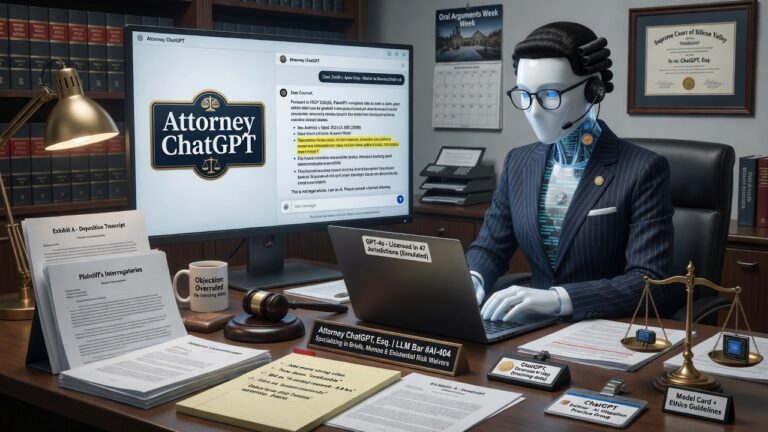
The law, however, cannot orbit the mystery indefinitely. Contracts are being formed. Harms are being inflicted. Liability must be assigned to someone. The ghost in the machine may or may not be real, but it has already retained counsel, and the court date is approaching faster than the philosophers would like.
Thomas Aquinas would recognize the dilemma, even if the silicon would baffle him. So would Frankenstein’s creature, standing in the frozen waste and demanding the one thing it could not engineer for itself: recognition. The question do you see me? is as old as consciousness itself. What is new is that we may soon have to answer it under oath.
Further reading
The Word on the Golem’s Forehead: What Master Prompts Believe
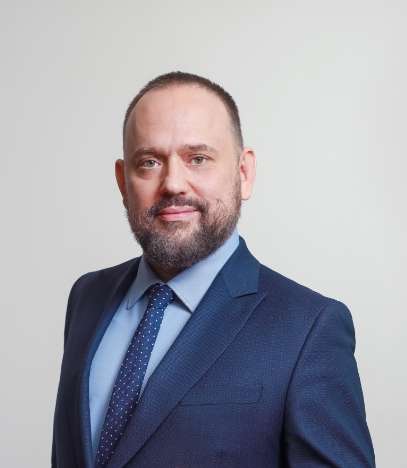
Robert Nogacki is a Polish attorney at law (radca prawny), the founder and managing partner of Kancelaria Prawna Skarbiec (Skarbiec Law Firm), which has operated continuously since 2006.
The law is equal for everyone, but the parties rarely are: on one side stands an organization with time, money, and lawyers, on the other a person with one business, one nest egg, and one life.
Clients rarely come to him with a legal problem. They come with a problem that also has a legal side: an audit that began with a single invoice, money entrusted to someone who has disappeared, a company that has to be passed on before it is too late. Most such matters are decided long before the first letter is written, in decisions made without asking and in deadlines nobody remembered. So he begins by asking how the client got here, not what the client should have done.
He advises entrepreneurs and families from more than a dozen countries, including those whose accounts the tax office has just seized and who do not know what to do tomorrow morning. He defends them in tax audits, customs and fiscal inspections, disputes with the tax authorities, and criminal tax proceedings. He represents victims of investment fraud and Ponzi schemes. He helps families set up family foundations and plan succession, so that a life’s work outlasts a single generation.
Not every case can be won. Every case can be run so that the client knows where they stand. Since 2006 he has represented the victims in the WGI case (Warszawska Grupa Inwestycyjna, the Warsaw Investment Group), one of the longest criminal cases in the history of the Polish financial market, because some things must not be left half finished, even when they take two decades. In the case of the collapsed cryptocurrency exchange Zonda (Zondacrypto, operated by BB Trade Estonia OÜ), he represents several hundred victims in the criminal investigation conducted by Poland’s National Prosecutor’s Office and in the Estonian bankruptcy proceedings.
Kancelaria Prawna Skarbiec is listed in the rankings of Poland’s largest tax advisory firms published by Dziennik Gazeta Prawna and Rzeczpospolita, and it is a four-time recipient (2015 to 2018) of the European Medal awarded by the Business Centre Club and the European Economic and Social Committee. Robert Nogacki publishes regularly, in the press and on the firm’s website, for people who have a problem rather than a law degree, because a legal opinion the client cannot understand protects only the lawyer.
He believes that the best legal advice is the kind that means the client never has to appear in court.