Guilt by Association: How a Tax System Defines Complicity
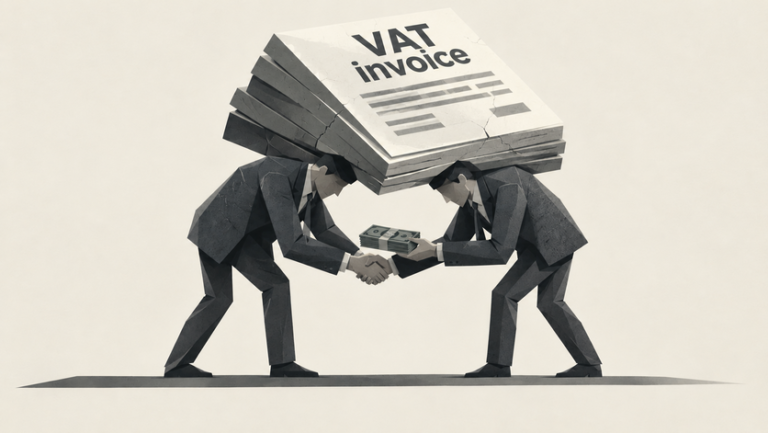
In Orwell’s 1984 there is a crime that requires no act, only the wrong cast of mind: thoughtcrime. Winston Smith is broken in the end not for what he did but for what he thought. For being near the wrong people. For failing to inform when he ought to have suspected. Poland’s tax system has its own version of thoughtcrime: participation in a VAT carousel. You need not know that you are taking part in a fraud. You need not profit from it. You need not even understand what a carousel is. It is enough that you bought goods from a company which, as it later turns out, was a link in the chain. It is enough that somewhere at the start of that chain, someone did not pay the tax. And suddenly you are the guilty one. You must prove that you did not know. You pay for the whole. Orwell described totalitarianism as a system in which guilt is independent of the act. The Polish tax system is not totalitarian, but this one mechanism runs on the same logic.
The Anatomy of a Carousel
To understand the trap, you have to understand the machine. A VAT carousel exploits a gap in the architecture of the European tax system. When goods cross a border between member states, the transaction is taxed at a zero rate. The buyer pays no VAT to the seller; it accounts for the tax itself, at home. This was an elegant solution, adopted in 1993 so as not to complicate trade within the single market. The trouble is that it opened a seam, and through that seam flow billions.
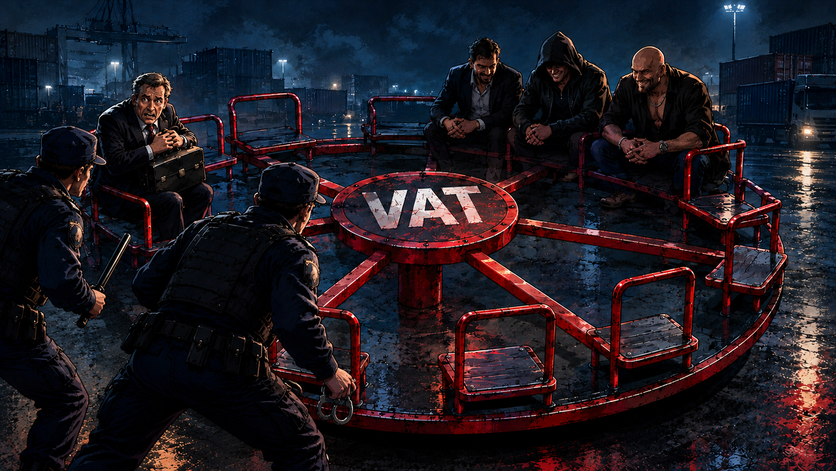
The scheme is simple. Company A in Germany sells goods to Company B in Poland with no VAT, because the transaction is intra-Community. B sells to C with VAT. C sells to D, D to E, and E exports back to Germany at the zero rate, with the right to a refund of the tax paid earlier in the chain. Except that B, the first company in Poland, never remits the VAT it collected from C. It vanishes. It is the missing trader. And all the tax that flowed through the chain has been extracted from the state. The goods can go round and round, hence the name. The same phones, the same electronics, the same fuel, moved between countries for no purpose but to generate fictitious liabilities and fictitious refunds.
The Perfect Crime, for Criminals
The genius of the carousel is that the real criminals are almost beyond reach. The missing trader is usually a shell: registered to a person with no assets, alive for a few months, trading only on paper. By the time the tax office starts asking questions, the company is gone. The person listed as its owner is dead, or homeless, or says he signed the papers for a bottle of vodka. The real organizers sit several layers away. They operate from safe jurisdictions. They have lawyers, accountants and corporate structures designed so that the trail breaks.
So whom does the tax office catch? It catches the companies that are in the chain but did not build it. Companies that bought the goods because the price was attractive. Companies that sold the goods because there was demand. Companies that did not know, or had no reason to know, that somewhere at the start of the chain someone was cheating. These companies have addresses. They have assets. They have bank accounts that can be frozen. And they have owners who can be charged.
Thoughtcrime: You Should Have Known
Orwell describes a habit of mind he calls crimestop: the ability not to see what should not be seen, to remain ignorant where knowledge is dangerous. The Polish tax authority expects the opposite: foresight. You should have known. You should have anticipated that your counterparty might be unreliable. You should have checked, and not only him, but his suppliers, and theirs. This is called due diligence. A phrase that sounds reasonable until you see what it actually demands. Did you confirm that the counterparty was registered for VAT? Did you verify that it had an office at the address it gave? Did you examine its financial history? Did you trace the supply chain to make sure the goods did not come from a suspicious source?
The Court of Justice of the European Union has ruled repeatedly that a trader cannot be required to carry out checks as thorough as those of a tax authority. That a taxpayer is not a law enforcement agency. That there is no duty to investigate one’s own counterparties. Polish practice ignores these rulings. The result is a standard that cannot be met. If you did not check, you were careless. If you checked and found nothing, you did not check enough. If you checked, found something, and traded anyway, you acted knowingly. Guilt is inevitable. Only its classification varies.
Fiscal Doublethink
Orwell defines doublethink as the capacity to hold two contradictory truths at once. The tax system demands similar mental gymnastics.
On the one hand: you have the right to deduct VAT. This is not a favor; it is a structural element of the tax. Without the right to deduct, VAT would not be a tax on value added but a turnover tax, piling up at every stage. On the other hand: you can lose that right if somewhere in the chain, perhaps five transactions back, in a company you have never heard of, someone committed fraud.
On the one hand: the presumption of innocence is the foundation of the rule of law. On the other hand: in a carousel case it is you who must prove that you did not know. The burden of proof is reversed.
On the one hand: a trader is supposed to run a business, not investigations. On the other hand: if you do not run investigations, you have failed to exercise due diligence.
To function in this system you must believe in your rights and know they can be taken away. You must trust your counterparties and suspect every one of them. You must be innocent and ready to prove it. That is doublethink in practice.
The Ministry of Truth Revises the Past
In 1984 the Ministry of Truth corrects the past: it rewrites the archives so that the present looks like the logical consequence of what came before. Something similar happens in VAT carousel cases. Transactions that were legal, routine and documented when they were made are reclassified, retroactively, as criminal.
Five years ago you bought goods from a counterparty. You checked him: registered, an office, taxes paid. The transaction passed without objection. You accounted for the VAT, deducted it, case closed. Now you learn that the company, which no longer exists, was a link in a carousel. That your transaction of five years ago is evidence of participation in a fraud. That the VAT you deducted must be repaid. With interest. Plus a penalty. Plus, perhaps, criminal charges.
The past has been changed. What was legal has become a crime. What was diligent has become negligent. And no one can tell you what you should have done differently, because by the standards of the time you did everything right. But the standards changed. Retroactively.
Big Brother’s Statistics
In 2023, 1,188 bank accounts were seized in Poland on suspicion of VAT fraud, more than twice as many as in 2019. The frozen funds came to 88.5 million zlotys. In 2024 more than 3,700 criminal tax investigations were opened in connection with VAT offenses. These numbers sound like success. They are presented as success. The system is fighting fraudsters, the results are rising, the budget is protected. But behind each of those numbers stand actual companies. Actual bank accounts: frozen, inaccessible, making it impossible to trade. Actual people: suspects, interrogated, living in uncertainty.
How many of these companies are the real organizers of carousels? And how many are traders who found themselves in the wrong place in the chain? The system does not distinguish. The system produces statistics. Orwell wrote that in Oceania the production of boots rose every year, though half the population went barefoot. Statistics serve power, not truth.
How to Survive
There is no way to eliminate entirely the risk of being drawn into a carousel. As long as the system works the way it does, every transaction carries a potential threat. But the risk can be reduced.
Due diligence, however absurdly high the standard, is a line of defense. Records of counterparty verification. Procedures. A decision trail showing that you made the effort. This does not guarantee that you will not be accused. But it changes the character of the case. It changes the position from which you defend yourself. And when the accusation comes, and it can come to anyone, you need someone who understands the mechanism. Who knows the case law of the Court holding that the reversed burden of proof has limits. Who can show that you were an honest trader in a dishonest system. How we defend these cases is set out on our service page: VAT Carousel Allegations: Defending Businesses in Poland.
A Final Thought
Winston Smith was broken not because he was guilty but because the system could define guilt however it wished. The Polish tax system is not totalitarianism. But the mechanism of liability for a VAT carousel runs on similar logic: you can be innocent in every sensible meaning of the word and still be punished.
The difference is that you can defend yourself. You can know your rights. You can have someone on your side.
Orwell did not give his protagonist that option.
You have it.
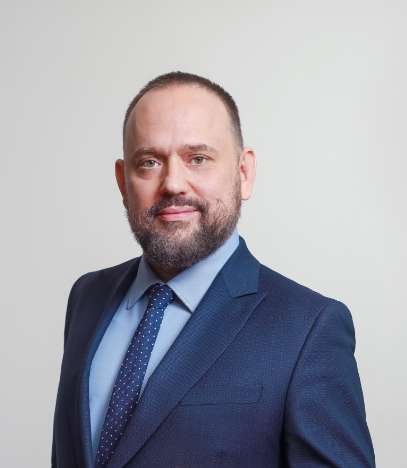
Robert Nogacki is a Polish attorney at law (radca prawny), the founder and managing partner of Kancelaria Prawna Skarbiec (Skarbiec Law Firm), which has operated continuously since 2006.
The law is equal for everyone, but the parties rarely are: on one side stands an organization with time, money, and lawyers, on the other a person with one business, one nest egg, and one life.
Clients rarely come to him with a legal problem. They come with a problem that also has a legal side: an audit that began with a single invoice, money entrusted to someone who has disappeared, a company that has to be passed on before it is too late. Most such matters are decided long before the first letter is written, in decisions made without asking and in deadlines nobody remembered. So he begins by asking how the client got here, not what the client should have done.
He advises entrepreneurs and families from more than a dozen countries, including those whose accounts the tax office has just seized and who do not know what to do tomorrow morning. He defends them in tax audits, customs and fiscal inspections, disputes with the tax authorities, and criminal tax proceedings. He represents victims of investment fraud and Ponzi schemes. He helps families set up family foundations and plan succession, so that a life’s work outlasts a single generation.
Not every case can be won. Every case can be run so that the client knows where they stand. Since 2006 he has represented the victims in the WGI case (Warszawska Grupa Inwestycyjna, the Warsaw Investment Group), one of the longest criminal cases in the history of the Polish financial market, because some things must not be left half finished, even when they take two decades. In the case of the collapsed cryptocurrency exchange Zonda (Zondacrypto, operated by BB Trade Estonia OÜ), he represents several hundred victims in the criminal investigation conducted by Poland’s National Prosecutor’s Office and in the Estonian bankruptcy proceedings.
Kancelaria Prawna Skarbiec is listed in the rankings of Poland’s largest tax advisory firms published by Dziennik Gazeta Prawna and Rzeczpospolita, and it is a four-time recipient (2015 to 2018) of the European Medal awarded by the Business Centre Club and the European Economic and Social Committee. Robert Nogacki publishes regularly, in the press and on the firm’s website, for people who have a problem rather than a law degree, because a legal opinion the client cannot understand protects only the lawyer.
He believes that the best legal advice is the kind that means the client never has to appear in court.