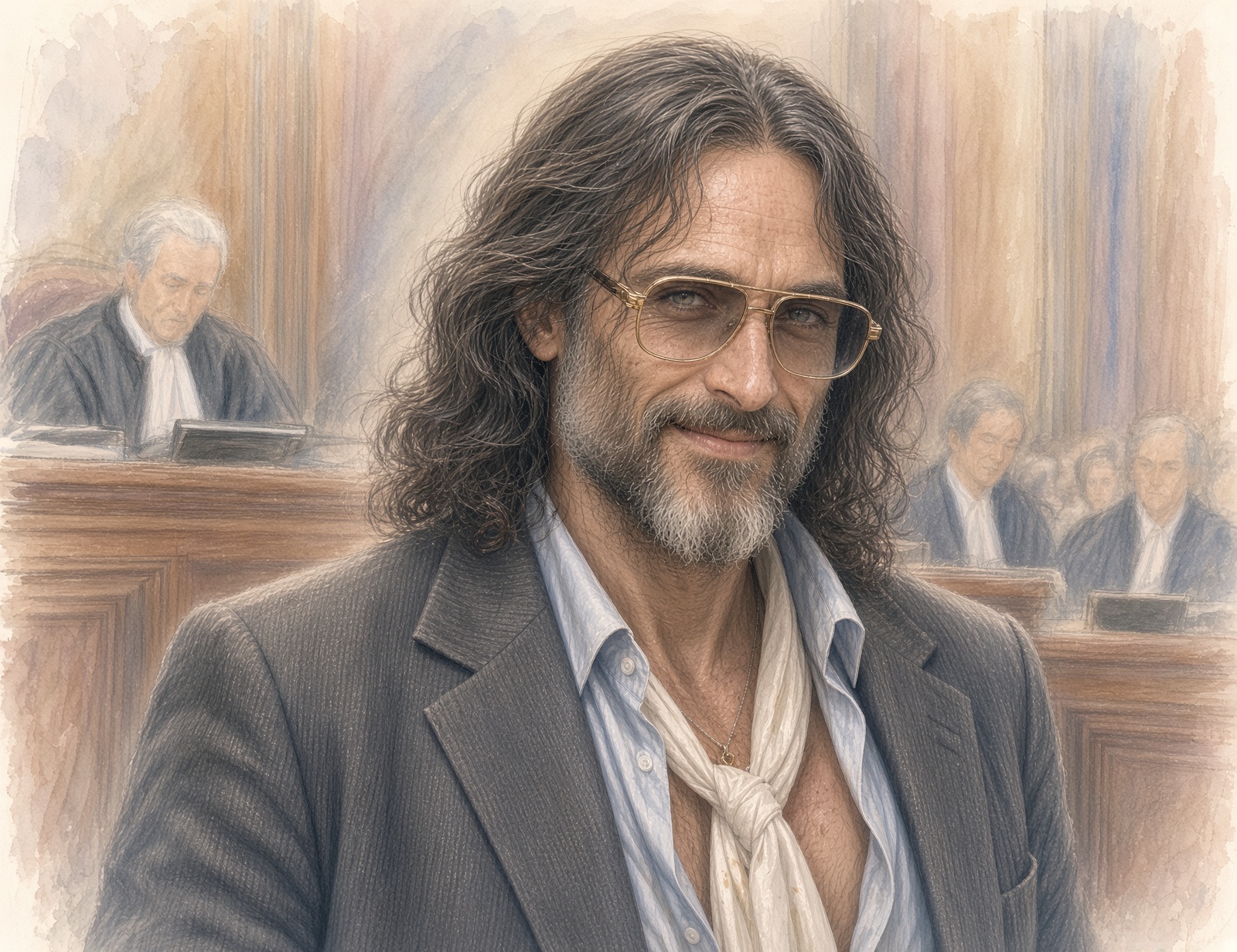
Time Is a Player: Russell Brand Gets Ten and a Half Years for Crimes Two Decades Old
On Monday, November 9, 2026, at Southwark Crown Court, in London, Mr. Justice Bennathan sentenced Russell Brand, the fifty-one-year-old comedian, actor, and former husband of Katy Perry, to ten years and six months in prison: nine years for a rape committed in 2009, and eighteen months for three sexual assaults committed between 2004 and 2009. Four days earlier, a jury had unanimously found him guilty on four of seven counts and acquitted him on the other three, among them the two oldest. The police had no CCTV footage and no forensic evidence. The latest of the crimes was seventeen years old; the earliest, twenty-two. In Poland, where I practice, two of the four would have been time-barred years before any investigation began, a third would probably not have met the definition of the offense on the day it was committed, and the fate of the fourth would have come down to a few months. R v Russell Brand is the story of a celebrity’s fall, but it is also something more useful: a demonstration of what criminal law does with time, and of what time does to evidence.
Filed Under “T”
Brand kept the phone number of a twenty-one-year-old fan under the letter “T.” It stood for “tart.” The judge cited the entry as a measure of Brand’s contempt for his casual partners, and then set out the rest. Early in 2009, after one of his shows, the two had consensual sex. A few days later, Brand, who was then thirty-three, invited her to his house. She agreed to intercourse with a condom. Then he turned her over, took the condom off, and, without asking, forced anal sex on her, though she asked him twice to stop, the second time loudly. Afterward, he told her to clean up the bed, and went to get ready for work. His driver took her to an Underground station. The driver, the judge noted, “for some reason” had tissues ready. Three words, and the judge left them alone.
The woman has no name in the sentencing remarks. In England, complainants in sexual-offense cases are anonymous for life, and the judge began by reminding the court of it. Nothing about the women appears here that the court did not publish, and the account of the crimes is the court’s own, given after the jury’s verdicts.
The other three offenses are lesser, but they are cut from the same cloth. In July, 2004, at a party given by a mutual acquaintance, a woman asked to be introduced to Brand because she thought he was funny. He grabbed her breasts as she sat talking to him. That night she wandered the streets of London, in tears, phoning a friend. Around the same time, at a London radio station, he pinned a newsreader he had never met against a wall, kissing and groping her in front of his entourage. When she pushed him away, one of the men laughed. The judge supposed that the companions had seen the sort of outrage that only Brand could get away with. It was also a crime, he added, and, “as it turns out,” Brand had not gotten away with it. Late in 2009, on the set of an advertisement for a DVD of his own work, Brand let it be known through an associate that he would not continue until a woman from the television company gave him a massage, and then put his face in her lap. He denied all of it. At trial, he testified that he had never touched a woman sexually without her consent, which the judge, after the verdicts, called one of a series of lies.
An English judge does not sentence by feel. He is bound, with one narrow exception, by the guidelines of the Sentencing Council, which sort every offense into categories and ranges. The rape fell into Category 2B, with a starting point of eight years; the prosecutor, by one account from the courtroom, had asked for Category 1, where the starting points begin at twelve. To the eight years the judge added two, for the removal of the condom without consent and for an ejaculation that left the woman fearing for months that she had contracted H.I.V., and he took off one for mitigation. For the assaults, he imposed sentences of nine months, eighteen months (reduced from two years), and eight months. Those three run concurrently with one another but consecutively to the rape. This is the principle of totality, which rules out mechanical addition and asks whether the total is just and proportionate. Brand will serve two-thirds of the term before being released on license, under supervision and liable to recall if he breaches its terms, and he will be subject, indefinitely, to the notification requirements of the sex-offender register. The sentence is not the last word: he may seek permission to appeal, and British commentators expect his lawyers to challenge at least its length.
Time as Evidence, Time as Verdict
English law has no statute of limitations for serious crimes. The Crown Prosecution Service, which brings criminal cases in England and Wales, said as much after the verdicts: sexual offenses can be prosecuted no matter how much time has passed. Time does not close a case there. It becomes part of the evidence, usually to the benefit of the defense.
On the Continent, time is often the verdict, and it is delivered without a trial. Poland, where nearly every crime has a clock on it, shows how. Move the Brand case to Warsaw: the same acts, against adult women, reported to the authorities only after the documentary. This is an exercise, not an opinion, because the legal classification of each act would be contested. At its harshest, a Polish court would treat the two assaults of 2004 and 2005 as forcing another person to submit to a sexual act (Article 197, § 2, of the Penal Code, the Kodeks karny). Until September 26, 2005, that offense carried a maximum of five years, and an offense with that maximum becomes time-barred after ten. Liability would have lapsed in 2014 or 2015. Had the assault at the radio station come after the penalty was raised, it would have lapsed early in 2021 at the latest, still before the television documentary of September, 2023, with which the investigation began.
The assault on the advertisement set would be harder still. The judge describes no force and no threat, and whether there was deception could be argued either way. Yet force, threat, and deception were the only means that the Polish definition of rape recognized until February 13, 2025, when the words “or in another manner, despite the lack of that person’s consent” were added. Earlier acts are judged under the earlier law, as the more lenient to the accused. Treated instead as an abuse of a relationship of dependence (Article 199, § 1, up to three years), the act would have been time-barred after five years, in 2014. And acts committed before January 27, 2014, can to this day be prosecuted in Poland only at the victim’s own request.
That leaves the rape of early 2009. At the time, it carried two to twelve years, which gives a limitations period of fifteen. With the forty-six days of pandemic suspension added, the basic term would have run out in the spring of 2024. It is extended by ten years only if proceedings are opened before it expires or, where proceedings are already under way, by the first step taken to look into the new act. The documentary aired in September, 2023; the charge concerning this woman was announced in December, 2025. The gravest count would therefore have depended on whether the authorities took up her complaint within roughly six months of the broadcast. In London, nobody had to ask.
Polish law is harsher now. Rape in its basic form carries two to fifteen years and is time-barred after fifteen, or after twenty-five once proceedings have been opened; for sexual offenses against children, the period cannot expire before the victim turns forty, and the gravest of them are never time-barred at all. The principle has not changed. Sweden showed how it operates in the case of Julian Assange. In 2015, three of the four allegations under investigation became time-barred. In November, 2019, nine months before the deadline for the fourth, the prosecutor Eva-Marie Persson closed the rape investigation, although she considered the complainant credible: the witnesses’ recollections had weakened with the years. “Time is a player in this decision,” she said.
Neither model is self-evidently right. A limitations period protects against a trial in which nothing can be checked anymore. Its absence protects against an impunity conferred by the calendar alone. The Polish code asks how many years have passed. The English court asks what the years have left.
A Trial Without Traces
The Metropolitan Police described the investigation with unusual candor. There was no camera footage and no forensic evidence, and the passage of time had limited what could be recovered digitally. Instead, detectives took more than four hundred statements from more than a hundred witnesses, reviewed some fourteen hundred documents, rebuilt timelines, and tracked down old floor plans and photographs of the places involved, including a former address of the defendant’s. They watched hundreds of hours of his standup and interviews. They also read all his books. In four police interviews, Brand said that he did not recognize the women accusing him; as the trial approached, his account changed, which the prosecutor called selective memory. It took a little more than three years to get from the broadcast to the sentence, and half of that time went to assembling the material for the first charges.
The sentencing remarks and the reports from the trial show what proof is made of in a case like this. First, reactions at the time. The woman assaulted in 2004 phoned a friend in the middle of the night, and the judge, cautious because the jury had acquitted Brand of a later attack on her, recorded only that something had caused her distress. Second, the defendant’s own words: the entry in his phone, and a memoir from 2007, passages of which were put to him in the witness box. Third, pattern. The prosecution stressed that the women did not know one another, and called its method suspect-centric: it examines a decade of the defendant’s conduct, and not whether the complainants behaved as victims are supposed to. English courts, in a line of authority tidied up by R v Freeman, in 2008, allow the evidence of one complainant to support a count concerning another, since independent accounts of similar behavior are hard to explain as coincidence.
The jury did not follow the pattern blindly. It acquitted Brand of a rape alleged to have taken place in 1999, of an attempted indecent assault alleged in 2001, and of an oral rape alleged in 2004, even though that last count concerned the same woman whose account of the party it accepted. Juries give no reasons, so the reasons will never be known. One can offer a hypothesis, and only a hypothesis. Guidelines issued by the British Psychological Society, in 2008, caution that a memory is a record of a person’s experience and not of the event itself, that it is always incomplete, and that, as a rule, its accuracy can be established only by independent evidence. For each of the four convictions, the remarks mention circumstances that could be checked with someone other than the complainant: the night call, the people present at the radio station and on the set, the driver, the entry in the phone. English law, for that matter, does not require that a complainant’s word be corroborated. Whether those circumstances were checked, and whether they tipped the balance, only twelve people know.
The judge himself showed what to do with the rest. He said that he disregarded the allegations made in the documentary, and those of which the jury had been less than sure. Journalism can start a case. It cannot decide one.
The Defense: Memory, the Press, and False Accusations
The arguments open to the defense in such cases deserve their strongest form, because in the next trial they may be right.
The first argument is delay. A man accused of what he did on a particular evening twenty-two years ago cannot produce an alibi, find his witnesses, or recover his phone records. English law offers a remedy, the stay of proceedings for abuse of process, but since CPS v F, in 2011, courts have granted it only exceptionally: fairness is to be secured by the trial itself, and by directions to the jury. In R v RD, convictions were upheld for offenses between thirty-nine and sixty-three years old. James Wood, a barrister, asked in the title of a commentary whether the doctrine is dead, and the scholar Holly Greenwood has argued for reviving it where evidence has gone missing.
The second argument is publicity. All four women went to the police after a Channel 4 documentary aired, and Brand’s counsel, Ian Winter, said that the reporting had “poisoned the well of justice.” It is a serious argument. When allegations reach the screen and the front page before they reach a police station, the independence of later accounts can no longer be taken for granted, and independence is what pattern evidence rests on. The judge opened his remarks by observing that Brand’s status had protected him until 2023, and that publication had emboldened women to come forward. The barrister’s sentence and the judge’s can both be true. That is the difficulty.
The third argument is that accusations are sometimes false, and that publicity injures even those who are never charged. Carl Beech, who told the police of a pedophile ring at Westminster, was sentenced in 2019 to a total of eighteen years, for perverting the course of justice and for fraud, among other offenses. Operation Midland, the inquiry he set off, cost about two million pounds and ended without a single arrest; a retired judge, Sir Richard Henriques, counted among its causes a culture in which “victims” must be believed. The singer Cliff Richard, who was never arrested or charged, was awarded two hundred and ten thousand pounds against the BBC over its broadcast of a police search of his home.
The loudest argument, though, was the fourth, and the weakest. The defense, according to agency reports, suggested that the women had not screamed, fought back, or run away. Since R v D, a 2008 decision of the Court of Appeal, an English judge may tell a jury that a late complaint is not necessarily a false one. After the trial, the Victims’ Commissioner, Claire Waxman, called for such directions to become a statutory duty. The Law Commission, the independent body that reviews the law of England and Wales, had already recommended expanding them, while keeping juries in trials for sexual offenses. The argument goes on.
Other Courtrooms: Harris, Spacey, Weinstein, Cosby
The Brand case has predecessors, and each teaches something different.
After the revelations about the television presenter Jimmy Savile, who died in 2011 without ever facing a court, the British police launched Operation Yewtree. In 2014, the entertainer Rolf Harris received five years and nine months for assaults committed between 1969 and 1986, and the judge noted that he was held to the maximum penalties of the period. The lesson: old crimes are tried under old ceilings. That did not apply to Brand. The oldest crime of which he was convicted took place in July, 2004, two months after the Sexual Offences Act 2003 came into force.
In July, 2023, in the same court, after a trial of the same length, a jury acquitted the actor Kevin Spacey of all nine charges, which concerned four men and the years from 2001 to 2013. The lesson: the absence of a limitations period is no guarantee of a conviction.
The case of the film producer Harvey Weinstein shows that pattern evidence cuts both ways. His first New York conviction was overturned in 2024, because the trial court had wrongly admitted testimony about acts that the indictment did not charge. At the retrial, the jury convicted him on one count and acquitted him on another; on a third, two successive juries returned no verdict, and the prosecutors then dropped it. In September, 2026, he was sentenced to fifteen years for an assault committed in 2006; he maintains his innocence and plans to appeal. On how jurors pull apart the counts of a single indictment, see the account of the Sean Combs trial (Diddy in the Hospital, Then Back in Solitary: What the Record of United States v. Combs Really Shows).
The comedian Bill Cosby was charged days before a twelve-year limitations period expired, and his conviction was overturned in 2021, because a previous prosecutor had promised him, in 2005, that he would not be charged, and Cosby, relying on that promise, had given damaging testimony in a civil suit. The lesson: old cases carry old promises.
The sequel is already on the calendar. On January 25, 2027, in the same London court, the trial of Tim Westwood, a former BBC presenter, is due to begin, on charges spanning the years from 1983 to 2016; Westwood denies the charges and is presumed innocent. In Paris, the court of appeal is scheduled to hear, from November 16th to November 20th, the case of the actor Gérard Depardieu, whose conviction for assaults committed in 2021 is not final. Brand himself faces a civil suit in New York, which he contests, brought under a statute that for one year reopened the courts to adult survivors whose claims had expired, and the London police are investigating two further allegations of rape. In none of these matters is anything settled.
The Judge Who Would Not Punish Fame
The most interesting thing in the remarks is what the judge refused. The prosecution wanted Brand’s fame treated as an aggravating factor hanging over the whole case. The judge separated two things. That the women could not, for years, avoid his face on television and in the newspapers he counted as harm. That fame had made the crimes possible he regarded as intrinsic to them, and so already accounted for. And he warned himself against punishing a man more because he is famous.
He rejected three other submissions as well. He would not treat the associates on the advertisement set as participants in the offense, though he wrote that they should have stopped Brand: he could not be sure that they knew what Brand intended. “Abuse of trust,” he observed, has a defined meaning in the guidelines, and being a celebrity is not within it. Nor would he accept that the women were “particularly vulnerable,” one because she had had a few drinks, the other because she was more than a decade younger than Brand and admired him. They were, he wrote, accomplished adults who had made reasonable decisions, and those decisions did nothing to diminish his guilt: whatever a woman wears, wherever she goes, whatever she drinks, she keeps the right to say no.
Time worked for both sides in this sentence. In Brand’s favor were the seventeen years that had passed since the last of the offenses, the absence of significant previous convictions, and his help for people struggling with addiction. The guidelines say that in rape cases good character should not normally carry significant weight, and the judge noted, besides, that by 2009 Brand had already committed two sexual assaults. He took a year off all the same. Against Brand was harm that had gone on growing through those years. The woman raped in 2009 abandoned the career she had begun, and still finds it hard to trust people. The newsreader was startled every time she heard his voice on television. For the assault at the party, the judge imposed nine months, above the range, which for an offense in that category ends at twenty-six weeks, because the consequences exceeded what the guidelines treat as typical.
He recorded, finally, that every one of the women had been told in court that she was lying, and that this was done on the defendant’s instructions. He did not increase the sentence for it. The right to defend oneself is not an aggravating factor, even when the defense fails. The remarks repay reading alongside an essay on how judges arrive at their decisions (First the Hunch, Then the Law): the guidelines oblige a judge to write his intuition out in steps that can be checked.
In Sum
On November 9, 2026, Russell Brand was sentenced to ten years and six months in prison for a rape and three sexual assaults committed between 2004 and 2009. The jury acquitted him of three other counts, and the defense may still appeal. The case was built without recordings or forensic traces, out of statements, documents, the defendant’s own words, and the convergence of accounts from women who did not know one another. English law sets no limitations period for such crimes, and it generally answers the complaint of delay with a trial and with directions to the jury, and only exceptionally with a stay. In Poland, the calendar would have decided most of it: two of the offenses would have been time-barred years before the investigation, the third would probably have fallen outside the definition then in force, and the fourth would have survived only if the authorities had moved quickly.
Three practical points follow for anyone whose case touches Poland. A person harmed years ago should begin by fixing the date and the legal classification of the act, and then compute the limitations period under the law in force on that date and under every amendment since, because the outcome may turn on the day the authorities first acted. After many years, the strongest evidence is whatever was created at the time: messages, photographs, medical records, the people one confided in. And a person accused of something that happened decades ago defends himself with the same material, read from the other side: diaries, travel, work records, and witnesses who have to be found while they still remember.

Robert Nogacki is a Polish attorney at law (radca prawny), the founder and managing partner of Kancelaria Prawna Skarbiec (Skarbiec Law Firm), which has operated continuously since 2006.
The law is equal for everyone, but the parties rarely are: on one side stands an organization with time, money, and lawyers, on the other a person with one business, one nest egg, and one life.
Clients rarely come to him with a legal problem. They come with a problem that also has a legal side: an audit that began with a single invoice, money entrusted to someone who has disappeared, a company that has to be passed on before it is too late. Most such matters are decided long before the first letter is written, in decisions made without asking and in deadlines nobody remembered. So he begins by asking how the client got here, not what the client should have done.
He advises entrepreneurs and families from more than a dozen countries, including those whose accounts the tax office has just seized and who do not know what to do tomorrow morning. He defends them in tax audits, customs and fiscal inspections, disputes with the tax authorities, and criminal tax proceedings. He represents victims of investment fraud and Ponzi schemes. He helps families set up family foundations and plan succession, so that a life’s work outlasts a single generation.
Not every case can be won. Every case can be run so that the client knows where they stand. Since 2006 he has represented the victims in the WGI case (Warszawska Grupa Inwestycyjna, the Warsaw Investment Group), one of the longest criminal cases in the history of the Polish financial market, because some things must not be left half finished, even when they take two decades. In the case of the collapsed cryptocurrency exchange Zonda (Zondacrypto, operated by BB Trade Estonia OÜ), he represents several hundred victims in the criminal investigation conducted by Poland’s National Prosecutor’s Office and in the Estonian bankruptcy proceedings.
Kancelaria Prawna Skarbiec is listed in the rankings of Poland’s largest tax advisory firms published by Dziennik Gazeta Prawna and Rzeczpospolita, and it is a four-time recipient (2015 to 2018) of the European Medal awarded by the Business Centre Club and the European Economic and Social Committee. Robert Nogacki publishes regularly, in the press and on the firm’s website, for people who have a problem rather than a law degree, because a legal opinion the client cannot understand protects only the lawyer.
He believes that the best legal advice is the kind that means the client never has to appear in court.