Zonda: Who Stood Behind BitBay? The Dubai Papers
From 2018 onward, BitBay, the exchange that later became Zonda, was owned by three Dubai companies: Arial, Skybay and Central Bay. Every public analysis of the exchange’s ownership stopped there. Beyond that point lay desert. I have obtained the registry documents of four Dubai companies from a single package: two from that trio, Skybay and Arial, and two that never appear in BitBay’s Polish registry file: Atriumbay, known for a two million zloty investment in a company run by Rafał Zaorski, and M C G, of which no one has written until now. The Central Bay papers are not in the set, but there is a lead on what Central Bay may have been called before. The documents show who formally stood behind each of the four: behind Skybay, Sylwester Suszek himself; behind Arial, a previously unknown Marcin Szczawiński; behind M C G, Roman Ż.; and behind Atriumbay, Patrycja Wojtol and a Filipina, Edita Mercado Hag Mouhamad. Before the names, a word about the city, and about why these documents can be trusted.
The City With Its Own Typeface
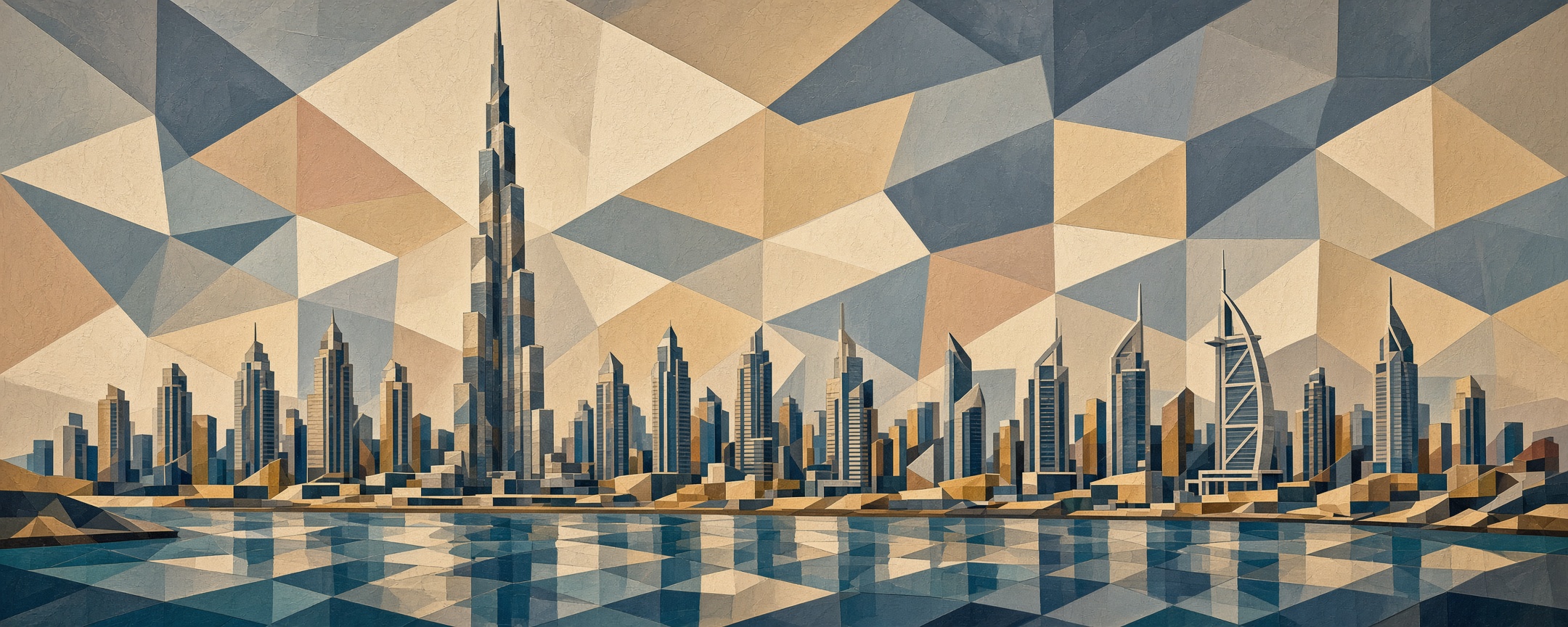
For Polish entrepreneurs, Dubai in 2017 was what Cyprus had been a decade earlier, with better weather. No corporate income tax (the tax arrived only in 2023), a bank on site, an office on site, and one condition that sounds exotic in Europe: until 2021, the law required that 51 percent of an onshore company be held by an Emirati citizen. A whole market grew around that requirement. The local sponsor lends a name, signs the papers, collects an annual fee and asks no questions. Management, the bank account and the decisions stay with the foreign partner holding 49 percent. A company is bought like a package: a name, a line of business, capital on paper, an office in a building whose owner rents addresses to hundreds of such companies at once.
Dubai is also the only city in the world with its own typeface. The Dubai Font was developed with Microsoft, unveiled on 30 April 2017, and, at the direction of the Crown Prince, made mandatory in government documents. It sounds like a whim. In a moment it will turn out to be evidence.
One more thing. When we read “a Dubai company,” we picture a glass tower on the canal in Business Bay. The owners of Poland’s largest cryptocurrency exchange resided in office number 113 in the Al Qusais Industrial Area 2 in Deira, among workshops and warehouses, in a building belonging to a Mr. Al Muhairi.
Four Documents, One Shareholder
The documents are printouts from the register of Dubai Economy, the Department of Economic Development (DED): the commercial licence, the partners annex and the commercial register extract. Four companies, four licences; Central Bay, the third shareholder in the Polish file, is not in the set, and I return to it under M C G:
- Atriumbay Investment in Commercial Enterprises L.L.C., licence 776826 of 23 February 2017. Partners and managers: Patrycja Jolanta Wojtol (18 percent) and Edita Mercado Hag Mouhamad of the Philippines (31 percent). Capital 400,000 dirhams. Office 210, Al Qusais 2.
- Skybay Investment in Commercial Enterprises L.L.C., licence 777127 of 28 February 2017. Partner and manager: Sylwester Jan Suszek (49 percent). Capital 300,000 dirhams. Office 113, Al Qusais Industrial 2.
- Arial Investment in Commercial Enterprises L.L.C., licence 781995 of 7 May 2017. Partner and manager: Marcin Michał Szczawiński (49 percent). Capital 300,000 dirhams. From 9 May 2018, office 113, the same as Skybay.
- M C G Investment in Commercial Enterprises L.L.C., licence 794066 of 8 November 2017. Partner and manager: Roman Przemysław Ż. (49 percent). Capital 300,000 dirhams. Office 302, Business Bay.
In all four, 51 percent is held by the same person: Ayesha Salem Ali Saeed Alshamsi, an Emirati citizen, with the same registry person number (452128). In none of them is she a manager. All four have an identical line of business, “Investment in Commercial Enterprises & Management,” which is a holding activity: forming companies and taking shares in them. Capital of 300,000 dirhams is the standard minimum quoted for that activity. Three of the offices sit in buildings of the same landlord. Four licences in nine months. One caveat, for the record: a professional sponsor serves many clients, so a shared sponsor proves a shared organiser and a shared calendar, not yet a shared beneficiary. That is proved only by the partners’ names and by the Polish registers.
What Follows From Them
- Skybay is Suszek in person. According to the 2017 financial statements, Skybay, with 47 percent of the shares, already sat at BitBay’s shareholders’ meeting on 8 December 2017; the registry court disclosed it on 26 July 2018. In the 2019 management report it holds 940 of 2,100 shares, that is 44.8 percent, and it remains the largest shareholder to the end. Rzeczpospolita established from court files that before his disappearance Suszek moved his BitBay shares to three of his own Dubai companies. For Skybay the document confirms it in black and white: Suszek is its partner and sole manager. Sylwester Suszek disappeared in March 2022, so from that day BitBay’s largest shareholder has formally had a management with no one managing.
- Arial is not Suszek. In December 2017 Arial held 38.5 percent of BitBay, and in 2019 870 shares, that is 41.4 percent; the registry court disclosed it on 30 January 2018, in place of Marek K. Its partner and sole manager is Marcin Michał Szczawiński, a name absent from BitBay’s registry file and from every publication on this case. The thesis of “Suszek’s three companies” is therefore a simplification. At the same time, on 9 May 2018, Arial moved its seat to Skybay’s address, a month before the resolution of 6 June 2018 that raised BitBay’s capital and tidied up the Dubai shareholder structure. Two companies at one address at the decisive moment is a picture of joint steering. Who Szczawiński is in relation to Arial, owner, trustee or front man, the document does not say. That is question number one.
- M C G belongs to Roman Ż. According to TVN24, Roman Ż. held no shares in BitBay but, according to documents, played a key role; in 2018 he bought a house on the Spanish coast together with Suszek, and the idea of a crypto mining investment in Dubai is said to have been his. Rzeczpospolita describes Suszek as Roman Ż.’s man. Until now this rested on testimony and accounts. The M C G licence is the first official document in which Roman Ż. stands next to Suszek inside the same Dubai construction: the same sponsor, the same line of business, the same capital, seven weeks after Suszek took over as BitBay’s chief executive (21 September 2017) and a month before the shareholders’ meeting of 8 December 2017. Hence a hypothesis: M C G was renamed Central Bay, BitBay’s third shareholder with 290 shares (13.8 percent), disclosed in the Polish register on 26 July 2018. Atriumbay is ruled out, because in February 2019 it was still called Atriumbay. M C G is ruled out only if Central Bay carries a different licence number. The check is simple: compare Central Bay’s registration number in BitBay’s court file with licence 794066. If they match, Roman Ż. was a BitBay shareholder, contrary to what has been established so far. If they do not, the package counted at least five companies.
- Atriumbay, Rafał Zaorski’s investor, comes from the same package. On 18 June 2018 Atriumbay subscribed for 60,000 Series B shares of Krypto Jam S.A., the market maker for BitBay, for 2,000,400 zloty, and Zaorski explained publicly that Atriumbay had invested in a firm for which Krypto Jam did the market making. Writing about Rafał Zaorski and BitBay’s books, I noted that whether Atriumbay belongs to the same family as BitBay’s shareholders could not be established from Polish documents. The Dubai documents change that: Atriumbay received its licence five days before Skybay, from the same sponsor, with the same line of business and an office with the same landlord. It is the first in the series and has the highest capital. Its partners, Wojtol and Mercado, do not appear in Polish registers. The two million zloty from the “strategic investor” in Zaorski’s company therefore came out of the same Dubai workshop that produced BitBay’s owner companies. Who stood behind that workshop remains to be established. That there was one, no longer does.
- The chronology shows a plan, not a flight in panic. The companies were formed between February and November 2017, and Skybay and Arial were already BitBay’s shareholders at the December 2017 meeting: from Skybay’s licence to taking 47 percent of the exchange, less than ten months passed. The registry court learned of it in 2018, as the exchange was landing on the warning list of the Polish Financial Supervision Authority (KNF) and announcing its move to Malta. According to Rzeczpospolita, Suszek wanted tax residence in Dubai and planned to buy property there. The 2019 printouts, with their receipt numbers, show that Skybay, Arial and Atriumbay were still being paid for and renewed in 2019. In the LEI database, which I cited when BitBay was struck off, Skybay appears at a Burj Khalifa address; the 2019 licence points to office 113 in Al Qusais. What happened afterwards is unknown. What is known is that the Polish registry court’s 2025 notices to the Dubai companies went unanswered, and that BitBay sp. z o.o. vanished from the register: dissolved by order of 9 January 2026, struck off on 17 February 2026.
Are These Documents Authentic?
Yes, with high probability. Certainty comes only from checking at the source by licence number; the numbers are on the documents, and the Dubai Economy portal is public, so anyone can do it. Here is what I checked in the files themselves.
- Metadata. The three 2019 printouts were generated by the PDFsharp library, the 2017 M C G file by Crystal Reports. The file creation times match the “Print Date” on the document to the second (Arial 09:40:52, Atriumbay 10:41:57, Skybay 21:22:03), in the UTC+4 time zone, which is the Emirates. For M C G there is an eight minute gap between the time on the report and the export of the file, which is typical of Crystal Reports. The change of generator between 2017 and 2019 matches the replacement of the DED system in that period; a forger producing four documents at once would use a single template. Both generations embed the Dubai Font, introduced into government documents in April 2017, and all the printouts are later than that. Yes, that typeface.
- No traces of editing. Each file has a single end of file marker; a program such as Acrobat appends another after every correction, so an edited file carries several. No forms, scripts or annotations. The fonts are uniformly embedded as subsets, with the same object numbers in the three 2019 files. The logos and header band are byte for byte identical in them; in M C G they have the same dimensions but different compression, consistent with the different generator. The blank trailing pages are a generator artefact, with no hidden content. The text layer contains no names other than the visible ones and no white masking rectangles, the simplest way of swapping data on a ready template.
- Consistency of numbering, which is not easily invented. Licence numbers rise with issue dates at a rate of roughly 60 to 70 a day, matching the order of magnitude of DED’s annual issuance (over 20,000 licences). Commercial register numbers rise at 150 to 175 a day, Chamber of Commerce membership numbers at the pace of licences, and the 2019 receipt numbers at roughly 970 a day across three dates, with a spread below 2 percent. Person numbers are identical on the licence page and in the partners annex, the shares add up to 100 percent, and the licence and register number pairs repeat without error on every page.
- Features no one can forge without access to the originals: clerical transliterations of Polish names into Arabic (Patrycja as “Pitrkaja”), the address format “office X, property of Y” with plot numbers matching the district (Business Bay 346, Al Qusais 243 and 233), system artefacts in the capital field (values of minus one), the unusual PDFsharp page format repeated in three files. Anyone wishing to forge this would first have to forge Dubai’s bureaucracy.
- Agreement with the rest of the world. Names, numbers and partners match BitBay’s registry file and the findings of the press. DED licences are annual; the “valid to 2020” dates on the 2019 printouts result from renewals paid just before the anniversary (Atriumbay on 3 February before 22 February, Arial on 2 May before 6 May) or a month late (Skybay on 25 March after 27 February). An earlier Skybay printout, valid to 27 February 2019, shows the previous year of the same cycle. Two independent printouts of one licence from different years agree with each other.
What the Documents Do Not Say
They do not say who the beneficial owner is. The Emirates have kept a beneficial ownership register since 2020, but access is reserved for the authorities, not for creditors and not for journalists. They do not say how profits were divided between the sponsor and the 49 percent partner, because that is governed by agreements that are not in the register. They do not say what is happening to these companies today. And for the record: being a partner in a Dubai company is not an accusation. The accusation lies in what cannot be seen behind these companies: the exchange’s assets that flowed through them, and the people who keep silent about it.
The order of moves is simple. The four licence numbers go to the Dubai Economy portal, where any reader can check them. Central Bay’s licence number from the Polish court file will settle the M C G question. The trustee of BB Trade Estonia can check whether the same vehicles sit above the Estonian company, and the creditors’ committee has the right to ask. The National Prosecutor’s Office, which merged the Zondacrypto probe with the Suszek disappearance case, has had an agreement with the Emirates on legal cooperation in criminal matters since 2023 and can ask about the beneficial owners, agreements and accounts of five companies, quoting the numbers in this text. This is what the Zonda collapse looks like from the side of the registers. The desert ended at office number 113.
The Zondacrypto Case
The Zondacrypto case is being examined by authorities in several countries, and no one today can predict the fate of the entrusted funds. We represent the victims and protect their position in the ongoing proceedings.

Robert Nogacki is a Polish attorney at law (radca prawny), the founder and managing partner of Kancelaria Prawna Skarbiec (Skarbiec Law Firm), which has operated continuously since 2006.
The law is equal for everyone, but the parties rarely are: on one side stands an organization with time, money, and lawyers, on the other a person with one business, one nest egg, and one life.
Clients rarely come to him with a legal problem. They come with a problem that also has a legal side: an audit that began with a single invoice, money entrusted to someone who has disappeared, a company that has to be passed on before it is too late. Most such matters are decided long before the first letter is written, in decisions made without asking and in deadlines nobody remembered. So he begins by asking how the client got here, not what the client should have done.
He advises entrepreneurs and families from more than a dozen countries, including those whose accounts the tax office has just seized and who do not know what to do tomorrow morning. He defends them in tax audits, customs and fiscal inspections, disputes with the tax authorities, and criminal tax proceedings. He represents victims of investment fraud and Ponzi schemes. He helps families set up family foundations and plan succession, so that a life’s work outlasts a single generation.
Not every case can be won. Every case can be run so that the client knows where they stand. Since 2006 he has represented the victims in the WGI case (Warszawska Grupa Inwestycyjna, the Warsaw Investment Group), one of the longest criminal cases in the history of the Polish financial market, because some things must not be left half finished, even when they take two decades. In the case of the collapsed cryptocurrency exchange Zonda (Zondacrypto, operated by BB Trade Estonia OÜ), he represents several hundred victims in the criminal investigation conducted by Poland’s National Prosecutor’s Office and in the Estonian bankruptcy proceedings.
Kancelaria Prawna Skarbiec is listed in the rankings of Poland’s largest tax advisory firms published by Dziennik Gazeta Prawna and Rzeczpospolita, and it is a four-time recipient (2015 to 2018) of the European Medal awarded by the Business Centre Club and the European Economic and Social Committee. Robert Nogacki publishes regularly, in the press and on the firm’s website, for people who have a problem rather than a law degree, because a legal opinion the client cannot understand protects only the lawyer.
He believes that the best legal advice is the kind that means the client never has to appear in court.