Zondacrypto Probe Merged With the Suszek Disappearance Case After Four Years
By decision of 30 July 2026, the investigation into the Zondacrypto exchange was merged with the National Prosecutor’s Office case concerning the disappearance of Sylwester Suszek. Until now the two proceedings ran separately, from the same address in Katowice, while the missing founder’s exchange kept taking deposits for four more years. A feuilleton on the price of the obvious.
In a certain city in Upper Silesia there operated an exchange. Not the old kind, with grain and oxen, but a modern one, a cryptocurrency exchange, which makes a fundamental difference: grain and oxen can be seen.
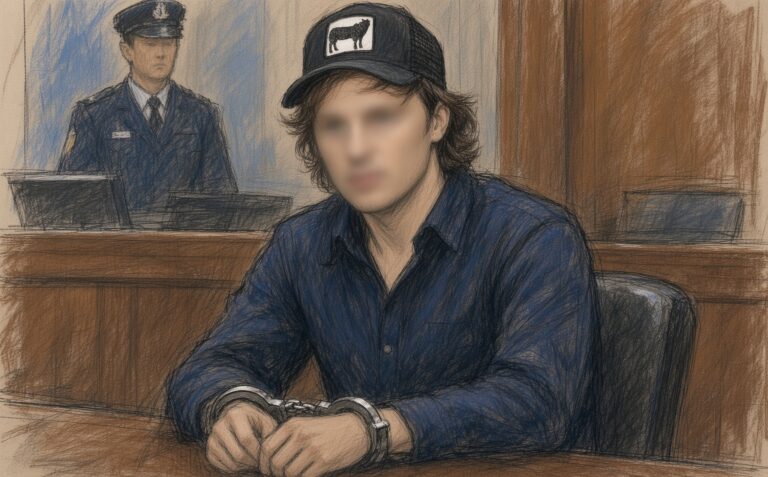
The exchange was founded by a man. This was in 2014, in Katowice, where the whole of this story will take place: the exchange, the clients, the investigations, and the address. At the end of 2021 the exchange changed its name; a name, too, has the right to start life afresh. And on 10 March 2022 the man drove to a business meeting and did not come back from it. He disappeared.
An investigation into the disappearance was opened. It went to the division for organised crime, received a case number with the year 2022 in it, and took up residence in Katowice, at 31 Wita Stwosza Street. It worked diligently: it grew volume by volume, and after two years it even charged somebody.
The exchange worked too. It had terms of service, or rather successive sets of terms, because terms of service are like a man: they change with the years, usually in their own favour. It had a licence, an Estonian one, since a respectable Silesian exchange keeps its licence in Tallinn; it is the done thing. It had, finally, clients, and the clients had confidence in it, which is to say, money.
So the years passed. Everyone worked at his own desk, separately, as in a well run office.
In the winter that turned 2025 into 2026, the reserves began to melt. In spring the media counted that they had melted by 99 percent and asked whether the exchange was solvent. The exchange replied that it was stable, solvent and safe, and called the calculations hurtful. The public ledger of transactions did not join the discussion, but recorded everything scrupulously, because a ledger does not know what is not the done thing.
The clients, meanwhile, conducted a dialogue with the exchange:
Client: I would like to withdraw my funds. Exchange: Withdrawals are temporarily suspended for technical reasons. Client: When will the reasons cease? Exchange: We are working on it. Client: On the reasons? Exchange: On the announcement.
The technical break is altogether a perfect invention: it sounds like a malfunction and works like a safe.
Between 5 and 15 April, close to one hundred million of the exchange’s own tokens left a wallet linked to the exchange for three foreign platforms, as tokens will in spring. On the exchange’s own screens the token’s price stood beautifully all the while. A price is a matter of convention: it stands where it has been stood.
That same April the exchange’s chief executive declared that access to the exchange wallet holding four and a half thousand bitcoins, worth over a billion zloty, rested with the founder, the same one who had disappeared in March 2022. Thus the exchange was the first in this case to establish subjective and objective connexity. The authorities needed one more quarter.
From then on, events moved quickly, though each in its own direction. On 17 April the Regional Prosecutor’s Office in Katowice opened an investigation into the exchange; the criminal complaints from injured clients ran into the thousands. In May the Estonian regulator suspended the licence partially, which is a state intermediate between existence and nonexistence, hitherto known mainly to quantum physics. At the end of June the licence was revoked in full. In July an Estonian court appointed an interim supervisor for the company, and its assets were placed under a disposal ban, which is a polite way of saying that until then they had been disposed of all too efficiently.
The prosecution, it must be said, worked without irony: it secured hardware and over 250 terabytes of server data, examined the company messengers, commissioned the opinion of an expert institution, set up a joint investigation team with the Estonians, and in France detained four million euro that had managed to travel there. The investigation was extended to January 2027. All of it was announced in communiqués numbered like software: update 2.0, 3.0, 4.0. The progress of our age consists, among other things, in misfortunes having versions.
And then it happened. By decision of 30 July 2026, with the consent of the National Prosecutor, the two investigations were merged. The ground given: subjective and objective connexity.
Subjective connexity means that the same people are involved. Objective connexity, that the same matters are. In human language: that the circumstances of the founding and operation of the exchange may bear on the findings concerning the disappearance of its founder. This hypothesis waited four years and four months for procedural status.
The finest thing in all of it is the topography. The Regional Prosecutor’s Office in Katowice, home of the younger investigation, the one about the money: 31 Wita Stwosza Street. The Silesian Branch Division of the National Prosecutor’s Office, where the older one, the one about the man, had been growing for four years: 31 Wita Stwosza Street. The younger lived on its own for one hundred and four days, so the neighbourhood on the shared staircase was brief. The older, however, spent four years looking out of the window at a world in which the missing man’s exchange operated, took deposits, and revised its terms of service.
The injured parties were instructed that henceforth all correspondence must be directed to the new address. The new address is 31 Wita Stwosza Street, Katowice. The case number has changed; so has the floor. The spokesman took his leave of the media, thanking them for their kind cooperation. Justice must be done him: he informed. He numbered, but he informed.
How could the exchange have been allowed to operate for four years after its founder disappeared? Evidently it could, since it did. The law knows no institution of corporate mourning. The company had not disappeared; the company had terms of service. Supervision existed, only in Tallinn. An investigation existed, only in another case. The clients existed, only at the deposit window. Every element of the system worked correctly. Only the whole failed, and the whole has no case number.
We prejudge nothing here; prejudging is for the courts, and the courts have not yet seen the files. What is known is what the communiqués say: that the circumstances of the founding and operation of the exchange are being examined, because they may bear on explaining the disappearance. That much, and no less.
The merger of the investigations is without doubt a step in the right direction. Establishing the direction took four years and four months, which allows a rough estimate of the length of the road. But let us walk it, by all means. The two investigations now live together, under one case number, and they have a great deal to tell each other. Let us hope not only to each other.
Further reading
Why Was a Polish Crypto C.E.O. Collecting Offers for Mortars, Submarines, and Gold?
All our analyses of the case are collected at Afera Zondacrypto (in Polish). In particular:
- Sylwester Suszek: what happened to Zonda’s founder?
- Zonda’s cold wallet: ten years of silence
- How much will Zonda’s injured clients recover?
- Legal assistance for injured Zondacrypto clients

Robert Nogacki is a Polish attorney at law (radca prawny), the founder and managing partner of Kancelaria Prawna Skarbiec (Skarbiec Law Firm), which has operated continuously since 2006.
The law is equal for everyone, but the parties rarely are: on one side stands an organization with time, money, and lawyers, on the other a person with one business, one nest egg, and one life.
Clients rarely come to him with a legal problem. They come with a problem that also has a legal side: an audit that began with a single invoice, money entrusted to someone who has disappeared, a company that has to be passed on before it is too late. Most such matters are decided long before the first letter is written, in decisions made without asking and in deadlines nobody remembered. So he begins by asking how the client got here, not what the client should have done.
He advises entrepreneurs and families from more than a dozen countries, including those whose accounts the tax office has just seized and who do not know what to do tomorrow morning. He defends them in tax audits, customs and fiscal inspections, disputes with the tax authorities, and criminal tax proceedings. He represents victims of investment fraud and Ponzi schemes. He helps families set up family foundations and plan succession, so that a life’s work outlasts a single generation.
Not every case can be won. Every case can be run so that the client knows where they stand. Since 2006 he has represented the victims in the WGI case (Warszawska Grupa Inwestycyjna, the Warsaw Investment Group), one of the longest criminal cases in the history of the Polish financial market, because some things must not be left half finished, even when they take two decades. In the case of the collapsed cryptocurrency exchange Zonda (Zondacrypto, operated by BB Trade Estonia OÜ), he represents several hundred victims in the criminal investigation conducted by Poland’s National Prosecutor’s Office and in the Estonian bankruptcy proceedings.
Kancelaria Prawna Skarbiec is listed in the rankings of Poland’s largest tax advisory firms published by Dziennik Gazeta Prawna and Rzeczpospolita, and it is a four-time recipient (2015 to 2018) of the European Medal awarded by the Business Centre Club and the European Economic and Social Committee. Robert Nogacki publishes regularly, in the press and on the firm’s website, for people who have a problem rather than a law degree, because a legal opinion the client cannot understand protects only the lawyer.
He believes that the best legal advice is the kind that means the client never has to appear in court.