The Business Judgment Rule in Poland: Present, but Pointing the Wrong Way
This article is a chapter of the ebook “Shielding Directors: A Practical Guide for Foreign Directors of Polish Companies” — see the full table of contents or download the complete ebook (PDF).
A development a diligent foreign reader may discover with relief, and must immediately learn to discount: Poland has a business judgment rule. Since 13 October 2022, the Commercial Companies Code provides (Article 293 § 3 for the sp. z o.o.; Article 483 § 3 for the S.A.; the simple joint-stock company had its version from inception) that a board member does not breach the duty of due care if, acting loyally to the company, they act within the limits of justified economic risk, including on the basis of information, analyses, and opinions that ought in the circumstances to be taken into account in making a careful assessment.
What the Polish business judgment rule protects
This is a genuine reform, and within its domain a meaningful one: it shields the rational risk-taker against the company’s damages claims under Articles 293/483, the post-acquisition lawsuit, the new owner’s retribution suit, the bankruptcy trustee acting in the company’s name on a soured investment. Document your decision process well, the information considered, the alternatives weighed, the advice received, and the 2022 rule is a real wall.
What it does not touch: Articles 299 and 116
But observe what stands on the other side of the wall and what does not. Article 299 liability is not liability for a decision; it is liability for the company’s debts, conditioned on a failed enforcement and an untimely petition. Article 116 of the Tax Ordinance likewise. Neither asks whether your business judgment was sound, informed, or loyal; the most brilliantly reasoned, immaculately documented decision to trade on for sixty more days in pursuit of a rescue is, for Article 299 purposes, simply sixty days of lateness. The business judgment rule and the transfer mechanism are not in tension; they are not even in conversation. They regulate different questions, and the question that ruins foreign directors is the one the business judgment rule does not touch.
The asymmetry in one sentence
Hence the asymmetry that defines director risk in Poland, and may serve as the closing aphorism: in Poland, the law protects you when the company sues you for being bold, and ruins you when a creditor sues you for being late. The practical response to that asymmetry, since courage is not protected, is procedure, set out in full in the protection programme.
Read the Full Guide
This chapter is part of the ebook “Shielding Directors: Navigating Personal Liability in Times of Financial Turmoil and Insolvency — A Practical Guide for Foreign Directors of Polish Companies.”
This article is general information, not legal advice. © Kancelaria Prawna Skarbiec
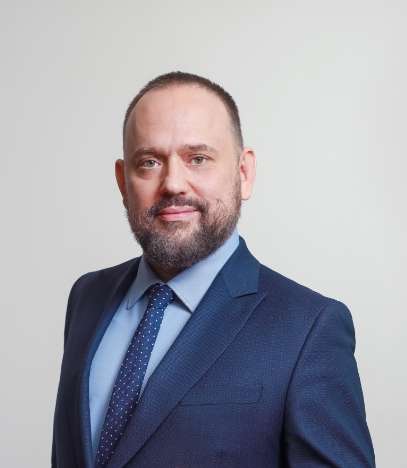
Robert Nogacki is a Polish attorney at law (radca prawny), the founder and managing partner of Kancelaria Prawna Skarbiec (Skarbiec Law Firm), which has operated continuously since 2006.
The law is equal for everyone, but the parties rarely are: on one side stands an organization with time, money, and lawyers, on the other a person with one business, one nest egg, and one life.
Clients rarely come to him with a legal problem. They come with a problem that also has a legal side: an audit that began with a single invoice, money entrusted to someone who has disappeared, a company that has to be passed on before it is too late. Most such matters are decided long before the first letter is written, in decisions made without asking and in deadlines nobody remembered. So he begins by asking how the client got here, not what the client should have done.
He advises entrepreneurs and families from more than a dozen countries, including those whose accounts the tax office has just seized and who do not know what to do tomorrow morning. He defends them in tax audits, customs and fiscal inspections, disputes with the tax authorities, and criminal tax proceedings. He represents victims of investment fraud and Ponzi schemes. He helps families set up family foundations and plan succession, so that a life’s work outlasts a single generation.
Not every case can be won. Every case can be run so that the client knows where they stand. Since 2006 he has represented the victims in the WGI case (Warszawska Grupa Inwestycyjna, the Warsaw Investment Group), one of the longest criminal cases in the history of the Polish financial market, because some things must not be left half finished, even when they take two decades. In the case of the collapsed cryptocurrency exchange Zonda (Zondacrypto, operated by BB Trade Estonia OÜ), he represents several hundred victims in the criminal investigation conducted by Poland’s National Prosecutor’s Office and in the Estonian bankruptcy proceedings.
Kancelaria Prawna Skarbiec is listed in the rankings of Poland’s largest tax advisory firms published by Dziennik Gazeta Prawna and Rzeczpospolita, and it is a four-time recipient (2015 to 2018) of the European Medal awarded by the Business Centre Club and the European Economic and Social Committee. Robert Nogacki publishes regularly, in the press and on the firm’s website, for people who have a problem rather than a law degree, because a legal opinion the client cannot understand protects only the lawyer.
He believes that the best legal advice is the kind that means the client never has to appear in court.