Frozen Russian Assets as a Vulture Fund Target
Tsarist Bonds, $225 Billion, and the New Lawfare Against Russia
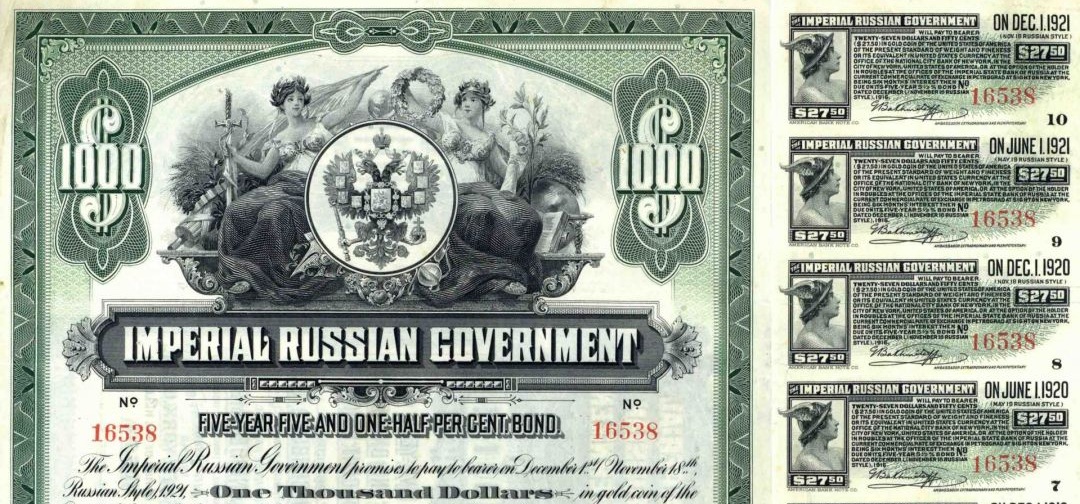
Twenty-five million dollars. This was the nominal value of the bonds that the Russian Empire sold to American investors through the National City Bank of New York in December 1916. The coupon rate stood at five and one-half percent per annum. The maturity: five years. The denomination: United States dollars, with a gold-clause provision permitting conversion at the prevailing gold parity.
Two hundred twenty-five billion, eight hundred million dollars. This figure, according to the complaint filed in June 2025, represents the present value of those same instruments, inclusive of accumulated interest calculated on a gold-adjusted basis. The multiplier: nine thousand and thirty-two.
Between these two figures lies a revolution that toppled a three-hundred-year dynasty. Two world wars. The rise and fall of the Soviet empire. The dissolution of the USSR. The invasion of Ukraine. And one fundamental question of law: can an obligation incurred by a state that ceased to exist more than a century ago be enforced before a contemporary tribunal, and, more pressingly, can it unlock frozen Russian assets?
The discussion of this article continues under the LinkedIn post.
Frozen Russian Assets: Three Hundred Billion Dollars in Legal Limbo
In response to Russia‘s invasion of Ukraine in 2022, the United States and its allies froze Russian sovereign assets valued at approximately three hundred billion dollars: reserves of the Central Bank of the Russian Federation, holdings of the National Wealth Fund, deposits of state financial institutions. The geography of the freeze matters for everything that follows. Roughly 210 billion euros sit in the European Union, of which about 193 billion euros are held by the Belgian depository Euroclear, where the Central Bank’s bonds have matured into cash that sanctions keep locked in place; reported figures for the Euroclear holdings range from about 185 to 202 billion euros depending on the date and on what is counted, and Euroclear’s own half-year report put sanctioned Russian assets on its balance sheet at 202 billion euros at the end of June 2026. Only about five billion dollars is held in United States financial institutions, less than two percent of the total.
Those five billion dollars, an estimate rather than an audited figure, are not sitting idle in a legal sense. In April 2024 Congress passed the REPO for Ukrainians Act, which authorizes the President to seize, confiscate or transfer Russian sovereign assets within United States jurisdiction for Ukraine’s benefit, and a 2025 bill would move the estimated five billion into an interest-bearing account and release it to Ukraine on a schedule. The assets are inaccessible to Moscow, untouchable for private creditors, and reserved, at least on paper, for a political purpose.
Into this stalemate steps an unexpected player: a Delaware limited-liability company, armed with a century-old bond and a strategy borrowed from the sovereign-debt lawfare playbook.
Noble Capital: Who Stands Behind the Plaintiff
Noble Capital RSD LLC is a limited-liability company registered in Delaware, a jurisdiction whose corporate law does not require the disclosure of LLC members or managers in public formation documents (details here). The initials “RSD” plausibly stand for Russian Sovereign Debt, though the complaint does not say so. The court docket identifies counsel, Kenneth Noble of Noble Law PLLC, and the LCvR 26.1 certificate of disclosure filed on 9 June 2025 lists corporate affiliations, but neither reveals the natural persons behind the vehicle.
More is known about the pattern than about the owners. In its opposed motion for an extension of time of 7 November 2025, and again in its motion to dismiss of 28 January 2026, counsel for the Russian Federation described the plaintiff as an entity “eponymously named after its counsel” that has “created a cottage industry of resurrecting claims based on ancient bonds”. The record supports the description. An affiliated Noble Capital LLC sued the People’s Republic of China in the District of Columbia over Qing-era bonds (dismissed in September 2025), filed a second action against China in the Northern District of Illinois over 1919 Republic of China bonds, and Kenneth Noble personally sued China in the Southern District of New York in October 2024 before substituting Noble Capital LLC as plaintiff. The origin of that last suit is a Manhattan eviction case. In October 2024 Noble’s landlord, an entity indirectly owned by the PRC, petitioned the New York City Housing Court for 99,500 dollars of unpaid rent; Noble, appearing pro se, answered with a set-off counterclaim based on 1937 Republic of China bonds and removed the case to federal court under the FSIA three times. Judge Broderick remanded it three times, the last on 8 January 2026, with a warning that a fourth attempt would invite Rule 11 sanctions. The Chinese dismissal is under appeal to the D.C. Circuit (No. 25-7156, notice filed 14 October 2025), so the two Noble Capital cases now run in parallel before the same appellate court.
The most striking assertion in the Russian filing concerns scale. According to the defendants, Noble Capital’s correspondence discloses that the entire 225.8 billion dollar claim rests on a single 1,000 dollar Russian Imperial War Bond, purchased on the internet earlier in 2025 for approximately fifty dollars and authenticated by a private grading service. The motion to dismiss repeats the single-bond thesis and places the certificate of authenticity in the record as an exhibit; the purchase price and the online purchase come only from the November filing, which cites the plaintiff’s own correspondence. All of this is the defendants’ account. The complaint speaks of bonds in the plural and the court has made no finding. If the account holds, however, the multiplier between purchase price and claim is not nine thousand but four and a half billion. Russia has also reserved the right to seek its legal fees under Rule 11.
A word on vocabulary. “Vulture fund” is this article’s characterization of a litigation strategy, not a judicial finding about Noble Capital, and the reader should weigh it as such. The pattern described below is what the term denotes.
Vulture Funds: How They Profit from Sovereign Debt
Vulture funds, termed euphemistically “activist funds” or “specialized restructuring vehicles”, operate according to a strictly defined business model that differs fundamentally from traditional distressed-debt investing.
Stage one, acquisition: purchase sovereign debt on secondary markets at four to twenty cents per dollar of face value following default or during acute distress.
Stage two, holdout strategy: refuse to participate in multilateral restructuring negotiations, even when ninety percent or more of creditors accept terms. Traditional distressed investors participate in restructurings, accepting haircuts in exchange for the debtor’s return to solvency. Vulture funds do precisely the opposite.
Stage three, forum shopping: litigate in favorable jurisdictions, primarily New York and London, where most sovereign-bond documentation is governed.
Stage four, coercion tactics: seek injunctions blocking payments to restructured bondholders and pursue asset seizures in third countries: bank accounts, commercial receivables, even naval vessels.
Stage five, forced settlement: compel the sovereign debtor into settlement at multiples of purchase price through relentless legal and political pressure.
Documented returns range from three hundred to two thousand percent, numbers impossible in any conventional asset class.
The Argentina Case: Vulture Fund Paradigm
The paradigmatic example is the fifteen-year legal war waged by Paul Singer’s NML Capital, the billionaire whom The New Yorker called “the doomsday investor”, against Argentina.
Argentina defaulted in December 2001 on approximately one hundred billion dollars in obligations, the largest sovereign default in history at that time. In 2005 and 2010 the country conducted restructurings, achieving 93 percent creditor participation at roughly thirty cents on the dollar.
NML Capital refused to participate. The fund purchased Argentine bonds for an estimated 49 to 177 million dollars, then waged a fifteen-year legal war that included:
- Obtaining a precedent-setting ruling interpreting the pari passu clause to prohibit payments to restructured bondholders unless holdouts were paid simultaneously in full.
- Seizing the Argentine naval training vessel ARA Libertad in the Ghanaian port of Tema in October 2012; the ship, with three hundred sailors aboard, was detained for seventy-seven days.
- Mounting a lobbying campaign in the U.S. Congress and funding think tanks portraying Argentina as a deadbeat debtor.
The war ended in 2016 with a settlement of 2.4 billion dollars, a return exceeding eleven hundred percent.
Singer’s triumph inspired a wave of imitators and ensured that every sovereign debtor must now factor vulture fund risk into its debt-management strategy.
Tsarist Bonds: What Did American Investors Actually Buy in 1916?
A Financial Instrument as Historical Artifact
The 1916 bonds are physical documents printed on security paper, embossed with the double-headed eagle of the Russian Empire, individually numbered, and equipped with interest coupons. They are bearer instruments: the holder is entitled to payment without demonstrating how possession was acquired. Transfer occurs through simple physical delivery. The bonds had a long afterlife as securities before they became curiosities: they were listed in Moody’s Manual as late as 1950 and traded on the New York Curb Exchange and its successor, the American Stock Exchange, until 1956, thereafter over the counter. Specimens can still be purchased on the collectors’ market, which is, on the Russian account of events, exactly how the plaintiff acquired its position.
The Gold Clause: Source of Astronomical Claims
The crucial element was the gold clause. The document provided that payment would be made in U.S. dollars or Russian rubles at the holder’s option, with value converted according to the gold parity prevailing at issuance.
In 1916 an ounce of gold cost 20.67 dollars, a price fixed by the United States in the 1830s and maintained for the next century. In June 2025, when the complaint was filed, gold traded at roughly 3,300 dollars; in September 2026 it trades around 4,400 dollars per ounce, more than two hundred times the 1916 parity. The complaint does not show its arithmetic. It pleads gold-adjusted principal and interest in an amount “not less than” 225.8 billion dollars, to be proven at trial, and the figure cannot be reconstructed from the face of the pleading: simple interest at 5½ percent on gold-adjusted principal falls far short of it, annual compounding overshoots it several times over. What can be said with confidence is that the claim is indexed to gold, and every rise in the gold price silently inflates it.
Why Did Americans Buy Russian Bonds?
December 1916 marked the apex of World War I. The Russian Empire was an Entente ally, fighting alongside Britain and France against Germany and Austria-Hungary. The Eastern Front was consuming millions of soldiers and vast material resources. Russia desperately needed capital to finance the war effort.
For American investors, tsarist bonds appeared attractive. The interest rate significantly exceeded that offered by U.S. Treasury securities. Russia was a military and economic power with enormous natural resources. Alliance with Britain and France seemed to guarantee victory in the war.
No one anticipated that within three months Tsar Nicholas II would abdicate, and within a year the Bolsheviks would seize power and refuse to pay any debts of previous governments.
The 1918 Decree: Revolution as Legal Event
The text of the Decree on the Annulment of State Loans, adopted by the Central Executive Committee under Yakov Sverdlov on 3 February 1918 (21 January in the old calendar), is characterized by ruthless clarity:
“All state loans contracted by the governments of the Russian landowners and bourgeoisie are hereby annulled as of December 1917. The coupons of these loans falling due in December 1917 shall not be honored. Similarly annulled are the guarantees given by the above-named governments for the loans of various enterprises and institutions. All foreign loans, without exception, are unconditionally annulled.”
The decree extinguished approximately sixty billion rubles in obligations, sixteen billion of them foreign debt. France, where an estimated 1.6 million citizens held Russian bonds, was hit particularly hard. The loss entered French collective memory under the name emprunts russes (Russian loans), becoming a byword for naïve faith in the solidity of foreign investment.
For the Bolsheviks, repudiation was not an act of financial desperation but a conscious ideological choice. Trotsky liked to point out that the Saint Petersburg Soviet of 1905 had warned Western bankers that loans to the Tsar would not be honored by a victorious revolution.
A detail from the later American litigation deserves mention. The decree did not stop payment at once. Coupons on the 1916 dollar bonds continued to be honored through December 1918, and interest on the parallel fifty-million-dollar credit certificates was paid until July 1920. What remained unpaid, according to the 1987 court record, was the principal of both instruments and the last five bond coupons. A default that visible, and that gradual, matters for the limitations analysis below.
The Odious Debt Doctrine: When Is Sovereign Debt Invalid?
The Sack Paradox
The theoretical foundations for the legal legitimization of debt repudiation were laid not by any Marxist but by a former official of the Tsar’s Finance Ministry. Alexander Nahum Sack, who emigrated after the revolution and settled in France, published a treatise in 1927 formulating the doctrine of dette odieuse, odious debt.
Sack formulated three conditions whose joint satisfaction allows debt to be classified as odious:
First, lack of consent. The debt was incurred without the population’s consent, by a government lacking democratic legitimacy.
Second, lack of benefit. The loan proceeds were not used for the needs or interests of society.
Third, creditor awareness. Lenders knew or should have known of the two preceding circumstances.
Whether the 1916 bonds satisfy these criteria is arguable, and the paradox cuts both ways. The Tsarist autocracy plainly lacked democratic consent. But the proceeds financed a defensive war fought by the nation as a whole, and Sack himself, a jurist of the old regime, was no friend of the Bolshevik repudiation; he treated regime debts as odious and ordinary state debts as binding on successors. The doctrine has never been adopted by any court as a rule of law. The Vienna Convention on Succession of States in respect of State Property, Archives and Debts of 1983, which has never entered into force, addresses the passing of debts to newly independent states but does not codify odious debt. As a defense for Russia, then, odious debt is rhetoric rather than law; the effective defenses lie elsewhere.
The British and French Settlements: Diplomacy, Not Legal Obligation
Noble Capital argues that since Russia satisfied British and French bondholders, it acknowledged its responsibility for tsarist debts. The complaint indeed pleads that Russia “has paid nearly all” imperial bonds held by British and French citizens, and points to Russia’s repayment of Soviet-era debt to Western creditors, completed in 2006 and 2017. These are the plaintiff’s most respectable arguments, and they deserve to be met rather than waved away.
The United States, 1933 and 1959
The American bondholders were not, in fact, left with nothing. When Washington recognized the Soviet Union in November 1933, the Litvinov Assignment transferred to the United States the Soviet claims to former Russian assets on American soil. The United States collected some nine million dollars, paid them into a Soviet Claims Fund and, in 1959, distributed the fund among certified claimants, including holders of the 1916 bonds. The Carl Marks plaintiffs put that distribution at about four percent of the bonds’ value. The relevant statute provided that an award for less than the full claim did not extinguish the claimant’s rights against the Soviet Government; but the Soviet Union always maintained that the Litvinov exchange had closed the question of mutual financial claims “once and for all”. The 1959 payment is thus a double-edged fact: proof that the bonds were treated as real claims, and proof that the American state chose diplomacy over litigation to resolve them.
United Kingdom, 1986
On 15 July 1986 the Soviet Union and the United Kingdom signed an agreement on the settlement of mutual financial and property claims arising before 1939, which the press portrayed as “repayment” of tsarist debt. In reality, the mechanism was different: the settlement released tsarist-era assets held in British banks since 1917 and permitted their distribution to bondholders, covering a small fraction of the face value of claims, while each state undertook not to pursue or support further claims. Denza and Poulsen, who studied the negotiating record, report that the Soviet side insisted its acceptance of responsibility was ex gratia and denied that successor states automatically inherit the obligations of former states. In exchange, the USSR gained access to London capital markets.
France, 1996 and 1997
The Franco-Russian memorandum of November 1996 provided for payment of four hundred million dollars, less than ten percent of the estimated value of French claims; the implementing agreement on the final settlement of claims arising before 9 May 1945 was signed on 27 May 1997. France waived further claims, and Russia gained membership in the Paris Club as a creditor nation. Article 7 of the agreement provides that the payments are not to be considered an admission of liability by either party or a confirmation of the legal validity of the claims settled.
Both European settlements, like the American one, were intergovernmental political compromises with express reservations of legal position, not performance of a legal obligation. A voluntary gift to one beggar does not create a legal obligation to give alms to all. As for the Soviet-era debt Russia did repay: it did so under the 1991 treaty by which the successor states divided the USSR’s debts and assets, and that treaty defined the debt assumed as obligations incurred by the USSR itself. Imperial debt, which the USSR never incurred and never recognized, was outside it by definition.
The Lawsuit: Frozen Russian Assets as the Real Target
The architecture of Noble Capital’s claims reveals the legal sophistication behind a seemingly quixotic demand.
Declaratory Judgment: Playing the Long Game
First, Noble Capital seeks a declaratory judgment establishing that Russia is indebted to the plaintiff in the amount of at least 225.8 billion dollars. Unlike a money judgment, which orders the defendant to pay and can be enforced through asset seizure, a declaratory judgment merely authoritatively resolves the legal question.
Why would a plaintiff choose the seemingly weaker remedy? For three reasons:
- Circumventing execution immunity. Even if a court recognized the claim, frozen Russian assets are protected from execution under FSIA. A declaratory judgment establishes the creditor’s rights without immediately confronting that barrier.
- Preparing ground for future action. A final judgment could serve as the basis for set-off in other transactions, enforcement actions in other jurisdictions, or settlement negotiations from a position of strength.
- Avoiding prematurity objections. Demanding immediate payment from frozen assets would likely be dismissed as impossible under current law, since OFAC sanctions block all transactions involving Russian state property.
Set-Off Rights: The Key to Frozen Assets
Second, the plaintiff seeks a declaration recognizing the right to set off tsarist-bond claims against any obligations that Noble Capital or its assignees might owe Russia, including obligations arising from frozen Russian assets.
This element is crucial for understanding the entire strategy. Noble Capital does not seek direct execution against frozen Russian assets but rather the right to use them as a compensatory instrument in the future, when the legal situation changes. The complaint even pleads that such a set-off would not amount to confiscation without compensation under customary international law, an argument aimed less at Moscow than at the Western governments that have hesitated to seize the principal.
Equitable Receiver: A Trap Awaiting Unfreezing
Third, the plaintiff seeks appointment of an equitable receiver who would take control of Russian assets in the United States the moment they are unfrozen, before Russia could withdraw or conceal them.
This architecture reveals a long-term play. Noble Capital is not counting on immediate payment. It is betting that someday, a year from now, ten years, twenty, geopolitical circumstances will shift, sanctions will be lifted or modified, and frozen Russian assets will become accessible. At that moment a final judgment from a United States federal court would transform from a piece of paper into a weapon of leverage.
Two facts temper the ambition. The assets within reach of a United States receiver amount to some five billion dollars, not three hundred billion; the rest lies in Europe, where a declaratory judgment from Washington binds nobody. And Congress has already earmarked those five billion dollars, through the REPO Act, for a public purpose that would compete with, and almost certainly outrank, a private creditor’s set-off.
The architecture also has a structural weakness that Russia was quick to exploit. The complaint pleads six counts, all of them for declaratory or injunctive relief, and none for breach of contract. A declaration and an injunction are remedies, not causes of action; American courts routinely dismiss complaints that plead only remedies. Russia’s counsel offers an explanation for the omission: a contract claim would have put the statute of limitations on the face of the pleading.
Sovereign Immunity: Can Russia Be Sued in U.S. Courts?
FSIA and the Commercial Activity Exception
The Foreign Sovereign Immunities Act of 1976 codifies in American law the principle of sovereign immunity. Foreign states are not subject to the jurisdiction of U.S. courts unless a claim falls within one of the enumerated exceptions.
Noble Capital relies on the commercial-activity exception in 28 U.S.C. § 1605(a)(2). The provision withdraws immunity where the action is based upon commercial activity carried on in the United States by the foreign state, or upon an act outside the United States in connection with such activity that causes a direct effect in the United States. The key precedent is the Supreme Court’s decision in Republic of Argentina v. Weltover, Inc. (1992), which held that issuing “garden-variety debt instruments” constitutes commercial activity and that a failure to pay in New York produces a direct effect there.
Carl Marks: These Bonds Have Been to Court Before
The 1916 dollar bonds are not new to American courts. In March 1982 certified classes of holders sued the Soviet Union in the Southern District of New York in two parallel actions, Carl Marks & Co., Inc. v. Union of Soviet Socialist Republics: one on the twenty-five-million-dollar 5½ percent bearer bonds at issue today, the other on a separate fifty-million-dollar 6½ percent credit floated in July 1916 by a syndicate led by J.P. Morgan and sold as three-year participation certificates. Default judgments were entered in March 1986. The USSR, represented by Baker & McKenzie, then appeared and moved to vacate. On 31 July 1987 Judge Brieant vacated the judgments and dismissed the actions, and the Second Circuit affirmed in February 1988.
The reasoning matters. The courts accepted that issuing public debt is commercial activity within the meaning of § 1605(a)(2). They dismissed nonetheless because, in their view, the FSIA could not be applied retroactively to conduct predating the 1952 Tate Letter, an era in which foreign sovereigns enjoyed absolute immunity and were entitled to rely on it.
The first argument of Russia’s motion to dismiss is that Carl Marks is issue-preclusive against Noble Capital, which pleads that it is the assignee of a bond that belonged to the certified class. Under the doctrine of jurisdictional finality, a dismissal for want of jurisdiction bars relitigation of the same jurisdictional question, and class judgments bind class members and their assignees. That argument is not as clean as it sounds. Preclusion attaches to the same question on the same law and facts; and the controlling law has since changed. In Republic of Austria v. Altmann (2004) the Supreme Court held that the FSIA does apply to conduct predating its enactment, including pre-1952 conduct. The premise on which Carl Marks rested no longer states the law. That does not by itself strip the 1987 judgment of preclusive force: preclusion protects judgments, not the reasoning behind them, and the Second Circuit’s judgment stands unreversed. But the D.C. Circuit’s test asks whether preclusion would work a “basic unfairness”, and a change in controlling law is a recognized ground for declining to apply it. Tellingly, Russia’s fifty-three-page memorandum does not cite Altmann and does not attempt to defend the non-retroactivity rationale on its merits; it asks the court to give the old result preclusive effect without re-examining the old reasoning. Whether preclusion survives a change of governing law of this magnitude is a genuine open question, not a settled one in either direction, and it is the first question Judge Friedrich will have to answer.
The Battle Over the Commercial Activity Exception
If preclusion fails, the court reaches § 1605(a)(2) afresh, and here the case is closer than the tsarist pedigree of the bonds suggests. On the plaintiff’s side: the bonds were sold to the American public, denominated in dollars and payable, at the holder’s option, at the office of the National City Bank of New York. That is a far tighter nexus with the United States than the Qing bonds in the Chinese case, which were issued and payable in China. Under Weltover, a failure to deliver money to a designated New York account is a “direct effect” in the United States, and the purpose of a loan is irrelevant to whether issuing it was commercial. The argument that a war loan by an autocracy is an acte de souveraineté, accepted by French courts in respect of French bondholders’ claims, has no purchase in American law.
Russia’s answer rests on three lines of authority. First, the “gravamen” test of OBB Personenverkehr v. Sachs (2015) as applied to antique bonds in MMA Consultants v. Republic of Peru (2d Cir. 2017): the act that injured the plaintiff is not the 1916 issuance in New York but the decision not to pay, which was taken in Petrograd, Moscow or nowhere at all, and a decision taken abroad is neither commercial activity “in the United States” nor an act “performed in the United States”. Second, Mortimer Off Shore Services v. Germany (2d Cir. 2010): a successor state that inherits liability by operation of law performs no “act” of its own, so no commercial activity of the Russian Federation is pleaded at all. Third, Morris v. People’s Republic of China (S.D.N.Y. 2007) and, again, MMA: a bond bought in the collectibles market a century after default is not a financial instrument, the “direct effect” of non-payment was felt in 1918 and 1921 and not when the plaintiff went shopping online, and payment at the National City Bank is “literally impossible” because the bank no longer exists. The Chinese court accepted the first of these lines in September 2025, and Judge Friedrich sits in the same courthouse.
The honest assessment is that both sides have real authority. The plaintiff has Weltover and geography; the defendant has Sachs, MMA and the awkward fact that the plaintiff pleads no act by the Russian Federation. The immunity fight is therefore not hopeless for Noble Capital, but it is uphill, and it is the whole of the present motion. Everything else, the limitations period above all, Russia has expressly held in reserve for the merits, should the case ever reach them.
Central Bank Execution Immunity
Even if a court found jurisdiction, the frozen Russian assets of the Central Bank enjoy special protection. 28 U.S.C. § 1611(b)(1) provides that property of a foreign central bank held for its own account is immune from execution unless the bank has explicitly waived that immunity. The Central Bank of the Russian Federation has made no such waiver. Russia also observes that the Central Bank and the National Wealth Fund did not exist in 1916 and had nothing to do with the bonds; naming them as defendants is a device to reach the assets, not a theory of liability.
Statute of Limitations: Can Claims Be Pursued After a Century?
The Time Problem
The bonds matured on 1 December 1921. According to Russia’s November 2025 filing, the applicable limitations period is six years under New York law, where the bonds were payable, or at most twelve years under the law of the District of Columbia, where the suit was filed. On any calculation, more than a century has passed. Russia has not yet argued the point in court: the FSIA entitles a sovereign to a ruling on immunity before it is compelled to defend the merits, and the motion to dismiss expressly reserves “the obvious bar of the statute of limitations” for a later stage. The point is held, not spent, and no court has ruled on it in this case; the six-year and twelve-year figures are Russia’s position, not a holding. There is, however, precedent on these very instruments: in 1948 the Second Circuit dismissed a suit by certificate holders against the syndicate banks because a New York court had already found the claims time-barred.
Noble Capital’s Argument: Equitable Tolling?
The plaintiff may attempt to invoke the doctrine of equitable tolling, suspension of the limitations period on grounds of equity. The argument would run as follows: limitations do not run against a creditor when the debtor actively denies that any obligation exists, or when the courthouse is effectively closed.
This argument is legally deficient for several reasons:
First, debt repudiation is not equivalent to the debtor “hiding”. It is the opposite, a public, notorious declaration refusing to perform the obligation. The 1918 decree was announced urbi et orbi, and every coupon date thereafter was a fresh, visible default.
Second, American courts were available to bondholders throughout this period. The Carl Marks class actually sued, in 1982. The absence of U.S. diplomatic recognition of the USSR until 1933 did not close the courthouse doors.
Third, even if some period of “suspension” were conceded, it would have ended no later than the USSR’s dissolution in 1991, or at the very latest with Altmann in 2004. More than twenty years have passed since then.
Fourth, the record shows that the market treated the claim as live and litigable for decades: a protective committee for the 1916 credit certificates operated from 1919 to 1938, the bonds were exchange-traded until 1956, and claimants collected from the Soviet Claims Fund in 1959. Holders who could organize, trade and collect could also sue.
The Chinese Analogy, Correctly Stated
On 15 September 2025 Judge Amir Ali dismissed Noble Capital LLC’s suit against the People’s Republic of China seeking 11.5 billion dollars on imperial bonds issued between 1898 and 1911. The court did not reach limitations or the merits. It held that China was immune because the commercial-activity exception did not apply: the gravamen of the suit was non-payment of bonds issued and payable in China, and the PRC’s issuance of new dollar bonds in 2020 and 2021 with immunity waivers did not extend to century-old instruments the plaintiff did not own. The case is analyzed here. Noble Capital appealed to the D.C. Circuit on 14 October 2025 (No. 25-7156); the appeal is pending, and its outcome will bear directly on how the same court reads § 1605(a)(2) in the Russian case.
The lesson for the Russian case is narrower than a slogan about the passage of time. The Chinese dismissal turned on geography, and the geography of the 1916 bonds is New York. Where the Russian case can follow the Chinese one is on the merits Judge Ali never reached: a claim that expired under any statute of limitations before most of today’s judges were born.
Lawfare: When Law Becomes a Weapon in Geopolitical Competition
What Is Lawfare?
The term lawfare, a blend of law and warfare, denotes the strategic use of legal rules, forums and procedures as weapons to achieve political, military or geopolitical objectives that would otherwise require traditional coercive means. Major General Charles Dunlap, who popularized the concept, defines lawfare as “using law as a substitute for traditional military means to achieve an operational objective”.
Contemporary analyses distinguish between offensive lawfare (harassing, constraining or delegitimizing an opponent) and defensive lawfare (building legal resilience and deterrence). Studies of Russian and Chinese strategy emphasize that “legal warfare” constitutes an integral element of hybrid warfare doctrine, alongside information and psychological operations.
Frozen Russian Assets as a Lawfare Battlefield
The struggle over frozen Russian assets is a textbook example of lawfare, where both sides deploy legal arguments, courts and institutional procedures as instruments in a broader political and economic confrontation. Since the first version of this article was published in January 2026, the battlefield has moved considerably.
Western lawfare has proceeded in stages:
- Using profits (windfall income) from sovereign assets without touching the principal: the EU decision of May 2024 and the G7 arrangement of October 2024 for a 50 billion dollar loan to Ukraine serviced from those profits.
- Designing a “reparations loan” in which the cash balances at Euroclear would be lent to the Commission and on to Ukraine, repayable only if Russia pays reparations. In December 2025 the plan foundered on Belgian resistance; the Union instead chose to borrow 90 billion euros on the capital markets, backed by the EU budget, for a loan to Kyiv covering 2026 and 2027, and the Council adopted the final legislation on 23 April 2026, together with the twentieth sanctions package, with disbursements from the second quarter. The loan is itself to be repaid from reparations due by Russia. The matter did not stay settled: in late August 2026 the Netherlands, Poland, Spain and Sweden wrote to the Commission asking for a proposal that would put the 193 billion euros at Euroclear to use after all, with the legal risk spread across all member states; the European Council is expected to take it up in October 2026. Meanwhile some 6.6 billion euros of interest income has already flowed to Ukraine.
- Removing the veto risk. On 12 December 2025 the EU immobilized the assets indefinitely under Article 122 TFEU, replacing the six-monthly unanimous renewal with a qualified-majority procedure, so that Hungary or Slovakia can no longer unfreeze 210 billion euros by abstention. The legal construction is itself contested and will be part of any Russian challenge.
- Argumentation based on the doctrine of countermeasures against a flagrant breach of international law (aggression), and, in the United States, the REPO Act’s statutory confiscation authority.
Russian lawfare has moved from threats to judgments:
- Moscow characterizes the freezing of sovereign reserves as illegal expropriation violating state immunity (legal analysis).
- In December 2025 the Central Bank of Russia sued Euroclear in the Moscow Arbitration Court for 18.2 trillion rubles, the full value of the frozen reserves. On 15 May 2026 the court, sitting behind closed doors, upheld the claim in full, and on 16 July 2026 the Moscow appellate court dismissed Euroclear’s appeal. Euroclear does not recognize the Russian court’s jurisdiction and calls the claim without merit; in June 2026 it sued the Central Bank of Russia in a Belgian civil court to block enforcement of the Moscow judgment. The Moscow judgment is unenforceable in the EU but could be pursued in jurisdictions friendly to Moscow, and it is the single largest reason for Belgium’s continued refusal to bear the reparations-loan risk alone.
- Russia threatens to seize Western investors’ assets on its territory, explicitly linking their value to the size of frozen reserves abroad, and has raised the 1989 investment treaty between Belgium and the USSR as a further avenue.
The Noble Capital Lawsuit in the Lawfare Context
The timing of Noble Capital’s lawsuit is suggestive. It was filed in June 2025, as Western governments were intensively debating mobilization of frozen Russian assets for Ukraine’s reconstruction and as the European Parliament conducted heated debates over mechanisms for their use. Any legal action complicating the status of these assets could serve as an instrument of pressure, or, conversely, as an obstacle to multilateral negotiations. Russian commentators quoted by RBC in January 2026 read the suit as an attempt to steer the American authorities towards a private-law alternative to confiscation for Ukraine.
In the world of lawfare, vehicles of this kind sometimes serve purposes their principals prefer not to disclose. Law becomes the battlefield for extracting or blocking economic value; each side uses legal institutions and narratives (reparations versus theft, countermeasures versus expropriation) to shape legitimacy, deter adversaries and influence third states and markets.
The facts now on the record, however, point to a more prosaic reading. A lawyer who has sued China three times over antique bonds, once to offset his own rent, and who now sues Russia over a bond his opponents say cost fifty dollars, is not the signature of a state actor. It is the signature of a litigant who has understood that a complaint against a sanctioned sovereign costs 405 dollars to file, generates headlines worth far more, and buys an option on a future in which the frozen billions change hands. That reading is a hypothesis, not a finding; discovery, if the case survives to that stage, would test it.
The Court as a Forum of Foreign Policy?
The Political Question Doctrine
A further line of defense is the political question doctrine, the principle that certain disputes are inherently unsuited to judicial resolution because they involve matters committed to the other branches of government.
Whether the Russian Federation should pay the debts of the Russian Empire is, in substance, a question about relations between the United States and Russia. It is a question about how to treat a revolution and its legal consequences. It is a question about whether American courts should become an instrument of pressure on a foreign state in the midst of an ongoing war. Courts have traditionally declined to answer such questions, leaving them to the President and Congress. Even if the plaintiff overcame every other barrier, the court could decline to adjudicate the matter as a political question.
The Iranian Precedent
History records cases in which the executive intervened in litigation over the assets of foreign states. After the Iranian revolution of 1979, American courts entered numerous judgments against Iran, but their enforcement was blocked by the Algiers Accords of 1981, under which the United States released Iranian assets in exchange for the freedom of American hostages.
Nothing guarantees that a similar intervention will not occur with Russian assets. The frozen funds are a bargaining chip in negotiations over Ukraine. Their destination, whether Ukraine’s reconstruction, the satisfaction of creditors, or exchange for something else entirely, is a political decision, not a judicial one.
The Sanctions Complication
Moreover, the very possibility of enforcement against frozen assets is doubtful under the sanctions regime. United States sanctions prohibit transactions involving blocked Russian property. Execution against such property would be a “transaction” within the meaning of the sanctions rules and would therefore require an OFAC license.
The Venezuelan experience illustrates the complications. In May 2025 a federal court vacated a judgment against Venezuela at the request of the creditors themselves, who concluded that American sanctions rendered the judgment practically worthless: it could not be enforced without breaking the law.
Comparative Context: Other Historical Debt Disputes
China: Qing Dynasty Bonds
Parallel to the Russian case ran the dispute over Chinese imperial bonds. Bonds issued by the Qing dynasty between 1898 and 1911, largely to finance railways and to pay the indemnity after the Boxer Rebellion, have remained in default since 1939, when the Republic of China declared a moratorium. The People’s Republic consistently refuses to recognize them as debts of a “previous reactionary regime”. Noble Capital LLC’s 2023 suit rested on the theory that the PRC’s issuance of new bonds in 2020 and 2021 waived immunity for the historical debt as well. The court rejected that theory and dismissed the case in September 2025, as described above.
Venezuela: When Debt Is Fresh
Venezuela defaulted in 2017, failing to service approximately sixty billion dollars in bonds. This is a contemporary insolvency in which every element required for enforcement is present: clear bond documentation with choice-of-law clauses, express waivers of immunity, identifiable assets in the form of subsidiaries on U.S. territory. A federal court in Delaware authorized the sale of Citgo Petroleum, Venezuela’s most valuable foreign asset, to satisfy creditors. The difference from tsarist Russia is fundamental: Venezuela is the same state that incurred the debt; the bond documents provide for U.S. jurisdiction; the assets are identified and attachable. The tsarist bonds fail that standard on every point.
Cuba: Castro’s Ghost Before a London Court
In April 2025 the United Kingdom Supreme Court refused Cuba permission to appeal in CRF I Limited v. Banco Nacional de Cuba, clearing the way for enforcement of a judgment of 72 million pounds. CRF I Limited, registered in the Cayman Islands, pursues claims based on Cuban debt from the 1980s. The Cuban case shows that enforcement against insolvent states is possible, but it requires decades of careful litigation, proof of a valid chain of assignment, and identification of assets not covered by immunity. CRF I spent more than twenty years on the case before obtaining a final judgment.
Turkey: How to Repay Imperial Debt
The Ottoman Empire provides an example of an imperial debt actually settled. The Empire took its first foreign loan in 1854, during the Crimean War. By 1875 the debt had become unserviceable, leading to de facto insolvency. The Decree of Muharrem of 1881 established the Ottoman Public Debt Administration, an international body that controlled part of the Empire’s tax revenue and channeled it directly to creditors. This essentially colonial mechanism operated until the Empire’s collapse.
The Republic of Turkey, founded in 1923, assumed under the Treaty of Lausanne approximately one-third of the Ottoman foreign debt. Over the following three decades it negotiated reductions and restructurings, making the final payment in 1954, exactly one hundred years after the first loan. The Turkish case demonstrates that settling imperial debt requires political will on both sides and willingness to compromise, not unilateral creditor enforcement.
Where the Case Stands and What Happens Next
The Procedural Record
The complaint was filed on 9 June 2025 and assigned to Judge Dabney L. Friedrich. Service on the four Russian defendants through diplomatic channels under 28 U.S.C. § 1608(a)(4) was completed on 1 October 2025. On 7 November 2025 Bruce Marks of Marks & Sokolov appeared for all defendants and sought a 120-day extension; the court granted an extension to 29 January 2026, citing the “potential complications with responding to historical allegations”. In mid-January 2026 Russia publicly demanded that the suit be withdrawn by 30 January, describing the bonds as long since consigned to “the trash can of history”. On 28 January 2026, a day ahead of the deadline, the defendants filed a fifty-three-page motion to dismiss for lack of subject-matter and personal jurisdiction under the FSIA. By joint motion the briefing schedule was extended: the plaintiff’s opposition was due on 13 April 2026 and the defendants’ reply on 29 June 2026. The docket continued to record filings through the summer. As of 8 September 2026 no decision on the motion has been published.
The Base Scenario: Dismissal
The most likely outcome remains dismissal at the threshold. Russia’s motion is confined, by design, to jurisdiction, and it advances six grounds:
- Issue preclusion from Carl Marks, which, if accepted, ends the case without reaching anything else, but which must survive the change of law worked by Altmann.
- No commercial-activity exception: the plaintiff does not identify which clause of § 1605(a)(2) it relies on, the gravamen of the claim is a refusal to pay that occurred abroad, the Russian Federation performed no act of its own, and a collectible bought online suffers no “direct effect” in the United States.
- Successor state, not successor government: the USSR dissolved into fifteen states in 1991, none of which assumed imperial debt; under the Restatement and the Yugoslav precedents, a successor state is not liable for a predecessor’s debts absent agreement.
- The political question doctrine: recognizing and apportioning successor-state liability among fifteen states is committed to the executive branch, which, through the Litvinov Assignment, chose diplomacy.
- No jurisdiction over the Ministry of Finance, the Central Bank and the National Wealth Fund: none existed in 1916, the Fund is not even a legal person, and no alter-ego facts are pleaded.
- No cognizable cause of action: declaratory and injunctive relief are remedies, and the complaint pleads nothing else.
The statute of limitations appears in the motion only in a footnote, expressly reserved for the merits. That is the correct sequencing under the FSIA, and it means the first ruling will say nothing about time. A court that stops at preclusion will have to explain how Carl Marks survives Altmann; a court that reaches § 1605(a)(2) will have to choose between Weltover‘s New York and Sachs‘s gravamen. Either way, the immunity question is the one to watch, and the D.C. Circuit’s pending decision in the Chinese appeal may answer part of it first.
The Alternative Scenario: The Long March Through the Instances
Noble Capital may continue regardless of the odds. Litigants of this kind operate on multi-year horizons, and the prospect of a long process has value in itself. Headlines about a “quarter-trillion-dollar suit against Russia” attract attention and, possibly, capital. An appeal to the D.C. Circuit would keep the matter alive for another two years and might, given the tension between Carl Marks and Altmann, produce an opinion of doctrinal interest even if the result is foreordained.
The Improbable Scenario: Political Intervention
One can imagine, in theory, a scenario in which the political branches decide to use frozen Russian assets to satisfy historical American creditors. That would be a political decision, not a legal one, and would require legislation. It is improbable. The five billion dollars within United States jurisdiction are already earmarked, under the REPO Act, for Ukraine; devoting them to a private claim from 1916, ahead of a country destroyed by Russian aggression, would be politically indefensible in Washington and diplomatically explosive in Kyiv and Brussels.
Epilogue: The Limits of Law’s Dominion Over History
Noble Capital RSD LLC v. Russian Federation is not only a dispute about money. It tests how far contemporary law can reach into the past, seizing dead debtors by the throat and requiring their heirs to pay for the sins of great-grandfathers.
The law knows many mechanisms for crossing time. Inheritance carries assets and liabilities between generations. Limitations close the window for enforcing a claim, though the claim itself may in theory persist forever. State succession transfers, at least in theory, rights and duties between political orders.
But there are limits. A revolution that overthrows a dynasty and installs a radically new social order is such a limit. A repudiation made in the name of new principles and maintained consistently for more than a century is such a limit. The passage of time beyond the span of generations is such a limit.
Tsar Nicholas II was executed in the basement of the Ipatiev House in Yekaterinburg in July 1918, five and a half months after the repudiation decree. His wife, five children and four servants died with him. Their remains lay in an unmarked grave for decades; the site was located secretly in 1979 and exhumed openly only in 1991.
The bonds bearing the imperial eagle are now collectors’ items, sold for a fraction of their face value as historical curiosities. Noble Capital acquired its position, on Russia’s account, for the price of a good dinner, betting on a jackpot: not in the courtroom, but in a future contest over frozen Russian assets. On the present record, there will be no jackpot. What there may be is a ruling on whether a forty-year-old dismissal still binds after the law beneath it has shifted, and that, for lawyers at least, is worth the price of admission.
History closed its books on the Romanovs in 1918. Whether the law has the power to reopen them will be decided, in the first instance, by a single judge in Washington; and the answer may matter less for one lawsuit than for three hundred billion dollars suspended in legal limbo between East and West.
The case is Noble Capital RSD LLC v. Russian Federation, No. 1:25-cv-01796 (DLF), United States District Court for the District of Columbia. Status as of 8 September 2026: the defendants’ motion to dismiss, filed 28 January 2026, is fully briefed and no ruling has been published; the related appeal in Noble Capital LLC v. People’s Republic of China, No. 25-7156, is pending before the D.C. Circuit. The law is stated as of that date.
Civil and Commercial Litigation
Court disputes in Poland are won over the long haul, pleading by pleading, not in a single hearing. We take over cases mid-course, including after an unfavourable first-instance judgment.

Robert Nogacki is a Polish attorney at law (radca prawny), the founder and managing partner of Kancelaria Prawna Skarbiec (Skarbiec Law Firm), which has operated continuously since 2006.
The law is equal for everyone, but the parties rarely are: on one side stands an organization with time, money, and lawyers, on the other a person with one business, one nest egg, and one life.
Clients rarely come to him with a legal problem. They come with a problem that also has a legal side: an audit that began with a single invoice, money entrusted to someone who has disappeared, a company that has to be passed on before it is too late. Most such matters are decided long before the first letter is written, in decisions made without asking and in deadlines nobody remembered. So he begins by asking how the client got here, not what the client should have done.
He advises entrepreneurs and families from more than a dozen countries, including those whose accounts the tax office has just seized and who do not know what to do tomorrow morning. He defends them in tax audits, customs and fiscal inspections, disputes with the tax authorities, and criminal tax proceedings. He represents victims of investment fraud and Ponzi schemes. He helps families set up family foundations and plan succession, so that a life’s work outlasts a single generation.
Not every case can be won. Every case can be run so that the client knows where they stand. Since 2006 he has represented the victims in the WGI case (Warszawska Grupa Inwestycyjna, the Warsaw Investment Group), one of the longest criminal cases in the history of the Polish financial market, because some things must not be left half finished, even when they take two decades. In the case of the collapsed cryptocurrency exchange Zonda (Zondacrypto, operated by BB Trade Estonia OÜ), he represents several hundred victims in the criminal investigation conducted by Poland’s National Prosecutor’s Office and in the Estonian bankruptcy proceedings.
Kancelaria Prawna Skarbiec is listed in the rankings of Poland’s largest tax advisory firms published by Dziennik Gazeta Prawna and Rzeczpospolita, and it is a four-time recipient (2015 to 2018) of the European Medal awarded by the Business Centre Club and the European Economic and Social Committee. Robert Nogacki publishes regularly, in the press and on the firm’s website, for people who have a problem rather than a law degree, because a legal opinion the client cannot understand protects only the lawyer.
He believes that the best legal advice is the kind that means the client never has to appear in court.