The Myth of the Hungry Judge: A Cautionary Tale in Legal Psychology
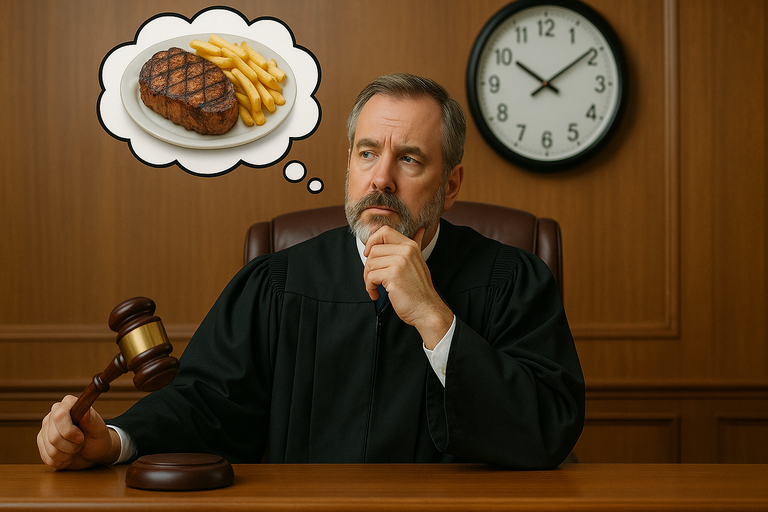
The notion that justice depends on what the judge ate for breakfast has become something of a legal truism, cited everywhere from law school lectures to artificial intelligence papers.
The notion that justice depends on what the judge ate for breakfast has become something of a legal truism, cited everywhere from law school lectures to artificial intelligence papers.
Its scientific justification stems from a 2011 study examining Israeli parole board decisions, which found that judges granted parole about 65% of the time at the start of the day and after food breaks, but the rate plummeted to nearly zero before breaks.
The study, published in the prestigious Proceedings of the National Academy of Sciences, seemed to confirm what legal realists had long suspected: that judicial decision-making is shaped by factors far removed from the law itself.
Danziger, S., Levav, J., & Avnaim-Pesso, L. (2011). Extraneous factors in judicial decisions. Proceedings of the National Academy of Sciences, 108(17), 6889-6892. https://doi.org/10.1073/pnas.1018033108
The finding proved irresistible, tapping into deep-seated intuitions about human nature and judicial fallibility. As Chatziathanasiou notes in the German Law Journal, the study “has entered common wisdom” and is “broadly and uncritically used as an argument” across legal scholarship.
The story fits perfectly into the narrative of bounded rationality and cognitive bias that has dominated behavioral science since Kahneman and Tversky. What could be more human than a judge’s judgment being swayed by an empty stomach?
Chatziathanasiou, K. (2022). Beware the Lure of Narratives: “Hungry Judges” Should Not Motivate the Use of “Artificial Intelligence” in Law. German Law Journal, 23(4), 452-464. https://doi.org/10.1017/glj.2022.32
But like many perfect stories in social science, this one may be too good to be true. A devastating critique by psychologist Daniel Lakens points out that the reported effect size is implausibly large. “If hunger had an effect on our mental resources of this magnitude,” Lakens argues, “our society would fall into minor chaos every day at 11:45.” We would have organized our entire judicial system around this overwhelming biological constraint.
The plot thickens further with Andreas Glöckner’s clever statistical analysis showing that much of the apparent effect could be explained by simple time management rather than judicial bias. Since favorable rulings take longer to write, judges rationally avoid starting complex cases right before a scheduled break. Through simulation, Glöckner demonstrated that this scheduling artifact alone could produce the dramatic pattern in the data.
Glöckner, A. (2016). The irrational hungry judge effect revisited: Simulations reveal that the magnitude of the effect is overestimated. Judgment and Decision Making, 11(6), 601-610. https://doi.org/10.1017/S1930297500004812
Additional concerns emerged about non-random case ordering, with unrepresented prisoners typically going last in each session. The original researchers attempted to control for various confounding factors, but as Weinshall-Margel and Shapard point out in their critique, the actual procedures of the parole board involved systematic patterns that weren’t fully accounted for.
The hungry judge effect thus offers a masterclass in how seductive narratives can override scholarly skepticism. We wanted to believe in the biased judge, and so we did, citing the study thousands of times with remarkably little scrutiny of its extraordinary claims. The episode recalls Richard Feynman’s warning that “the first principle is that you must not fool yourself – and you are the easiest person to fool.”
None of this definitively proves that judges are immune to the effects of hunger or fatigue. More modest influences of this type may well exist. But the study that launched a thousand citations appears to have dramatically overstated the case. As Chatziathanasiou warns, such exaggerations can damage public trust in the judiciary while providing dubious justification for reforms like increased use of artificial intelligence in legal decision-making.
The hungry judge story thus stands as a cautionary tale about the need to maintain scholarly skepticism even – or especially – when findings confirm our preexisting beliefs.
In law as in science, the most dangerous myths are the ones that feel intuitively right. Sometimes a judge is just a judge, managing their time as best they can, neither perfectly rational nor hopelessly biased.
The truth, as usual, is more mundane but also more interesting than the headlines suggest.

Robert Nogacki is a Polish attorney at law (radca prawny), the founder and managing partner of Kancelaria Prawna Skarbiec (Skarbiec Law Firm), which has operated continuously since 2006.
The law is equal for everyone, but the parties rarely are: on one side stands an organization with time, money, and lawyers, on the other a person with one business, one nest egg, and one life.
Clients rarely come to him with a legal problem. They come with a problem that also has a legal side: an audit that began with a single invoice, money entrusted to someone who has disappeared, a company that has to be passed on before it is too late. Most such matters are decided long before the first letter is written, in decisions made without asking and in deadlines nobody remembered. So he begins by asking how the client got here, not what the client should have done.
He advises entrepreneurs and families from more than a dozen countries, including those whose accounts the tax office has just seized and who do not know what to do tomorrow morning. He defends them in tax audits, customs and fiscal inspections, disputes with the tax authorities, and criminal tax proceedings. He represents victims of investment fraud and Ponzi schemes. He helps families set up family foundations and plan succession, so that a life’s work outlasts a single generation.
Not every case can be won. Every case can be run so that the client knows where they stand. Since 2006 he has represented the victims in the WGI case (Warszawska Grupa Inwestycyjna, the Warsaw Investment Group), one of the longest criminal cases in the history of the Polish financial market, because some things must not be left half finished, even when they take two decades. In the case of the collapsed cryptocurrency exchange Zonda (Zondacrypto, operated by BB Trade Estonia OÜ), he represents several hundred victims in the criminal investigation conducted by Poland’s National Prosecutor’s Office and in the Estonian bankruptcy proceedings.
Kancelaria Prawna Skarbiec is listed in the rankings of Poland’s largest tax advisory firms published by Dziennik Gazeta Prawna and Rzeczpospolita, and it is a four-time recipient (2015 to 2018) of the European Medal awarded by the Business Centre Club and the European Economic and Social Committee. Robert Nogacki publishes regularly, in the press and on the firm’s website, for people who have a problem rather than a law degree, because a legal opinion the client cannot understand protects only the lawyer.
He believes that the best legal advice is the kind that means the client never has to appear in court.