The Antichrist Without Christ: Peter Thiel’s Nashville Lectures
What Peter Thiel’s Nashville lectures get wrong about the oldest villain in Christianity.
Six Hours in a Masonic Temple
On Monday, October 19, 2026, in the Grand Lodge of Tennessee, which is to say the Masonic temple in downtown Nashville, Peter Thiel was finishing the fourth evening of his lectures on the Antichrist. Thiel co-founded PayPal and Palantir, the company that sells data analysis to armies, intelligence services, and police; he is the political patron behind the career of Vice-President J. D. Vance; and he describes himself as a Christian who is orthodox “with a small o” and, in print, as a Protestant. A man worth more than thirty billion dollars spoke for roughly six hours over four consecutive Mondays, and the organizers refunded the press its ticket money, because the whole thing was off the record. A pass for the series cost a hundred dollars. At the door, the investigative reporter Phil Williams photographed the arrivals and recognized among them pastors and publicists of American Christian nationalism. The evening ended with a party at Kid Rock’s honky-tonk.
Three weeks earlier, Thiel had promised that on the final night he would reveal the Antichrist’s identity. He revealed a profession. The Antichrist will be a politician, and if you are looking for a particular person, Thiel said, look for “a very bad president of the United States”. America, he went on, is the last and final form of the Roman Empire; there is no successor; when America is finished, so is the West, so is Christendom, and so is the world. In the opening lectures, according to recordings obtained by Politico, he explained that Pope Leo XIV had taken up artificial intelligence because he needed a popular subject to distract from the Church’s sexual-abuse scandals, and that Barack Obama was doing the same thing, because the Democrats have no ideas and can at least oppose A.I. The target was the encyclical of May, 2026, on protecting the human person in the age of intelligent machines. Thiel closed with an appeal to Nashville as the world capital of Protestantism, the center of a form of Christianity that has no center, to get over its inferiority complex and fight.
I draw nothing from the lecturer’s private life, though that is where part of the American press began. The Gospel forbids it (Matthew 7:1), and as an argument it is weak anyway. These lectures collapse on their own.
What the Lectures Get Right
Honesty requires saying first what is strong in them. Thiel takes seriously a doctrine that the educated West has consigned to horror films and tabloid covers; for that alone he deserves respect. Reading “that which restrains” in the Second Letter to the Thessalonians (2 Thessalonians 2:6 and 7), the katechon in Greek, as the Roman Empire has a patristic pedigree: Tertullian read it that way, and so did John Chrysostom, and so, reporting the Fathers, did John Henry Newman, the Anglican theologian who later became a Catholic cardinal and, in 2019, a saint, in the Advent sermons of 1835 on which Thiel modeled his series.
The Antichrist as a benefactor of humanity who promises peace and solves every problem is a motif of modern Christian literature at its best: Vladimir Solovyov’s “A Short Tale of the Antichrist,” from 1900; Robert Hugh Benson’s “Lord of the World,” from 1907; Joseph Ratzinger’s commentary in the first volume of “Jesus of Nazareth.” Thiel has made the case in his own voice, too, and more carefully than in Nashville: in an essay in First Things this past July, written with Sam Wolfe, “The Pope and the Antichrist,” he stays with Benedict XVI, Solovyov, and the Tübingen theologian Hans Küng, passes on, through Ratzinger, the warning that apocalyptic images overflow their banks like a torrent, and names no politician. And René Girard, his teacher, warned in the last chapter of “I See Satan Fall Like Lightning” that the most powerful anti-Christian movement would be the one that takes over and radicalizes the concern for victims, and that the Antichrist would boast of bringing the peace and tolerance that Christianity had failed to deliver. Thiel, in other words, has a Girardian argument available to him. The fear of a technology that would hand one authority total control over every human being is not paranoia; it is the subject of those books. Had Thiel stopped there, he would have delivered a decent, if derivative, Advent sermon. He did not stop.
The Last Rome: Jerome, Lactantius, and Augustine’s Answer
Begin with the sentence that sounds like a confession of faith. Thiel said that when America is done, the West is done, Christendom is done, and the world is done. Christendom is the Christian world, a civilization shaped by Christianity, not the faith itself; the distinction must not be blurred, because everything rests on it. The sentence has a long history in the Church, and it is a history of error. In 409, as the barbarians were crossing the Rhine, Jerome, the translator of the Bible, wrote from Bethlehem to the widow Ageruchia that he who restrained had been taken out of the way, and we do not understand that the Antichrist is near. He took a verse of Paul’s and slotted the news from the front into it, a front from which he was separated by more than twenty years of life in Palestine. A year later, after Alaric took Rome, he added that the city which had captured the whole world had itself been captured. Augustine answered with thirteen years of work and the twenty-two books of “The City of God.” He granted that reading the restrainer as the Empire was not absurd, and in the same chapter confessed that he did not know what Paul meant (Book XX, Chapter 19). The work as a whole says one thing: the City of God is not Rome, Christian Rome is not the Church, empires rise and fall, and the Church baptized the people who toppled them. Thiel repeats Jerome’s gesture and skips Augustine’s answer.
He has a closer predecessor, too. Lactantius, a rhetorician at Diocletian’s court who later tutored Constantine’s son, wrote around the year 310 that Rome was the one city still holding everything up; that when it fell, no one could doubt the end had come; that God must be begged not to let the hated tyrant arrive sooner than we think; and that, by calculation, two hundred years remained at most (“Divine Institutes,” Book VII, Chapter 25). Thiel said the same thing in Nashville, with Washington in place of Rome. Rome fell; the world did not; and the “Divine Institutes” sit on the shelf beside the books that corrected them.
There is also a simpler test of Thiel’s sentence. If by Christendom he means the Church, he is answered by the promise that the gates of hell shall not prevail against it (Matthew 16:18): either the promise is conditional and the Pentagon sets the condition, or the premise is false. If he means the civilization, he is answered by Augustine: the civilization is not the Church, and its end is not the end of the world. The third possibility, that he meant only the end of a particular historical order, he closed himself, by adding that with America the world would end. History supplies the rest. Christianity existed before Rome converted and after Rome fell: in Edessa, in Aksum, in China, where the Xi’an stele of 781 commemorates the Church of the East. Most of the world’s Christians now live outside Europe and North America. From Lagos, Manila, or São Paulo, the sentence about the end of Christendom with the end of America does not sound like heresy; it sounds like provincialism. And it is provincialism of a familiar cut. In the fifteen-twenties, the monk Philotheus of Pskov wrote to Moscow that two Romes had fallen, the third stood, and a fourth there would not be. Russian messianism grew from that sentence; earlier, in the seventh century, the apocryphal Pseudo-Methodius had promised a Last Roman Emperor who would lay down his crown on Golgotha. The Fathers expected Rome to break, not to last; the pedigree of a final Rome with no successor is apocryphal and imperial, not patristic. Every last Rome so far has died, and the Church attended every funeral. The only kingdom without a successor that the Bible knows is the stone cut out by no human hand, which shatters all the others (Daniel 2:34 and 44), and it keeps no embassy in Washington.
Thiel also has an older predecessor in political theology proper. Eusebius of Caesarea, Constantine’s court theologian and the most influential early exponent of an imperial Christian theology, wrote the Empire into the plan of salvation. The Church never made that theology its own teaching, and in 1935 the German theologian Erik Peterson, a Lutheran professor who had converted to Catholicism, gave it its most influential critique, in a treatise titled “Monotheism as a Political Problem”: the God of Christians is a Trinity, and no emperor and no superpower can mirror a Trinity. Peterson was writing against Carl Schmitt, the jurist of the Third Reich, who made the katechon the axis of his political theology because he needed a concept that would hold the state together and keep chaos from rising to the top; Schmitt answered Peterson only thirty-five years later, and the quarrel is still going. Thiel takes Paul’s darkest verse from its most compromised commentator.
A Katechon with a Street Address
The construction does not hold up against its own sources. In the Fathers, in Irenaeus and Hippolytus, in Tertullian, Chrysostom, and Jerome, there is a sequence: the Empire restrains; then it is taken out of the way, as Paul writes (2 Thessalonians 2:7); then it breaks into Daniel’s ten kingdoms; and only out of that breakup does the usurper rise, the little horn that uproots three of the ten and gathers the rest under itself. Hippolytus even imagined the Antichrist healing the wounded beast of Rome and ruling in the manner of Augustus; but the beast, in his account, has first been broken. Thiel wants both things at once and without the middle: an America intact, last and without successor, and in its highest office the Antichrist. Either America has been taken out of the way, in which case it is not the last and final form of anything but the wreck the usurper inherits and restores; or it has not, in which case its president is not the lawless one in the Fathers’ sense, since they have him revealed only after the removal. There is no contradiction in a restraining order becoming the instrument of a tyrant; the Fathers assumed as much. What is missing is the criterion that tells one state from the other. In Nashville, the only one on offer was the one the Nashville Scene summarized as partisan: which party won the election. A katechon that restrains only during one party’s terms in office is not a katechon. It is a voting preference with a Greek surname. Thiel knows this better than anyone: at his Oxford lectures, the T-shirts read “Don’t immanentize the katechon”, which I read as a warning not to give the restrainer an address in history. In Nashville, the katechon got an address.
The Antichrist According to John, Hippolytus, and Origen
The gravest objection concerns the concept itself. In the New Testament, the word “antichrist” appears only in the Johannine letters, and there it has a strict definition: the antichrist is whoever denies that Jesus is the Christ come in the flesh (1 John 2:18 and 22; 4:2 and 3; 2 John 7). The Fathers held to that definition with stubbornness. Polycarp, a disciple of the Apostle John, wrote to the Philippians that whoever does not confess Jesus come in the flesh is antichrist, and whoever twists the sayings of the Lord to his own desires is the firstborn of Satan. Hippolytus, who wrote the first treatise on the Antichrist, at the beginning of the third century, built the entire figure on a principle of imitation: Christ is a lion, and he will be a lion; Christ is a king, and he a king; Christ came as a lamb, and he will come as a lamb, being a wolf within; Christ sent out apostles, and he will send out false ones; Christ gathered the scattered sheep, and he will gather a scattered people; Christ showed his own body as a temple, and he will raise a temple of stone. Origen, the greatest mind of the early Church, answered the pagan Celsus that there are two extremes of human nature, the perfection of virtue in Jesus and the perfection of evil in the one who is called Antichrist; that the one bears the name of Son of God and the other that of son of the devil; and that evil reaches its height precisely when it takes on the appearance of good (“Against Celsus,” Book VI, Chapter 45). In his commentary on Matthew he went further: the abomination of desolation standing in the holy place is a false word enthroned where Scripture ought to be read, and antichrist is anything that pretends to be the truth and is not (as Bernard McGinn summarizes it in “Antichrist,” Columbia University Press, 2000, p. 64).
Thiel knows the imitation motif. He repeatedly showed his audience Signorelli’s fresco in Orvieto, in which Satan whispers into the ear of an Antichrist who looks disconcertingly like Christ, and the one attendee permitted to publish an account summarized the thesis this way: the Antichrist will be perversely hyper-Christian, co-opting the culture and ethics of Christianity while removing Jesus from its center. The criterion, then, is on the slide. It is not on the list. The list deserves precision, because Thiel attaches people to it in different ways. In San Francisco he named the type: the Antichrist of the twenty-first century is a Luddite who wants to stop all science, “someone like Greta or Eliezer”, meaning Greta Thunberg and Eliezer Yudkowsky, with Nick Bostrom alongside them as “legionnaires of the Antichrist” who want a world government in order to stop science. In First Things, by way of the medieval abbot Joachim of Fiore, he raised the theory that Benedict XVI took his own successor for the Antichrist, called it “tempting,” and set it aside in favor of another suspect, the theologian Hans Küng and his program of world peace through dialogue among religions. In Nashville he accused Obama and Leo XIV of exploiting the fear of A.I. for political gain. The people named as the type do not impersonate Christ, do not gather a people, do not demand worship; they propose regulations, and none of them satisfies John’s definition, Hippolytus’s portrait, or Origen’s test. The people named as enablers are charged with clearing the way, and that charge needs what the lectures never supply: a demonstration that a regulation leads to a throne. One Bishop of Rome is floated in print as a candidate and set aside; his successor, whose office it is to confess Jesus come in the flesh, is suspected for an encyclical on human dignity. A doctrine in which the marks of the Antichrist are positions on artificial intelligence and climate, and in which the Christological criterion never comes into use, is not a Christian doctrine; it is an enemies list wearing a stole.
The Fathers were not above pointing fingers; but they pointed at emperors and heretics, never at the empire’s critics. Nero, in the earliest texts, and in the fourth century Constantius II, Constantine’s son, whom Athanasius called the image of Antichrist and his precursor, and whom Hilary of Poitiers called Antichrist outright. It is worth seeing why. Not for economic policy. For backing the Arians, who denied the divinity of the Son, and for persecuting bishops without martyrdom, with money and honors. Hilary wrote that he was fighting Constantius the Antichrist, who does not scourge the back but strokes the belly; that the emperor had found a way to persecute without making martyrs, and honored bishops so that they would cease to be bishops (“Against Constantius,” Chapters 4 and 5). The criterion was the confession of faith, and the man named was a ruler who financed the Church. The Church has known the opposite temptation for centuries: Luther saw the Antichrist in the Pope, Catholic polemicists returned the favor, and none of these identifications has yet come true. Irenaeus wrote as early as the second century that it was more certain, and less hazardous, to await the fulfillment of the prophecy than to invent names, since many names can be fitted to the number. Thiel knows the rule: in First Things he praises Benedict for resisting the “down-market temptation” to name his suspect, and calls it a law that everybody who thinks about the Antichrist long enough identifies a candidate. He then identifies several. Newman, whom Thiel cites, read his own age in the light of prophecy and was not free of political judgments, but he insisted that the Fathers’ interpretations do not carry the certainty of the doctrine the Fathers hand down. He finished four sermons without a name. Thiel promised a name and delivered an office and a party.
“Peace and Security,” with the Roles Reversed
The exegesis follows the same pattern. Thiel reads Paul’s warning that when people say “peace and security” sudden destruction will come upon them (1 Thessalonians 5:3) as a prophecy of today’s cult of safety, of climate activists and A.I.-risk researchers. A good many exegetes, though not without dispute (Jeffrey Weima for the imperial reading, Joel White against it), see in the words “peace and security” a slogan of imperial propaganda, pax et securitas, the banner of the Pax Romana. On that reading, Paul is mocking the self-confidence of the Empire, that is, the advertising of the very entity Thiel has cast as the katechon. The Fathers did not need modern epigraphy to see it: Irenaeus applied the verse to the kings who are setting their affairs in order and extending their rule, which is to say, to the governors, not to their critics. On this reading, the roles have been swapped: a verse aimed at the Empire’s advertising has been turned on the Empire’s critics. Whoever accepts the reading must apply it in both directions.
The swap runs deeper, into the Apocalypse itself. John’s Beast rules through commerce and control: no one may buy or sell without its mark (Revelation 13:16 and 17), and the Babylon that falls is a city of merchants (Revelation 18). The saints conquer not by arms but by the blood of the Lamb and the word of their testimony (Revelation 12:11). In the twenty-first century, data and digital systems are part of the infrastructure that decides who may buy and sell. I am not claiming that the co-founder and chairman of Palantir is the Beast; I am claiming something more modest. A discernment that can never be applied to its own author is not discernment. The Gospel has the beam and the mote for that (Matthew 7:3). When Thiel tells his audience that the Pope writes about artificial intelligence for political motives, it is worth asking whose business the regulation of artificial intelligence would constrain. Cui bono runs both ways.
Solovyov, Girard, and Augustine’s Question
Then comes the literature Thiel himself claims as his tradition. Solovyov’s Antichrist is a thirty-three-year-old genius, an ascetic and a philanthropist, the author of a treatise called “The Open Way to Universal Peace and Prosperity”; he ends wars, feeds the hungry, unites humanity under one scepter, and asks only to be acknowledged. Benson’s Felsenburgh is, granted, an American politician, but he is the apostle of humanitarianism, of the religion of man, of a frictionless technical civilization with no room left for the Church. Thiel quotes the title in full and uses only its first half, the peace of Küng’s Weltethos; the second half, the benefactor who solves every problem, he leaves unapplied, and as it happens it describes his own prospectus. More important, though, is Solovyov’s ending. The Emperor splits the Christians by flattering each confession with what it loves most: the Catholics with power and splendor, the Orthodox with the antiquity of the rite, the Protestants with freedom of inquiry. A remnant survives that answers that what is most precious in Christianity is Christ himself, and in that remnant Catholics, Orthodox, and Protestants are at last united. In Nashville, Thiel told the Protestants that they were the capital of the world, the center of what has no center, and that they must fight; three weeks earlier, he had told the same hall that Leo XIV’s encyclical on human dignity in the age of machines was a smoke screen for scandals. In Solovyov’s tale, that is not the speech of the katechon. It is the Emperor’s speech to the Protestants.
And then there is the master. Thiel studied with René Girard, the French anthropologist at Stanford, and makes no secret of the debt. For half a century, Girard explained one thing: communities unite by designating a scapegoat, and the Bible, from Joseph and the prophets to the Gospels, is the text that exposed the mechanism by taking the victim’s side. In his vocabulary, Satan means what it means in Hebrew, the accuser; the Paraclete, the Spirit that Jesus promised, is the defender, the advocate of the accused. Girard himself warned that the concern for victims could be radicalized into a totalitarian command and a permanent inquisition, so Thiel has a Girardian argument available to him. What he owes his audience is evidence that the people he names embody that corruption, and a criterion that would catch it just as readily among his allies. Criticism is not yet scapegoating. Scapegoating is the designation of particular people as carriers of an evil that cannot be proved against them, so that the community may recognize itself in a shared opposition. A series in which the Pope, a former President, the effective-altruism movement, and two people named outright become the “legionnaires of the Antichrist,” and in which the hall is meant to accept this without any right of public reply, fits that definition without strain. In his last book, “Battling to the End”, Girard wrote that globalization and technology had accelerated the worldwide empire of violence, and that the only way out was to renounce retaliation entirely and to imitate Christ rather than imitating men; in the katechon he saw whatever had once held violence back, and he warned that without it a collective loses its stability. Restraining violence and restraining technology are not the same thing, and there is no need to conflate them. It is enough to notice that the pupil has called the restraint of his own industry satanic, while the master saw in restraint the last thing we have left. Whoever calls the Accuser’s work discernment has not read the master; he has opened a franchise. Girard also said, and Thiel quotes him, that Christ and Antichrist are mingled and concomitant until the apocalypse, that is, until the unveiling. In Nashville, Thiel joked that perhaps he was not introspective enough to realize that he himself was the Antichrist, but that in any case he failed to meet the criteria he had set. Augustine, commenting on John’s letter, said the same thing without the joke: antichrist means “contrary to Christ,” so let each person question his own conscience whether he is an antichrist, for the more lying antichrist is the one who confesses Jesus with his mouth and denies him with his deeds. Thiel’s essay invokes the same tradition when it praises Tyconius and his theory of a bipartite Church, Christ and Antichrist inside one body; a reader who takes Tyconius seriously looks inward first. In Augustine, the question gets asked. In Thiel, it gets deflected.
Prudence, Form, and Hope
Thiel calls his opponents devotees of “safetyism.” In Thomas Aquinas, safety goes by another name. Prudence, the charioteer of the virtues, has its parts in Aquinas, and among them are foresight and caution, cautio (“Summa Theologiae,” Secunda Secundae, Question 49). A critique of absolutized safety is legitimate, and Aquinas himself writes that one cannot guard against every evil. Thiel’s label, however, does not distinguish prudence from cowardice, because the people who land on his list are the ones proposing ordinary prudence. A theology in which a cardinal virtue is the mark of the Beast has lost the first distinction every moral tradition teaches. A detail from September, 2026, shows how far this has gone. Dario Amodei, of Anthropic, called on the industry to deliberately slow the pace at which models acquire new capabilities, and Sam Altman and Elon Musk, men who agree on little else, backed him; Thiel, at the same moment, was arguing in Nashville that the wish to slow down was something closer to evil than to caution.
That leaves form. Jesus told his followers to say in the light what they heard in the dark, and to proclaim from the rooftops what was whispered (Matthew 10:27); questioned by the high priest, he answered that he had taught openly and said nothing in secret (John 18:20). Esoteric apocalyptic at a hundred dollars a head, for initiates, with reporting forbidden, has the form of Gnosis, the Church’s oldest rival: secret knowledge for the chosen. One attendee was allowed to publish an account, a reporter for an outlet that Thiel funds and that a former vice-president of his fund founded; another newsroom’s request was refused. That is not secrecy. That is control over who gets to betray it. Thiel’s own essay closes by saying that esotericism has its time and place, but not in matters concerning the fate of the world, and asks who can hope for salvation in philosophical reticence. By that standard, the lectures were the wrong form for their subject. The announcement itself, that a name would be spoken in the fourth lecture, is a gesture the Gospel described in advance: people will come saying “the time is at hand”; do not follow them (Luke 21:8; Matthew 24:23 to 26). Augustine, commenting on the katechon, wrote that he frankly confessed he did not know what Paul meant (“The City of God,” Book XX, Chapter 19). Thiel knows: America. He names names and promptly withdraws them, since nothing is final; he harvests the fruit of the accusation without the burden of the claim. The Catechism calls this rash judgment and, if the charge is false, calumny (paragraph 2477); the Gospel is shorter: let your yes be yes and your no be no (Matthew 5:37). As for the Pope, Thiel did not engage the encyclical; he diagnosed its author. Paul forbade judgment before the time, because only the Lord will disclose the purposes of the heart (1 Corinthians 4:5). This is not theology. This is opposition research.
“Jesus Is Lord”
Thiel’s defenders will answer that this was a provocation to thought, not a treatise; that halls full of people willing to listen for six hours to talk of the last things are something the churches of the West cannot fill these days; that the threat of technocratic control is real; and that the Fathers really did see a katechon in Rome. All of this is true, and none of it rescues the theses. A provocation that cannot survive its own sources is not a provocation but a mistake; a full hall testifies to hunger, not to nourishment; and the Fathers who prayed for Rome never mistook Rome for the Church.
Thiel asked a real question: what restrains? The Church answered it in the second century, in Smyrna, when the old bishop Polycarp refused to say the words “Caesar is Lord” and went to the stake for it. The sentence “Jesus is Lord” is the whole Christian theory of the katechon and of the Antichrist at once: it tells every empire, including the last and final one, that it is not God, and it tells every accuser that the judgment is not his. Everything that was Christian in Nashville fits inside that sentence. Everything that was Thiel’s is what the sentence excludes. He came to warn against a man who would promise the world peace, security, and the solution of every problem through technology, and he recommended to a full hall, as the cure, the kind of man who promises the world the solution of every problem through technology, only without the security.
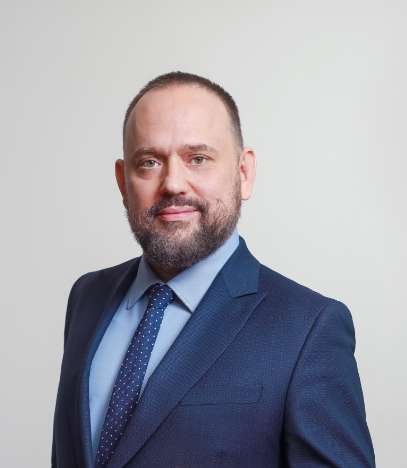
Robert Nogacki is a Polish attorney at law (radca prawny), the founder and managing partner of Kancelaria Prawna Skarbiec (Skarbiec Law Firm), which has operated continuously since 2006.
The law is equal for everyone, but the parties rarely are: on one side stands an organization with time, money, and lawyers, on the other a person with one business, one nest egg, and one life.
Clients rarely come to him with a legal problem. They come with a problem that also has a legal side: an audit that began with a single invoice, money entrusted to someone who has disappeared, a company that has to be passed on before it is too late. Most such matters are decided long before the first letter is written, in decisions made without asking and in deadlines nobody remembered. So he begins by asking how the client got here, not what the client should have done.
He advises entrepreneurs and families from more than a dozen countries, including those whose accounts the tax office has just seized and who do not know what to do tomorrow morning. He defends them in tax audits, customs and fiscal inspections, disputes with the tax authorities, and criminal tax proceedings. He represents victims of investment fraud and Ponzi schemes. He helps families set up family foundations and plan succession, so that a life’s work outlasts a single generation.
Not every case can be won. Every case can be run so that the client knows where they stand. Since 2006 he has represented the victims in the WGI case (Warszawska Grupa Inwestycyjna, the Warsaw Investment Group), one of the longest criminal cases in the history of the Polish financial market, because some things must not be left half finished, even when they take two decades. In the case of the collapsed cryptocurrency exchange Zonda (Zondacrypto, operated by BB Trade Estonia OÜ), he represents several hundred victims in the criminal investigation conducted by Poland’s National Prosecutor’s Office and in the Estonian bankruptcy proceedings.
Kancelaria Prawna Skarbiec is listed in the rankings of Poland’s largest tax advisory firms published by Dziennik Gazeta Prawna and Rzeczpospolita, and it is a four-time recipient (2015 to 2018) of the European Medal awarded by the Business Centre Club and the European Economic and Social Committee. Robert Nogacki publishes regularly, in the press and on the firm’s website, for people who have a problem rather than a law degree, because a legal opinion the client cannot understand protects only the lawyer.
He believes that the best legal advice is the kind that means the client never has to appear in court.