Zondacrypto Goes Global: From the New York Times to the KuCoin Feed
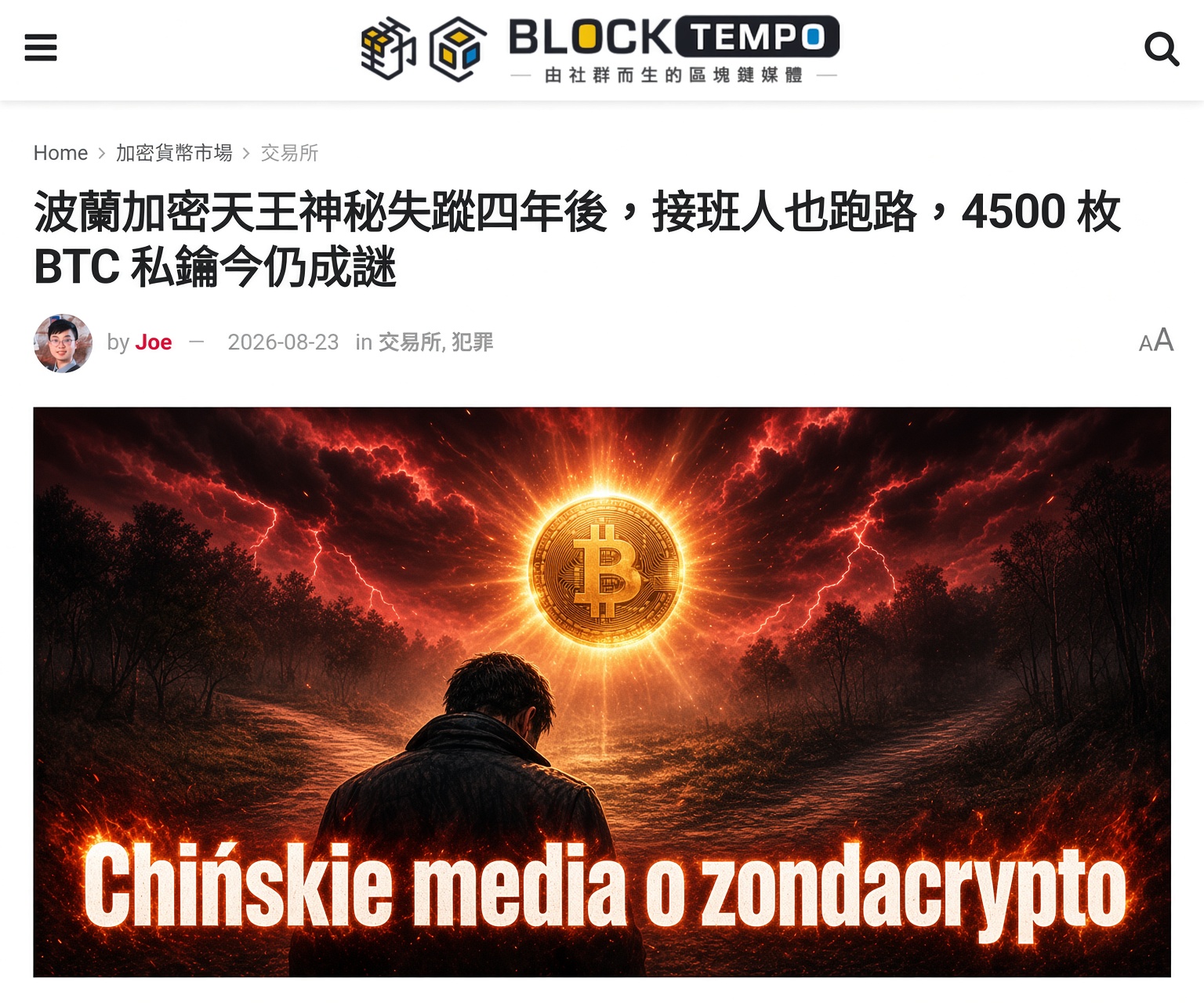
An axe buried in the windshield of a blue Ferrari. The headquarters of an exchange claiming 1.3 million customers, occupying a shabby upstairs room in Tallinn above a kitchenware shop, door to door with a nail salon whose employees never saw anyone go in. A wallet said to hold 4,500 bitcoins that has been asleep on the blockchain for the better part of a decade. This is how one of the largest cryptocurrency outlets publishing in Chinese now tells the story of Zondacrypto, retelling Andrew Higgins’s feature in the New York Times. Three weeks ago, in the comments under one of my posts, someone asked whether anyone still cared about this case. This week the answer arrived in Chinese. A few hours later came another, from a still less expected direction: the news feed of the KuCoin exchange. What follows is a map of the week, and of what it means for the people who lost money.
The escalation is easiest to see when the channels are laid out in order. In April, the exchange’s troubles lived on forums and Telegram channels. In July, Rzeczpospolita’s reporting on negotiations in the Gulf carried the case into the mainstream; the institution of the crown witness, around which those reports circled, is one I took apart at the time in a separate analysis of the crown witness question in Kral’s case. This week added three floors at once. Polish state television announced a supposed “small crown witness” status, a status that Polish law does not, in fact, allow anyone to receive. The Times published Higgins’s feature. And before the Polish reader had finished the original, its retellings were already hanging in Chinese and in KuCoin’s app. It is hard to imagine a better obituary for the “old news, move on” narrative than a feature retold in three languages.
That, at least, was the count on Sunday evening; the counter has since gone stale. Within a day of the Times piece, the story was carried by a chain of reprints in English, from crypto.news to U.Today, and then by editions in Spanish and Portuguese, in German, in Vietnamese, and in Indonesian; Chinese arrived in its second script, with a dispatch in simplified characters and a flash from the BingX exchange in the same script. In Poland, the television dispatch was repeated within hours by Rzeczpospolita and Wyborcza, with more titles in the queue. Eight languages in a day. My cautious “in Chinese” of yesterday deserves an honest amendment: also, now, in the script the mainland reads.
What does a reader in Taipei, Hong Kong, or Singapore learn about a Polish exchange? That in its country of registration it never reported a single suspicious transaction, a fact the Estonian regulator noted in a report on an industry in which three quarters of firms reported nothing either. That its hot wallets emptied by 99.7 per cent, and that between December and April roughly 21.2 million dollars left them in five hundred and eleven transactions across thirty different currencies. That on June 29th the Estonian regulator revoked the parent company’s license. That, by the investigators’ estimates cited in these pieces, more than thirty thousand customers have reported losses, with the potential damage put at no less than three hundred and fifty million zlotys, about ninety million dollars. And that on July 30th the National Prosecutor’s Office merged the exchange investigation with the case of Sylwester Suszek’s disappearance, because the two stories were one story from the beginning. The feature also documents something that in Poland had been discussed sotto voce: a reporter at Wirtualna Polska was told by Kral to be careful, in messages that cited details of the journalist’s private medical history. Worth filing away for the next time someone insists that what we are dealing with is merely an accounting misunderstanding. My full commentary on the New York Times feature is published separately.
The language of these publications matters more than their content. If the hypothesis I have argued since May is right, and Kral chose the Mekong region, then the trade press published in Chinese is the local paper of his ecosystem. A fugitive’s capital is anonymity: being nobody among strangers. Until this week, in that world, he was nobody. Now he is content in the language of his hosts, with a face, a biography, and an estimate of what he may control. For the operators of that infrastructure, a client with a loud file stops being a discreet depositor and becomes either a liability or a prize; both roles are bad for him. Roman Z., whose escape route I analyzed in May, was caught not by geography but by sociology. Fame in the language of one’s surroundings is sociology in its purest form. Fate has added a detail no screenwriter would dare: in that outlet, the piece about Kral sits beside articles on the kidnapping of cryptocurrency holders and on the rising fashion for attacks in which the key to a wallet is extracted with iron tools. An editorial coincidence that reads like the occupational hazards page of his new life. Higgins, as it happens, also asked me. I told the Times exactly what I have been writing for my readers since May: I would look in Southeast Asia. And one sentence more, my assessment as counsel for the victims: that this construction was fraudulent from day one. The consistency of theses between posts for the victims and the New York Times is not a virtue; it is hygiene. A hypothesis that changes with the audience is not a hypothesis.
The fourth floor of this escalation has its own set design. Between a bitcoin quote at 77,000 dollars and an alert that XRP had just slid hard in the space of five minutes, users of the KuCoin exchange were given two dispatches on Zondacrypto to read on Sunday: in the morning, a sober synthesis of the Times feature; before noon, a bulletin pricing the ZND token near zero. For the record, since not every reader will know: KuCoin is one of the world’s largest cryptocurrency exchanges, operating since 2017, claiming tens of millions of registered users and running its own news service built directly into the app, the same app in which those users keep their wallets open and place their orders. It knows the taste of conversations with prosecutors, having pleaded guilty before American justice in 2025 to operating without a license and paid close to three hundred million dollars. Which makes the lesson it now shows its users, with us as the example, all the more pointed. In the earlier installments of this story, the languages changed; this time the channel did. The case has stopped being news about the market and has become content inside the market, read between one order and the next. For a man whose capital is anonymity, this is another floor of the same problem: the people quickest to recognize him are the ones he has moved in among.
What, exactly, did the second dispatch announce? That ZND, Zondacrypto’s own token, is worth almost nothing. That is not a new loss; it is the certification of an old one. An exchange’s token is a promise made by its issuer, and promises are priced in trust; when the issuer went dark in April, the price was a formality, which an automated monitor called Whale Alert completed on Sunday at 7:22 universal time. Analysts write of the signature of an insider exit and, to their credit, note honestly that this is the interpretation of a pattern, not a legal finding. I share the discipline, all the more gladly because patterns can be verified on the chain, and the number of people doing the verifying is now growing in several time zones at once. What this token was, and what it never was, I explain in my analysis of the ZND token (in Polish).
Now the part that matters most to some of you. The legal position of a token holder differs from that of a client with a balance in bitcoin or zlotys. A balance is a claim for the release of funds. A token is an instrument whose value was built on the issuer’s assertions; if those assertions prove to have been part of a deception, the loss on the token may enter the damages pursued in the criminal proceedings, though that is always an individual, evidentiary question. Practically: preserve the complete history of your ZND purchases, the dates, the amounts, the transaction confirmations, as carefully as your deposit history. In a loss report this is a separate, countable item, and it must not be mislaid. The broader legal situation of the exchange’s clients is covered in my analysis for Zondacrypto customers (in Polish).
Second, internationalization works for the victims slowly but surely. Every new publication raises the price of tolerating this case in any jurisdiction the money passed through or the people sit in, and the published transaction data are ready leads for thousands of analysts, since Sunday including those who read in Chinese. A trace on the chain does not fade.
Third, the information discipline stands. Exchange feeds simplify: somewhere along the way the dispatches managed to christen both missing men founders, though there was only one. We read the reports; we do not repeat them; we correct them in our own space. Restitution does not depend on how many capitals write about the case, but on what gets disclosed and secured. And for those who were told in April that this was a local website outage, one observation from this week: local outages do not get obituaries in trading apps on the other side of the planet.
A story told in eight languages will not disappear in any of them. The market has just priced Zondacrypto’s promises. The courts will price the accountability, and counsel for the victims will see to it that they do so with a full map of the assets and real repair of the damage. Kancelaria Prawna Skarbiec represents Zondacrypto’s customers in the criminal proceedings; those who have not yet reported their losses, including holders of the ZND token, can reach us through the contact form on this site.
The Zondacrypto Case
The Zondacrypto case is being examined by authorities in several countries, and no one today can predict the fate of the entrusted funds. We represent the victims and protect their position in the ongoing proceedings.

Robert Nogacki is a Polish attorney at law (radca prawny), the founder and managing partner of Kancelaria Prawna Skarbiec (Skarbiec Law Firm), which has operated continuously since 2006.
The law is equal for everyone, but the parties rarely are: on one side stands an organization with time, money, and lawyers, on the other a person with one business, one nest egg, and one life.
Clients rarely come to him with a legal problem. They come with a problem that also has a legal side: an audit that began with a single invoice, money entrusted to someone who has disappeared, a company that has to be passed on before it is too late. Most such matters are decided long before the first letter is written, in decisions made without asking and in deadlines nobody remembered. So he begins by asking how the client got here, not what the client should have done.
He advises entrepreneurs and families from more than a dozen countries, including those whose accounts the tax office has just seized and who do not know what to do tomorrow morning. He defends them in tax audits, customs and fiscal inspections, disputes with the tax authorities, and criminal tax proceedings. He represents victims of investment fraud and Ponzi schemes. He helps families set up family foundations and plan succession, so that a life’s work outlasts a single generation.
Not every case can be won. Every case can be run so that the client knows where they stand. Since 2006 he has represented the victims in the WGI case (Warszawska Grupa Inwestycyjna, the Warsaw Investment Group), one of the longest criminal cases in the history of the Polish financial market, because some things must not be left half finished, even when they take two decades. In the case of the collapsed cryptocurrency exchange Zonda (Zondacrypto, operated by BB Trade Estonia OÜ), he represents several hundred victims in the criminal investigation conducted by Poland’s National Prosecutor’s Office and in the Estonian bankruptcy proceedings.
Kancelaria Prawna Skarbiec is listed in the rankings of Poland’s largest tax advisory firms published by Dziennik Gazeta Prawna and Rzeczpospolita, and it is a four-time recipient (2015 to 2018) of the European Medal awarded by the Business Centre Club and the European Economic and Social Committee. Robert Nogacki publishes regularly, in the press and on the firm’s website, for people who have a problem rather than a law degree, because a legal opinion the client cannot understand protects only the lawyer.
He believes that the best legal advice is the kind that means the client never has to appear in court.